
Ipakita ang simpleng tala ng item
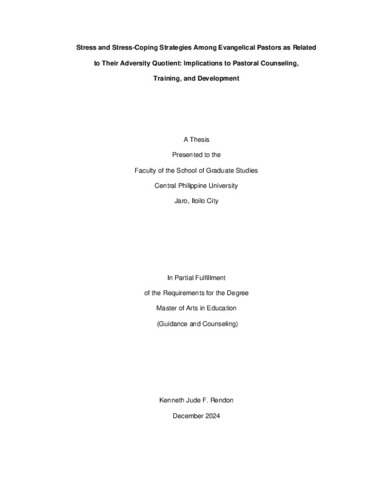
Stress and stress-coping strategies among evangelical pastors as related to their adversity quotient: Implications to pastoral counseling, training, and development
| dc.contributor.adviser | Java, Margen A. | |
| dc.contributor.author | Rendon, Kenneth Jude F. | |
| dc.date.accessioned | 2026-02-07T08:47:57Z | |
| dc.date.available | 2026-02-07T08:47:57Z | |
| dc.date.issued | 2024-12 | |
| dc.identifier.citation | Rendon, K. J. F. (2024). Stress and stress-coping strategies among evangelical pastors as related to their adversity quotient: Implications to pastoral counseling, training, and development [Unpublished master's thesis]. Central Philippine University. | en_US |
| dc.identifier.uri | https://hdl.handle.net/20.500.12852/3678 | |
| dc.description | Abstract only | en_US |
| dc.description.abstract | This survey-correlational research aimed to determine the stress and stress-coping strategies among evangelical pastors as related to their adversity quotient, and their implications to pastoral counseling, training, and development. The participants of the study were124 evangelical pastors of International Care Ministry (ICM), who were classified according to sex, civil status, education, income, occupation, and religious affiliation. This study adopted the following data-gathering instruments: Perceived Stress Scale (PSS-10), Brief COPE, and Adversity Quotient Scale. Frequency counts, percentage analyses, means, ranks, and standard deviations were used in the descriptive data analysis; the t-test for independent samples, and Pearson’s r, were used to analyze the inferential data. Results revealed moderate levels of stress among the participants as a whole, and when classified according to sex, civil status, education, income, occupation, and religious affiliation. The most frequently used adaptive coping strategies were problem-focused approach, emotion focused, and avoidant focused; ranked accordingly in that order. No significant differences existed in the participants’ level of stress, as well as, in stress-coping strategies when classified according to sex, civil status, education, income, and religious affiliation. However, significant differences existed among the participants classified according to occupation. On the other hand, no significant differences existed in the adversity quotients among the participants classified according to sex, civil status, education, income, occupation, and religious affiliation. A moderate positive correlation existed between coping strategies and adversity quotients, indicating that effective coping strategies improves resilience. A nonsignificant correlation existed between stress level and adversity quotient, which seems to indicate that resilience is more dependent on coping than on the intensity of stress. The study recommends that customized pastoral care programs be given to pastors to help them manage stress and improve resilience by adapting coping strategies. | en_US |
| dc.format.extent | xii, 135 leaves | en_US |
| dc.language.iso | en_US | en_US |
| dc.publisher | Central Philippine University | en_US |
| dc.subject.lcc | LB 2326.3 .R46 2024 | en_US |
| dc.subject.lcsh | Clergy | en_US |
| dc.subject.lcsh | Pastoral counseling | en_US |
| dc.subject.lcsh | Adjustment (Psychology) | en_US |
| dc.subject.lcsh | Clergy--Job stress | en_US |
| dc.subject.lcsh | Clergy--Training of | en_US |
| dc.title | Stress and stress-coping strategies among evangelical pastors as related to their adversity quotient: Implications to pastoral counseling, training, and development | en_US |
| dc.type | Thesis | en_US |
| dcterms.accessRights | Limited public access | en_US |
| dc.description.bibliographicalreferences | Include bibliographical references | en_US |
| dc.contributor.chair | Encio, Lucio T. | |
| dc.contributor.committeemember | Orquinaza, Nelida T. | |
| dc.contributor.committeemember | Espina, Bibiana C. | |
| dc.contributor.committeemember | Prudente, Rose Marie P. | |
| dc.contributor.department | School of Graduate Studies | en_US |
| dc.description.degree | Master of Arts in Education (Guidance and Counseling) | en_US |