

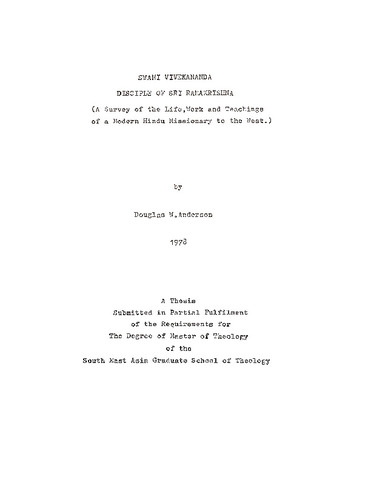
Swami Vivekananda: Disciple of Sri Ramakrishna (A survey of the life, work and teachings of a modern Hindu missionary to the West)
| dc.contributor.author | Anderson, Douglas W. | |
| dc.date.accessioned | 2026-02-04T03:29:52Z | |
| dc.date.available | 2026-02-04T03:29:52Z | |
| dc.date.issued | 1978 | |
| dc.identifier.citation | Anderson, D. W. (1978). Swami Vivekananda: Disciple of Sri Ramakrishna (A survey of the life, work and teachings of a modern Hindu missionary to the West) [Unpublished master's thesis]. South East Asia Graduate School of Theology. | en_US |
| dc.identifier.uri | https://hdl.handle.net/20.500.12852/3637 | |
| dc.description | Abstract only | en_US |
| dc.description.abstract | In this thesis the writer a) surveys the life, work and teachings of Swami Vivekananda and b) suggests reasons why Christians today should be aware of Vivekananda and of the continuing influence of his teachings. After a brief introductory chapter the writer, in chapter II, outlines the life of Sri Ramakrishna, Vivekananda's master and guru, Attention is drawn to the astonishing austerities undergone by Ramakrishna in his pursuit of "God", to his mysticism, to his approach to the problem of the plurality of religions, and to his impact on Vivekananda and other young men. Chapter III is biographical, outlining the life and achievements of Vivekananda. The chapter falls into three main sections, each relating to a period in Vivekananda's life. First, Vivekananda's wanderings throughout India, his grief at India's low estate, and his epoch making decision to help India by earning money in the United States, are described. Next the astonishing (and controversial) impact made by Vivekananda in 1893 at the Chicago Parliament of Religions, his subsequent widespread influence (exerted through lecturing) in the United States and Europe, and his gradual realisation that "spiritual" India possessed a message for the "materialistic" West, are related. Thirdly, Vivekananda's desire to help his beloved India, his vision of "practical Vedanta", and the subsequent founding of the Ramakrishna Mission are outlined. Chapter IV is more "theological". Here the writer attempts to systematize the beliefs and teachings of Vivekananda. It is suggested that Vivekananda's whole approach to religion rests upon his monistic understanding of reality, an approach which inevitably leads him to stress the "divinity of mankind". For this reason, the writer argues, Vivekananda's understanding of the nature of salvation is in complete contrast to that held by traditional Christianity. In the concluding chapter the writer first summarizes the influence of Vivekananda in both India and the Western World. He then suggests that in recent years there has been a growing tendency among some Christian writers to interpret Christianity in terms of a monistic understanding of reality similar to that advocated by Vivekananda. For this reason the writer suggests that it would be profitable for Christians today to have an understanding of Vivekananda and his thought. | en_US |
| dc.format.extent | 184 leaves | en_US |
| dc.language.iso | en | en_US |
| dc.publisher | South East Asia Graduate School of Theology | en_US |
| dc.subject.lcc | BT 212 .A53 1978 | en_US |
| dc.subject.lcsh | Disciples | en_US |
| dc.subject.lcsh | Gurus | en_US |
| dc.subject.lcsh | India | en_US |
| dc.subject.lcsh | Missionaries | en_US |
| dc.subject.lcsh | Mysticism | en_US |
| dc.subject.lcsh | Religions | en_US |
| dc.subject.lcsh | Religious pluralism | en_US |
| dc.subject.lcsh | Kathāmr̥ta (Ramakrishna) | en_US |
| dc.subject.lcsh | Vivekānanda, Swami | en_US |
| dc.title | Swami Vivekananda: Disciple of Sri Ramakrishna (A survey of the life, work and teachings of a modern Hindu missionary to the West) | en_US |
| dc.title.alternative | A survey of the life, work and teachings of a modern Hindu missionary to the west | en_US |
| dc.type | Thesis | en_US |
| dcterms.accessRights | Limited public access | en_US |
| dc.description.bibliographicalreferences | Includes bibliographical references | en_US |
| dc.contributor.department | South East Asia Graduate School of Theology | en_US |
| dc.description.degree | Master of Theology | en_US |
Fichier(s) constituant ce document
Ce document figure dans la(les) collection(s) suivante(s)
-
Master of Theology [64]