

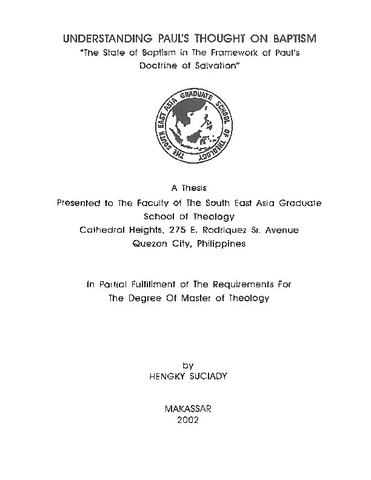
Understanding Paul's thought on baptism: The state of baptism in the framework of Paul's doctrine of salvation
| dc.contributor.adviser | Merentek, Victor I. | |
| dc.contributor.author | Suciady, Hengky | |
| dc.date.accessioned | 2026-02-04T01:52:06Z | |
| dc.date.available | 2026-02-04T01:52:06Z | |
| dc.date.issued | 2002 | |
| dc.identifier.citation | Suciady, H. (2002). Understanding Paul's thought on baptism: The state of baptism in the framework of Paul's doctrine of salvation [Unpublished master's thesis]. South East Asia Graduate School of Theology. | en_US |
| dc.identifier.uri | https://hdl.handle.net/20.500.12852/3633 | |
| dc.description | Abstract only | en_US |
| dc.description.abstract | If we survey the Bible especially the New Testament, we shall find that Christian baptism is not the major theme. Baptism was generally practiced in adherence to Christian message as indicated in the Bible. The Apostles did not in the message itself explicitly teach how it should be done, because it has already been incorporated. Even though baptism is found only in fragments of statements in New Testament; I believe that Christian baptism is an important topic because it is related to the doctrine of salvation. In the New Testament, I found that baptism is a firm message which John the Baptist put as an emphasis on repentance. In Acts, baptism is considered a sacrament; one who is baptized is entering the "New Testament" community, and his fellowship as a believer with Christ. Hence, I choose this topic "Understand Paul's thought on baptism" fits the state of baptism in the framework of the doctrine of salvation. Understanding the meaning of baptism by translating the Bible literally; for example by quoting the preposition directly from the Bible may be misleading. One should locate the whole context of the Bible according to the situation of receiver, and the aim of the letter. Paul's argument on baptism in Rome, the first Corinthians and Galatians shows that baptism is related to the person of Christ and His works. We will find that Paul wants us to know that baptism is incorporated (a symbol) in Christ's work in salvation for the believers. On the other hand, one who receives baptism begins with the knowledge of Jesus Christ, who discloses Himself to him. But Baptism just like the Torah cannot save one is life (as a sinner). Questions arise; how or in what way does baptism play a role in the work of God as indicated in Paul's thought on the doctrine of salvation. In the first chapter, I describe the historical aspect of baptism. Firstly, I point out the accounts of baptism found in the Gospels and the Acts. I draw an inference from them that relates closely to the baptism. By scrutinizing the terminologies, ideas and thoughts espoused by early thinkers; we may learn that baptism has always been one of the hottest debates in history of the church. In the second chapter, I explain Paul’s thought on baptism in Rome, The first Corinthians, and Galatians. It is important that we analyze the situation and struggle of the congregation to which Paul sent his letters, because they will help us to stay focus on the exegesis. By understanding the uniqueness of Paul’s calling and ministry to the congregations will delineate a clear picture of Paul's thought on baptism. On the latter of the chapter, I describe the theological significance of the teaching of baptism in the light of Paul's thought. In the third chapter, I show how Paul’s thought on baptism gives a clear implementation on the teaching of infant baptism. Finally, I conclude Paul's thought on baptism that shows the state of baptism in the framework of Paul's doctrine of salvation and as the foundation to build the unity in the diversity of the churches in Indonesia for the ecumenical movement. | en_US |
| dc.format.extent | viii, 113 leaves | en_US |
| dc.language.iso | other | en_US |
| dc.publisher | South East Asia Graduate School of Theology | en_US |
| dc.subject.lcc | BT 212 .S83 2002 | en_US |
| dc.subject.lcsh | Bible. Epistles of Paul | en_US |
| dc.subject.lcsh | Baptism | en_US |
| dc.subject.lcsh | Salvation--Christianity--History of doctrines | en_US |
| dc.subject.lcsh | Ecumenical movement | en_US |
| dc.subject.lcsh | Christians | en_US |
| dc.title | Understanding Paul's thought on baptism: The state of baptism in the framework of Paul's doctrine of salvation | en_US |
| dc.type | Thesis | en_US |
| dcterms.accessRights | Limited public access | en_US |
| dc.description.bibliographicalreferences | Includes bibliographical references | en_US |
| dc.contributor.department | South East Asia Graduate School of Theology | en_US |
| dc.description.degree | Master of Theology | en_US |
이 항목의 파일
This item appears in the following Collection(s)
-
Master of Theology [75]