
Показать сокращенную информацию
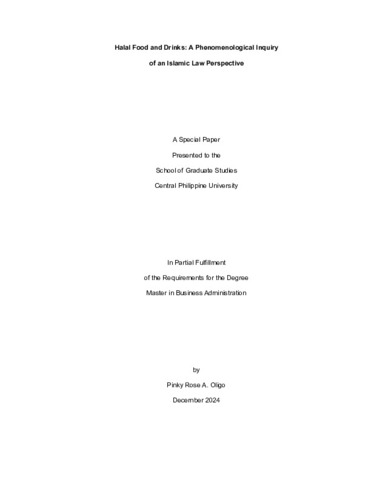
Halal food and drinks: A phenomenological inquiry of an Islamic law perspective
| dc.contributor.adviser | Monsole, Gilda C. | |
| dc.contributor.author | Oligo, Pinky Rose A. | |
| dc.date.accessioned | 2026-01-27T00:59:20Z | |
| dc.date.available | 2026-01-27T00:59:20Z | |
| dc.date.issued | 2024-12 | |
| dc.identifier.citation | Oligo, P. R. A. (2024). Halal food and drinks: A phenomenological inquiry of an Islamic law perspective [Unpublished master's special paper]. Central Philippine University. | en_US |
| dc.identifier.uri | https://hdl.handle.net/20.500.12852/3628 | |
| dc.description | Abstract only | en_US |
| dc.description.abstract | This study explores the lived experiences of individuals who adhere to Islamic dietary laws regarding the consumption of halal food and drinks. It investigates the influence of cultural and social factors on the perception and experience of halal consumption and examines challenges related to halal food certification. The research also aims to inform the development of marketing strategies for halal products. Seven Muslim participants were selected using purposive sampling, and subjected to one-on-one semi-structured interviews. A qualitative phenomenological approach was employed to analyze the data, resulting in seven key themes: (1) Lived Experience of Adherence to Islamic Dietary Laws, (2) Cultural and Social Influences, (3) Overcoming Challenges, (4) Understanding Consumer Perception, and (5) Recommendations for Improving Halal Offerings. The findings highlight that halal consumption is seen as a religious duty tied to faith, spiritual purity, and cleanliness. Cultural and social influences, particularly family traditions and community values, play a significant role in shaping halal dietary practices. However, challenges such as mistrust in halal labeling, counterfeit certifications, and vendor dishonesty were identified. Participants emphasized the importance of halal certification for ensuring compliance with Islamic law, but skepticism remained due to mislabeling. Recommendations for improving the halal food market include clearer labeling, dedicated halal sections in stores, and enhanced transparency through digital media and social platforms. Theoretical insights suggest that Information Processing Theory and the Health Belief Model (HPAM) can enhance halal labeling and marketing strategies. The study's practical implications emphasize the need for transparency, better certification systems, and culturally tailored marketing to boost consumer confidence and expand the halal market in multicultural settings. | en_US |
| dc.format.extent | xii, 142 leaves | en_US |
| dc.language.iso | en_US | en_US |
| dc.publisher | Central Philippine University | en_US |
| dc.subject.ddc | GSL Theses 650.072 Ol3 | en_US |
| dc.subject.lcc | HE 1621 .O45 2024 | en_US |
| dc.subject.lcsh | Halal food | en_US |
| dc.subject.lcsh | Islamic law | en_US |
| dc.subject.lcsh | Food--Religious aspects--Islam | en_US |
| dc.subject.lcsh | Muslims--Dietary laws | en_US |
| dc.subject.lcsh | Islam--Customs and practices | en_US |
| dc.title | Halal food and drinks: A phenomenological inquiry of an Islamic law perspective | en_US |
| dc.type | Special paper | en_US |
| dcterms.accessRights | Not publicly accessible | en_US |
| dc.description.bibliographicalreferences | Includes bibliographical references | en_US |
| dc.contributor.chair | Denuevo, Althea | |
| dc.contributor.committeemember | Gumban, Gynnyn G. | |
| dc.contributor.committeemember | Encio, Lucio T. | |
| dc.contributor.committeemember | Mucho, Lenny Rose P. | |
| dc.contributor.department | School of Graduate Studies | en_US |
| dc.description.degree | Master in Business Administration | en_US |