

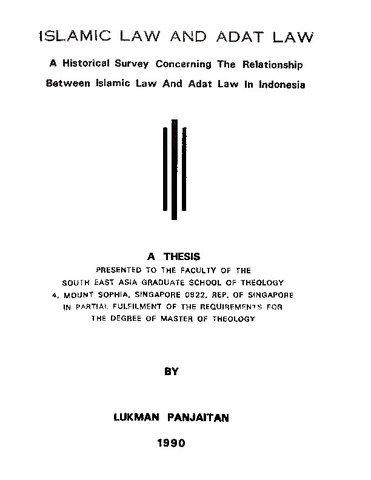
Islamic law and Adat law: A historical survey concerning the relationship between Islamic law and Adat law in Indonesia
Page views
255Date
1990Share
Metadata
Show full item recordAbstract
This thesis is entitled: "Islamic Law and Adat Law"(A Historical Survey Concerning the Relationship between Islamic Law and Adat Law in Indonesia). The aim of this thesis is to examine the problems which occurred in the encounter between Islamic Law (Shariah) and Adat (Custom) Law which exist in Indonesia. Both of these Law systems encounter each other, and at that event they were not always adaptable or could be synchronized. And at that encounter the conflicts occurred. These conflicts appeared because both of that Laws nave a different conception.
In Islam, that conception of Law is broad and wide and developed into the "Shariah". This conception of Law is different from the precept or law understood by the Western people. For Islam, the "Shariah" covers a broad sphere: the relationship between man and God, and between man with, his fellows. Islamic Law also acknowledges Adat or custom as a source and foundation of the society for its precept/law, as long as that Adat/custom is not contrary to the Qur'an and Hadith. At the same time we know that the adat/customs have a decisive role in sustaining and harmonizing the life of that society. The Adat also covers the internalized "mores" in any tribe: which cannot, be evaded. In consequence of this, for the reason of disturbing the harmony in any society. The society can punish (on the basis of their Adat Law) any disturbers.
From the coming of Islam in Indonesia, elements of indigenous people's adat or customs have been incorporated with the Islamic institutions especially in the marriage regulation ana Islamic law of inheritance. The influence of adat law/custom was very strong which forced the Islamic Law to adapt itself with it, even though we also find that the Islamic Law has succeeded in replacing some part of the indigenous adat law/custom. In this connection, both of that Laws often have intermingled each other, thus it is hard for us now to distinguish the original basis of that "new" law. We must also remember that the Islamic Law concerning marriage regulation and law of inheritance which are holed in Indonesia originated from the Syafi'i school of law. This explains the tendency of the adherents of Islam in Indonesia to maintain their own indigenous adat law according to Syafi'ite tradition. In this Syafi'i school we have a principle for holding any laws: "Adat becomes a Lawyer" (Al-'Adatu Muhakkamah), which means: "Any (good) Adat/custom can be regarded as a Law".
This thesis also pays attention to the involvement of the colonial government to the problems around Islamic Law and Adat Law in, the first part of this 20th century. This involvement was roused by the influence of Adat Law scholars such as Cornelius van Vollenhoven, Barend ter Haar, and Raden Soepomo. By the hand of those scholars, Adat Law at last was taken as the positive law especially for the inheritance problems. From their conception we found what was called "Theorie Receptie" which means: the Islamic Law is acknowledged when it was received by the Adat or custom of the people. This theory is contrary to another theory which is called "Receptio in Complexu" which means that Islamic Law is really acknowledged as Law without Adat Law. This "Theorie Receptie" influenced the lines of legal thinking in Indonesia that limited the application of Islamic Law and the development of Islam in Indonesia. The influence of this theory was very great among the Indonesian law scholars who studied in Leiden (Netherland) or in the "Rechtshogeschool" in Jakarta.
The great influence of the Adat Law could be seen at the serious debate between Nationalist Moslems and the Nationalist secularists in deciding the foundation of the nation at the crucial moments just before the days of Independence 17 August 1945. In this context the Nationalist-Moslems tried to make the Islamic Law (Shariah) as the basic principle of the Indonesian Nation. But, on the other hand the Nationalist-secularists, especially by the influence of Raden Soepomo ( an Adat Law scholar) refused to do so and suggested the another idea which is based on the Indonesian historical background of custom and culture. After the Independence, the issue of the "state foundation" has coloured the history of Indonesia when the Moslems tried to insert the Islamic Law (Shariah) by its political parties. Then, after a long debate on the Constituent Assembly the idea of making the Islamic Law as the basic principle of the nation was rejected. Again, at this moment the Moslems failed "to make the Islamic Law as the foundation of the state. The Presidential decree dated 5th July, 1959, ended this debate, and as the consequence the Pancasila and the 1945 Constitution was declared as the basic principle of the nation.
This thesis also gives attention to the consequences of the Government in trying to create a unified Law throughout Indonesia. This new orientation gave importance to the Adat Law, and to the Islamic Law. In this context I also want to examine the political implication of the Government attempt (i.e. Unification of National Law) to the Adat Law, especially to the Islamic Law concerning the Marriage Law in 1973. I examine some problems of the relationship between Islamic Law and Adat Law concerning the inheritance problems. Here I try to investigate the attempts of the Islamic Law scholars to give answers for the new challenges to apply the Islamic Law in the life of the Moslems in Indonesia (Hazairin, T.M. Hasbi Ash-Shiddieqy, and Anwar Harjono). I also describe the development of Islamic thought related to Islamic Law which was roused in a Seminar/ Workshop in 1975 in Jakarta. I compare it to the result of 1978 and 1982 Seminar about Inheritance Law. I also mention the 1975 Seminar on Adat Law.
At the end, I try to conclude and give my opinion and suggestion to the problems I examined, especially to the future of the relationship between Islamic Law and Adat Law in the midst of Indonesian society. In this context I give my suggestions about the religions’ contribution (esp. Islam and Christianity) to the development of National Law in Indonesia.
Description
Abstract only
Suggested Citation
Panjaitan, L. (1990). Islamic law and Adat law: A historical survey concerning the relationship between Islamic law and Adat law in Indonesia [Unpublished master's thesis]. South East Asia Graduate School of Theology.
Type
ThesisSubject(s)

Department
South East Asia Graduate School of TheologyDegree
Master of TheologyShelf Location
BT 212 .P36 1990
Physical Description
xi, 168 leaves
Collections
- Master of Theology [75]