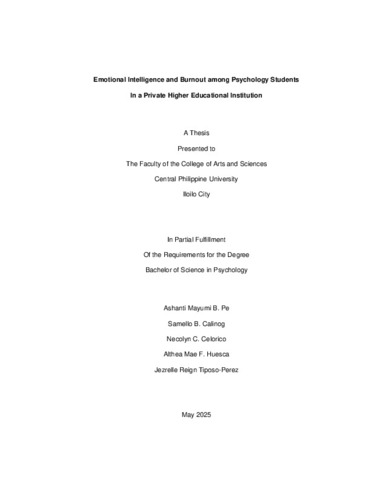

Emotional intelligence and burnout among psychology students in a private higher educational institution
| dc.contributor.adviser | Tiposo-Perez, Jezrelle Reign | |
| dc.contributor.author | Pe, Ashanti Mayumi B. | |
| dc.contributor.author | Calinog, Samello B. | |
| dc.contributor.author | Celorico, Necolyn C. | |
| dc.contributor.author | Huesca, Althea Mae F. | |
| dc.contributor.author | Tiposo-Perez, Jezrelle Reign | |
| dc.date.accessioned | 2026-01-05T02:52:17Z | |
| dc.date.available | 2026-01-05T02:52:17Z | |
| dc.date.issued | 2025-05 | |
| dc.identifier.citation | Pe, A. M. B., Calinog, S. B., Celorico, N. C., Huesca, A. M. F., & Tiposo-Perez, J. R. (2025). Emotional intelligence and burnout among psychology students in a private higher educational institution [Unpublished bachelor's thesis]. Central Philippine University. | en_US |
| dc.identifier.uri | https://hdl.handle.net/20.500.12852/3595 | |
| dc.description | Abstract only | en_US |
| dc.description.abstract | This study was conducted to determine the relationship between emotional intelligence and burnout, along with its dimensions: personal-related, studies-related, colleagues-related, and teachers-related burnout, among psychology students at a private higher educational institution. The research aimed to identify the personal factors of the students, their levels of emotional intelligence and burnout, and the correlation between the two variables. A descriptive correlational approach was utilized in gathering data from 230 psychology students across all four year levels. The TEIQue-SF was used to measure Emotional Intelligence whereas the burnout and its dimensions were assessed with the CBI-S. Spearman’s rho correlation coefficient was employed to analyze the level of emotional intelligence and the level of burnout and its dimensions. Then, the Pearson’s r was used to determine the relationship between the two variables. The findings revealed that the majority of students displayed an average level of emotional intelligence. Personal-related burnout and studies-related burnout were the most prevalent with a high level of burnout, while burnout related to colleagues and teachers was less pronounced with a moderate level of burnout. As a conclusion, the level of emotional intelligence and the level of burnout and dimensions among psychology students has no significant correlation. The findings suggest that guidance counselors should address the high levels of burnout among students by implementing programs designed to alleviate burnout. Furthermore, school administrators should remain attentive to these concerns and promote practices that prioritize the welfare of students. Finally, future researchers should conduct further investigations to explore the underlying reasons for the prevalence of burnout, including a wider scope of factors beyond emotional intelligence. | en_US |
| dc.format.extent | xi, 61 leaves | en_US |
| dc.language.iso | en_US | en_US |
| dc.publisher | Central Philippine University | en_US |
| dc.subject.lcc | BF 76.5 .P4 2025 | en_US |
| dc.subject.lcsh | Emotional intelligence | en_US |
| dc.subject.lcsh | Burn out (Psychology) | en_US |
| dc.subject.lcsh | College students--Psychological aspects | en_US |
| dc.subject.lcsh | Students--Mental health | en_US |
| dc.subject.lcsh | Private universities and colleges | en_US |
| dc.title | Emotional intelligence and burnout among psychology students in a private higher educational institution | en_US |
| dc.type | Thesis | en_US |
| dcterms.accessRights | Limited public access | en_US |
| dc.description.bibliographicalreferences | Includes bibliographical references | en_US |
| dc.contributor.committeemember | Labra, Wenmar G. | |
| dc.contributor.committeemember | Alicante, Jelvit Amor C. | |
| dc.contributor.committeemember | Pamocol, Darril F. | |
| dc.contributor.department | College of Arts and Sciences | en_US |
| dc.description.degree | Bachelor of Science in Psychology | en_US |