

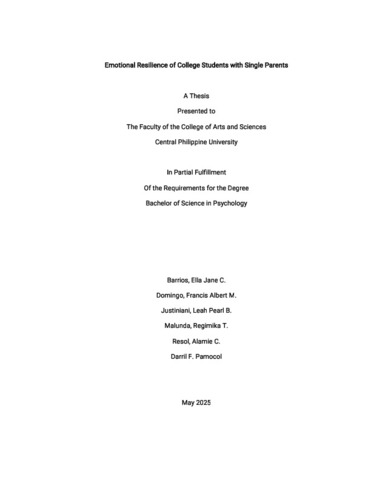
Emotional resilience of college students with single parents
| dc.contributor.adviser | Pamocol, Darril F. | |
| dc.contributor.author | Barrios, Ella Jane C. | |
| dc.contributor.author | Domingo, Francis Albert M. | |
| dc.contributor.author | Justiniani, Leah Pearl B. | |
| dc.contributor.author | Malunda, Regimika T. | |
| dc.contributor.author | Resol, Alamie C. | |
| dc.contributor.author | Pamocol, Darril F. | |
| dc.date.accessioned | 2025-11-26T07:28:36Z | |
| dc.date.available | 2025-11-26T07:28:36Z | |
| dc.date.issued | 2025-05 | |
| dc.identifier.citation | Barrios, E. J. C., Domingo, F. A. M., Justiniani, L. P. B., Malunda, R. T., Resol, A. C., & Pamocol, D. F. (2025). Emotional resilience of college students with single parents [Unpublished bachelor's thesis]. Central Philippine University. | en_US |
| dc.identifier.uri | https://hdl.handle.net/20.500.12852/3591 | |
| dc.description | Full text available | en_US |
| dc.description.abstract | This study explored the emotional resilience of college students raised by single parents and enrolled in a private higher education institution, specifically Central Philippine University. Utilizing a quantitative research design, the study gathered data from 305 purposively and snowball-sampled respondents through both face-to-face and online surveys. A two-part instrument was employed: a Personal Factors questionnaire, which included the Introversion-Extroversion Scale, and the Connor-Davidson Resilience Scale 25 (CD-RISC 25) to assess emotional resilience levels. Statistical analysis was conducted using SPSS version 25, with descriptive and inferential techniques such as the Kolmogorov-Smirnov Test and Kruskal-Wallis Test. Findings revealed varied emotional resilience scores across different parent-child sex combinations, family income brackets, and personality traits. In particular, respondents in father-son households and extroverted individuals recorded lower resilience scores. However, results showed no statistically significant differences in emotional resilience when analyzed according to parent-child sex combination, family income, and introversion- extroversion traits. The study concluded that emotional resilience among Filipino college students raised by single parents may be more deeply influenced by cultural and relational factors, such as familial closeness and community support, rather than by financial status or personality traits alone. Based on these findings, the study offers recommendations for students, parents, mental health professionals, guidance counselors, government agencies, and future researchers to better support and understand the emotional development of students from single-parent households. | en_US |
| dc.format.extent | ix, 67 leaves | en_US |
| dc.language.iso | en_US | en_US |
| dc.publisher | Central Philippine University | en_US |
| dc.rights.uri | http://publicdomain.org/publicdomain/zero/1.0/ | * |
| dc.subject.lcc | BF 76.5 .B37 2025 | en_US |
| dc.subject.lcsh | College students--Psychology | en_US |
| dc.subject.lcsh | Children of single parents--Psychology | en_US |
| dc.subject.lcsh | Adaptability (Psychology) | en_US |
| dc.subject.lcsh | Emotional intelligence | en_US |
| dc.subject.lcsh | Stress management | en_US |
| dc.subject.lcsh | Adjustment (Psychology) | en_US |
| dc.subject.lcsh | College students--Mental health | en_US |
| dc.subject.lcsh | Single parent families--Psychological aspects | en_US |
| dc.title | Emotional resilience of college students with single parents | en_US |
| dc.type | Thesis | en_US |
| dcterms.accessRights | Publicly accessible | en_US |
| dc.description.bibliographicalreferences | Includes bibliographical references | en_US |
| dc.contributor.committeemember | Tiposo-Perez, Jezrelle Reign | |
| dc.contributor.committeemember | Agutaya, Erla Grace L. | |
| dc.contributor.committeemember | Labra, Wenmar G. | |
| dc.contributor.department | College of Arts and Sciences | en_US |
| dc.description.degree | Bachelor of Science in Psychology | en_US |
Files in this item
This item appears in the following Collection(s)
Related items
Showing items related by title, author, creator and subject.
-
Exploring life away from home: A phenomenological study
(2024-05)Experiencing such a transitional phase from adolescence to young adulthood can be quite a challenge especially now that society has just slowly recovered from the pandemic. The main goal of this qualitative phenomenological ... -
Coping strategies and maternal stressors of postpartum mothers
(Central Philippine University, 2024-05)The transition to motherhood is often accompanied by significant stressors, necessitating adaptation and coping mechanisms. Understanding the relationship between maternal stressors and the coping strategies of postpartum ... -
Pangakong napako: The stories of individuals who experienced infidelity in relationships
(Central Philippine University, 2024-05)Infidelity is a complex and sensitive issue with profound effects on individuals and relationships. Researchers focused on women's experiences of infidelity in past relationships, noting that such betrayal can lead to ...


