| dc.contributor.adviser | Tamayo, Jane Marie D. | |
| dc.contributor.author | Villanueva, Kyanna Mayelle B. | |
| dc.contributor.author | Elizalde, Ernestine Grace F. | |
| dc.contributor.author | Rojo, Danna Rose S. | |
| dc.contributor.author | Talagtag, Faye T. | |
| dc.contributor.author | Tamayo, Jane Marie D. | |
| dc.date.accessioned | 2025-11-13T03:08:31Z | |
| dc.date.available | 2025-11-13T03:08:31Z | |
| dc.date.issued | 2025-06 | |
| dc.identifier.citation | Villanueva, K. M. B., Elizalde, E. G. F., Rojo, D. R. S., Talagtag, F. T., & Tamayo, J. M. D. (2025). Decision-making styles of the college students in a private higher education institution [Unpublished bachelor's thesis]. Central Philippine University. | en_US |
| dc.identifier.uri | https://hdl.handle.net/20.500.12852/3580 | |
| dc.description | Full text available | en_US |
| dc.description.abstract | This study aimed to determine the decision-making styles of college students in a private higher education institution. The variables of the study were sex, involvement in extracurricular activities, and household income. The researchers used a descriptive-inferential research design. Descriptive statistics used median, range, frequency, and percentage while inferential statistics used were Mann Whitney U Test set at 0.01 level of significance and Kruskal Wallis H Test. The researchers utilized online and face-to-face basis of an adopted questionnaire, comprising two parts: 1) demographic variables, and 2) decision-making styles. The results showed that most students use vigilance style where they tend to pursue decision-making goals by exploring rational and relevant solutions, as well as evaluating various alternatives. When grouped according to sex, both male (Median = 10, Range = 7) and female (Median = 10, Range = 9) students had the highest score in vigilance, when grouped according to involvement in extracurricular activities, vigilance has the highest median score in all categories, and when grouped according to household income, all income levels showed the highest median in vigilance. Statistical analysis using the Mann-Whitney U test indicated a significant difference in Hypervigilance based on sex (p < .001), while no significant differences were found for decision-making styles when grouped by extracurricular involvement or household income, as shown by the Kruskal-Wallis test (p > .05). | en_US |
| dc.format.extent | viii, 113 leaves | en_US |
| dc.language.iso | en_US | en_US |
| dc.publisher | Central Philippine University | en_US |
| dc.rights.uri | http://publicdomain.org/publicdomain/zero/1.0/ | * |
| dc.subject.lcc | BF 76.5 .V55 2025 | en_US |
| dc.subject.lcsh | College students--Decision making | en_US |
| dc.subject.lcsh | College students--Psychology | en_US |
| dc.subject.lcsh | Decision making--Psychological aspects | en_US |
| dc.subject.lcsh | Private universities and colleges | en_US |
| dc.subject.lcsh | Education, Higher--Research | en_US |
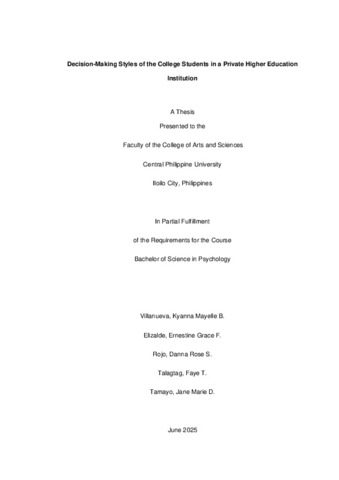
| dc.title | Decision-making styles of the college students in a private higher education institution | en_US |
| dc.type | Thesis | en_US |
| dcterms.accessRights | Publicly accessible | en_US |
| dc.description.bibliographicalreferences | Includes bibliographical references | en_US |
| dc.contributor.committeemember | Labra, Wenmar G. | |
| dc.contributor.committeemember | Tiposo, Jezrelle Reign T. | |
| dc.contributor.committeemember | Dacles, Prince Joash L. | |
| dc.contributor.department | College of Arts and Sciences | en_US |
| dc.description.degree | Bachelor of Science in Psychology | en_US |