
Ipakita ang simpleng tala ng item
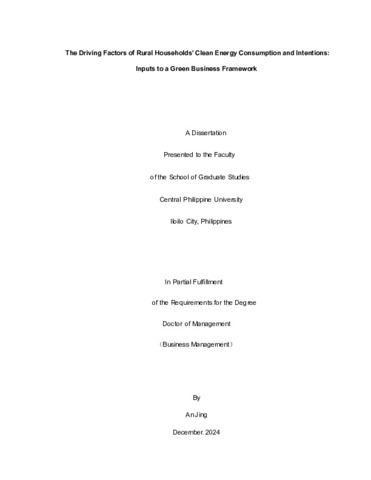
The driving factors of rural households' clean energy consumption and intentions: Inputs to a green business framework
| dc.contributor.adviser | Penetrante, Mary O’ T. | |
| dc.contributor.author | An, Jing | |
| dc.date.accessioned | 2025-10-27T03:53:56Z | |
| dc.date.available | 2025-10-27T03:53:56Z | |
| dc.date.issued | 2024-12 | |
| dc.identifier.citation | An, J. (2024). The driving factors of rural households' clean energy consumption and intentions: Inputs to a green business framework [Unpublished doctoral dissertation]. Central Philippine University. | en_US |
| dc.identifier.uri | https://hdl.handle.net/20.500.12852/3570 | |
| dc.description | Full text available | en_US |
| dc.description.abstract | This study determined the driving factors of rural households clean energy consumption and intentions as inputs to a green business framework. The study employed a secondary research utilizing macro-level data sourced from the China Energy Statistics Yearbook and micro data from China Rural Energy Consumption Survey, involving 19 provinces and 1892 rural households from 488 counties in 276 cities in china. The results revealed that there were significant relationships between the human, social, economic, and accessibility dimensions of households and their energy consumption. It was observed that households with higher human capital may enjoy "high-quality at low cost". Access to clean energy and its associated costs were significant determinants of clean energy consumption expenditure, with proximity to supply points positively impacting consumption. The probability of households choosing clean energy consumption increased by 0.15 for every 1% increase in educational attainment. For every 1% increase in per capita income, the probability of households choosing clean energy consumption increased by 0.4111, with odds of not choosing clean energy consumption being 1.5084 times higher, with households in the eastern region being 1.97 times more likely to choose clean energy than not. | en_US |
| dc.format.extent | 222 leaves | en_US |
| dc.language.iso | en_US | en_US |
| dc.publisher | Central Philippine University | en_US |
| dc.rights.uri | http://publicdomain.org/publicdomain/zero/1.0/ | * |
| dc.subject.lcc | HD 30.37 .A5 2024 | en_US |
| dc.subject.lcsh | Renewable energy sources--Economic aspects | en_US |
| dc.subject.lcsh | Clean energy | en_US |
| dc.subject.lcsh | Energy consumption--Environmental aspects | en_US |
| dc.subject.lcsh | Sustainable development--Economic aspects | en_US |
| dc.subject.lcsh | Environmental protection--Economic aspects | en_US |
| dc.subject.lcsh | Consumer behavior--Economic aspects | en_US |
| dc.subject.lcsh | Rural development--Environmental aspects | en_US |
| dc.subject.lcsh | Households--Energy consumption | en_US |
| dc.title | The driving factors of rural households' clean energy consumption and intentions: Inputs to a green business framework | en_US |
| dc.type | Dissertation | en_US |
| dcterms.accessRights | Publicly accessible | en_US |
| dc.description.bibliographicalreferences | Includes bibliographical references | en_US |
| dc.contributor.chair | Libo-on, Rowena M. | |
| dc.contributor.committeemember | Encio, Lucio T. | |
| dc.contributor.committeemember | GUMBAN, GYNNYN | |
| dc.contributor.committeemember | Samorin, Maria Corazon | |
| dc.contributor.department | School of Graduate Studies | en_US |
| dc.description.degree | Doctor of Management major in Business Management | en_US |
Mga file sa item na ito
Lumilitaw ang item na ito sa mga sumusunod na (mga) Koleksyon
Mga parehong item
Ipinapakita ang mga item na nauugnay sa pamagat, may-akda, tagalikha at paksa.
-
Perceived effect of wind turbine in the community of San Lorenzo, Guimaras
(2019-04)This study was conducted to determine the perceived effect of wind turbine in the community of San Lorenzo, Guimaras. Specifically, the study aimed to determine 1) the personal profile of the respondents, 2) the perceived ... -
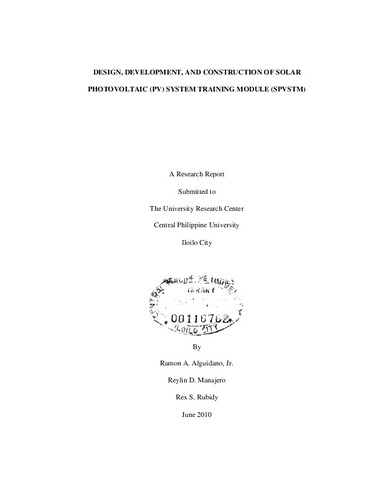
Design, development, and construction of solar photovoltaic (PV) system training module (SPVSTM)
(Central Philippine University, 2010-06)This study aimed to design, develop, and construct a locally-made Solar PV System Training Module (SPVSTM) for educational use specifically on subjects related to alternative and renewable energy. This training module is ... -
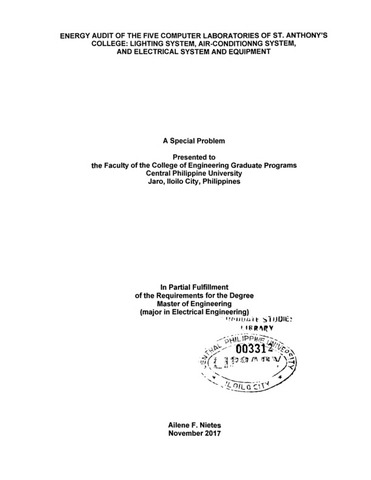
Energy audit of the five computer laboratories of St. Anthony’s College: Lighting system, air-conditioning system, electrical system and equipment
(2017)St. Anthony’s College (SAC) is a Catholic, private institution of higher learning which offers different courses using computer laboratory facilities. The laboratories are mainly equipped with computers, air-conditioners ...