
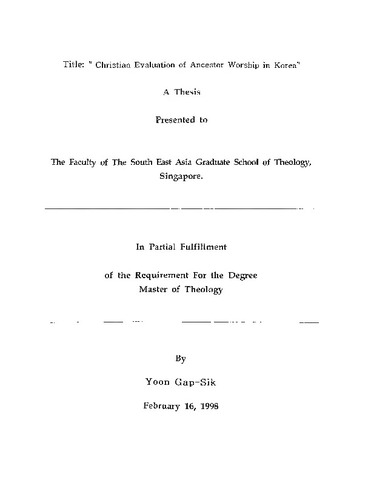
Christian evaluation of ancestor worship in Korea
| dc.contributor.adviser | Sun, Soon-Hwa | |
| dc.contributor.author | Yoon, Gap-Sik | |
| dc.date.accessioned | 2025-10-03T02:37:49Z | |
| dc.date.available | 2025-10-03T02:37:49Z | |
| dc.date.issued | 1998-02-16 | |
| dc.identifier.citation | Yoon, G. S. (1998). Christian evaluation of ancestor worship in Korea [Unpublished master's thesis]. South East Asia Graduate School of Theology. | en_US |
| dc.identifier.uri | https://hdl.handle.net/20.500.12852/3549 | |
| dc.description | Abstract only | en_US |
| dc.description.abstract | Ancestor worship is an inevitable issue which Korean ministers must face. Since the Decalogue teaching has prevented Korean Christians from performing ancestor worship, traditional practices in Korea were driven into serious confrontation with Christianity to the point of incurring severe persecution and martyrdom. Today, no ritual performance related to ancestor worship is admitted in the Korean church. However, ancestor worship can be viewed as a reflection of national spirit and custom which has served to integrate people's spiritual life. It also played the role of building intimate relationship among relatives. Nevertheless, it has been tabooed as an obstacle in the setting of practical ministry, making ministers and laity agonize about the given reality. Thus, it is necessary for the Korean church to take a progressive position toward this matter by establishing the alternative to the situation in conflict along with theological underpinnings. Church members are to be freed from unhealthy shackles in their faith life. Open treatment of ancestor worship consequently will dissolve the current problem and help the church take more active mission strategies. The method of this thesis is twofold: theoretical research and practical intervention. In terms of its scope, I will deal respectively with the definitions of ancestor worship and its essential meanings in relation to its religious role, the encounter of Christianity with the Confucian tradition and Christian response, empirical observation of church members' views on ancestor worship, and reinterpretation of ancestor worship on a biblical and theological ground. By way of this investigation, I will seek to enlarge our mission field. In chapter one, I will describe the purpose of the research, method, and scope. In the chapter two, I will introduce the Confucian understanding of ancestor worship. In the next chapter, I will analyze the different views on ancestor worship between the Roman Catholic Church and the Protestant Church. In the subsequent chapters, I will survey the on-site data with a critical analysis, and then make a final evaluation. In the conclusion, I will summarize the result of this research and further task. It seems desirable for the church to see ancestor worship not as a faith matter but as an expression of filial affection toward ancestors. Remembering ancestors' merit and grace serves to strengthen the bond of family. Therefore, in spite of its superstitious elements, I would argue that the church must endeavor to settle Christianity in its indigenous cultural soil by appropriating positive aspects of ancestor worship. | en_US |
| dc.format.extent | 58 leaves | en_US |
| dc.language.iso | other | en_US |
| dc.publisher | South East Asia Graduate School of Theology | en_US |
| dc.subject.lcc | BT 212 .Y66 1998 | en_US |
| dc.subject.lcsh | Ancestor worship--Christianity | en_US |
| dc.subject.lcsh | Christianity and culture | en_US |
| dc.subject.lcsh | Koreans--Religious life | en_US |
| dc.subject.lcsh | Koreans--Social life and customs | en_US |
| dc.title | Christian evaluation of ancestor worship in Korea | en_US |
| dc.type | Thesis | en_US |
| dcterms.accessRights | Limited public access | en_US |
| dc.description.bibliographicalreferences | Includes bibliographical references | en_US |
| dc.contributor.department | South East Asia Graduate School of Theology | en_US |
| dc.description.degree | Master of Theology | en_US |
| local.subject | Korean Christians | en_US |
| local.subject | Korean church | en_US |
Files in this item
This item appears in the following Collection(s)
-
Master of Theology [73]