

Ipakita ang simpleng tala ng item
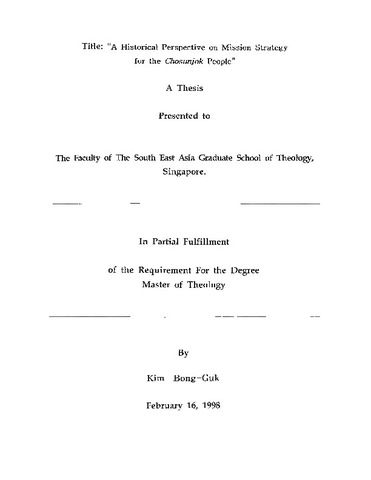
A historical perspective on mission strategy for the Chosunjok people
| dc.contributor.adviser | Lee, Nam-Sup | |
| dc.contributor.author | Kim, Bong-Guk | |
| dc.date.accessioned | 2025-09-13T03:45:59Z | |
| dc.date.available | 2025-09-13T03:45:59Z | |
| dc.date.issued | 1998-02-16 | |
| dc.identifier.citation | Kim, B. G. (1998). A historical perspective on mission strategy for the Chosunjok people [Unpublished master's thesis]. South East Asia Graduate School of Theology. | en_US |
| dc.identifier.uri | https://hdl.handle.net/20.500.12852/3523 | |
| dc.description | Abstract only | en_US |
| dc.description.abstract | This thesis aims to examine the current situation of the mission for the so-called Chosunjok people in the Samsung region of North-East Manchu. It is necessary for us to make an inquiry into what happened there and why the mission failed, and then to establish an alternative mission strategy. In the mainland China, foreign religions as well as traditional ones have been persecuted despite the occasional tolerance with an intention to impress the western countries with a mild image. The so-called Samja Church officially approved in China is a good example of such a double-edged policy of religion. There is another type of small underground church based on individual household unit. The problem here is that these two types of church are not in a supportive relationship, but in an exclusive network. This thesis does not argue for one group against another, excluding one type of church at the expense of another. To ignore the Samja Church will be too extreme since the official channel of mission is broken down. However, I believe that authentic Christians gather around the household type of church. Thus I will argue that mission abroad in China should ultimately focus on supporting the household churches albeit keeping the official relationship with the Samja Church. In order to develop my thesis, I will analyze the negative aspects of the mission for the Chosunjok people. I suspect that the failure of mission is largely due to the lack of qualification of missionaries. The mainline churches of Han people in China look at the Chosunjok people's church from a negative point of view since their missionaries have neglected caring for their soul because of their persistent interest in money. This thesis of course seeks to criticize such a skewed perspective of mission while offering a corrective to that phenomenon. As practical mission strategies, I suggest that utilizing literary works and broadcasting system is highly productive, and that developing small groups of base community in a village unit and campus becomes a point of new departure in the Chosunjok mission. Finally, I think that the previous trial and error serves as a mirror to check upon our failure and boost up our energy of mission with a humble mind. Otherwise, China will continue to be a desert of the gospel. | en_US |
| dc.format.extent | 49 leaves | en_US |
| dc.language.iso | other | en_US |
| dc.publisher | South East Asia Graduate School of Theology | en_US |
| dc.subject.lcc | BT 212 .K56 1998 | en_US |
| dc.subject.lcsh | Missions | en_US |
| dc.subject.lcsh | Korea | en_US |
| dc.subject.lcsh | Koreans--Religion | en_US |
| dc.subject.lcsh | Christians | en_US |
| dc.subject.lcsh | Missionaries | en_US |
| dc.title | A historical perspective on mission strategy for the Chosunjok people | en_US |
| dc.type | Thesis | en_US |
| dcterms.accessRights | Limited public access | en_US |
| dc.description.bibliographicalreferences | Includes bibliographical references | en_US |
| dc.contributor.department | South East Asia Graduate School of Theology | en_US |
| dc.description.degree | Master of Theology | en_US |
| local.subject | Chosunjok people | en_US |
Mga file sa item na ito
Lumilitaw ang item na ito sa mga sumusunod na (mga) Koleksyon
-
Master of Theology [75]