

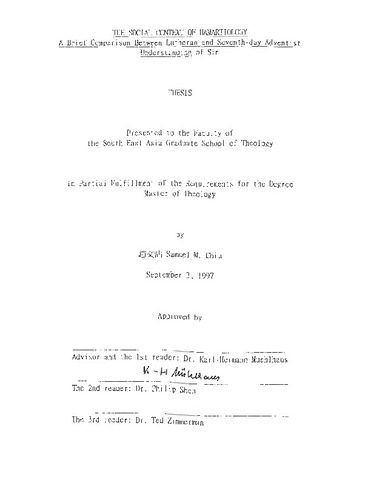
The social context of hamartiology: A brief comparison between lutheran and seventh-day adventist understanding of sin
| dc.contributor.adviser | Muehlhaus, Karl-Hermann | |
| dc.contributor.author | Chiu, Samuel M. | |
| dc.date.accessioned | 2025-09-13T03:07:26Z | |
| dc.date.available | 2025-09-13T03:07:26Z | |
| dc.date.issued | 1997-09 | |
| dc.identifier.citation | Chiu, S. M. (1997). The social context of hamartiology: A brief comparison between Lutheran and Seventh-day Adventist understanding of sin [Unpublished master's thesis]. South East Asia Graduate School of Theology. | en_US |
| dc.identifier.uri | https://hdl.handle.net/20.500.12852/3521 | |
| dc.description | Abstract only | en_US |
| dc.description.abstract | This research will focus on hamartiology as it is described in standard Lutheran and Seventh-day Adventist [SDA] writings, specifically to ascertain whether the social aspect of Sin is affirmed. After a preliminary comparison, the writer of this thesis discovers a need for both denominations to show that: Sin is not only against God, other people and oneself, but also against the whole universe including the ecological system. Even throughout the scripture are the Social aspects emphasized. Martin Luther points to Satan as the initiator of Sin, the accuser of sinners, and the opponent of the Lord. The social dynamic of Luther's understanding on sin is this: We should lay before God our faith and our righteousness that they may cover and intercede for the sins of our neighbor, a task we take upon ourselves to so labor and serve in them as if they were our very own. Lutherans have developed a further sensitivity to the social aspects of the doctrine of "[original] sin", to include the nature, the agent, and the effect of Sin. It was Bonhoeffer that clearly established substances to give a social interpretation to the concepts of sin, and of creation, atonement, repentance, new-life, and the church. The teachings of Adventist pioneers (especially Ellen G. White) focus on how to treat sin and sinners as well as the faithful for the benefit of the whole cosmic society. They developed a fuller understanding of the social aspects of Christian faith, particularly of the confrontation of good with evil and of universal judgement. After more comparisons between the Lutheran doctrine of the "Two Kingdoms" and the SDA concept of the "Great Controversy," the research uncovers the sin problem as a Cosmic battle that demands more than social action. The Lord's solution for sinners is the price on the Cross as paid to a "corporate God"; salvation should not be preached without the [collective] wrath of Heaven over Sin. Our response to God's grace will decide our final destiny; our understanding on Christianity must not only be anthropological or theological, but also be social. The conclusions are that the essence of SDA beliefs is "cosmic" instead of "legalistic". The Lutherans, on the other side, are gradually opening, more than before, towards the social direction of Christian faith. The bridge of more significant communication may be built. For this, each denomination must accept that there is something to consider in the other's stance: 1> Their dissimilar views: a> Lutherans are aware of corrupted sinful human nature in working out the governance of the church or the governance of the state; the emphasis is on God looking after us in this world through these institutions. b> SDAs are aware of the corruption of the sinful world; they suspect the effectiveness of the social modification on this world, but they emphasize man's part in the restoration of the sinless cosmos by God's grace. 2> Their closer views: a> they both admit the personal and social effect of sin, and the need of God's gracious salvation; they all oppose legalism. b> they both consider the usage of Law after conversion. 3> The respect potential: a> When Lutherans can appreciate the SDA concern for the cosmic motif of Christian faith and beware of "individualistic salvation". b> When SDAs can appreciate the Lutheran concern over the corruption of sinful human nature and beware of "legalistic salvation". | en_US |
| dc.format.extent | 105 leaves | en_US |
| dc.language.iso | en | en_US |
| dc.publisher | South East Asia Graduate School of Theology | en_US |
| dc.subject.lcc | BT 212 .C45 1997 | en_US |
| dc.subject.lcsh | Sin | en_US |
| dc.subject.lcsh | Lutherans | en_US |
| dc.subject.lcsh | Seventh-Day Adventists | en_US |
| dc.subject.lcsh | Religions | en_US |
| dc.subject.lcsh | Christian sects | en_US |
| dc.subject.lcsh | Martin, Luther R. | en_US |
| dc.subject.lcsh | White, Ellen G., 1827-1915 | en_US |
| dc.title | The social context of hamartiology: A brief comparison between lutheran and seventh-day adventist understanding of sin | en_US |
| dc.type | Thesis | en_US |
| dcterms.accessRights | Limited public access | en_US |
| dc.description.bibliographicalreferences | Includes bibliographical references | en_US |
| dc.contributor.department | South East Asia Graduate School of Theology | en_US |
| dc.description.degree | Master of Theology | en_US |
| local.subject | Hamartiology | en_US |
이 항목의 파일
This item appears in the following Collection(s)
-
Master of Theology [75]