

Ipakita ang simpleng tala ng item
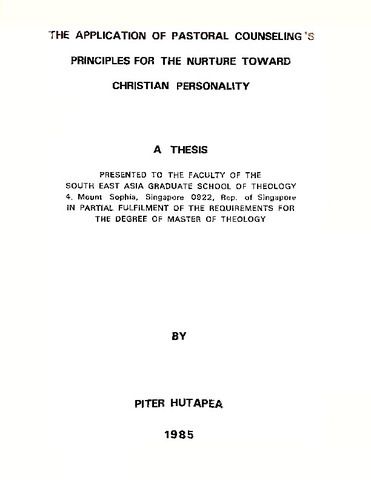
The application of pastoral counseling's principles for the nurture toward Christian personality
| dc.contributor.adviser | Poerwowidagdo, Judowibowo | |
| dc.contributor.author | Hutapea, Piter | |
| dc.date.accessioned | 2025-08-12T08:47:41Z | |
| dc.date.available | 2025-08-12T08:47:41Z | |
| dc.date.issued | 1985 | |
| dc.identifier.citation | Hutapea, P. (1985). The application of pastoral counseling's principles for the nurture toward Christian personality [Unpublished master's thesis]. South East Asia Graduate School of Theology. | en_US |
| dc.identifier.uri | https://hdl.handle.net/20.500.12852/3501 | |
| dc.description | Abstract only | en_US |
| dc.description.abstract | This thesis is entitled 'The Application of Pastoral Counseling's Principles for the Nurture toward Christian Personality'. The study was encouraged by a search for Batak Christian life style today. The Batak Christians, nowadays are guided by three distinctive sources of values, namely the Adat, the teachings of the church, and modernization. It seems that they are convinced that three sources are equally to be accepted and followed in order to establish their identity as Batak people living in this modern times as church members. The Adat is rooted in ancestors’ religion. The ancestors, it is held, believe in Adat as a totalitarian unity. The Adat function was to regulate the harmonious relationship among their gods, and the ancestors' worlds as macrocosmos and the microcosmos entities as a totality. This relation has been actualized by a system of human relationship called 'Dalihan Na Tolu'. This means the 'Dalihan Na Tolu' itself refers to the Adat as a totality. So the ancestors experienced the cosmos, the community, the individual, etc, as a totality. By this a unity of functionally heterogeneous entities, co-operating for the sake of totality, was conceived. The Gospel is the proclamation of salvation of God spread widely by foreign missionaries into the Batak land. The latter cut Adat into portions and used the 'Dalihan Na Tolu' to approach primitive Batak life. To the Christian Batak living today, 'Dali-han Na Tolu' is still valid as the rule for social life among Bataks. In order to function as a good member of Batak society, everyone enters into the 'Dalihan Na Tolu ' affiliation and must participate in certain rites. The Batak church neither accepts nor rejects it as a human relationship. On the other part, the traditional teaching of the Batak church about the meaning of the salvation of God, emphasizes primarily individual salvation rather than responsibility for others. The concept of modernization rejects the traditional way of life, and on the other part, it views Batak church teachings as a force which obstruct the process of development. Indeed, many Christian Bataks experience tension and conflict while they decide on the meaning of life because they have three value systems. This dilemma influence the process of personality growth and appears in various problems of emotional life. By applying pastoral counseling principles to the nurture toward a christian personality, emotional problems could be handed more easily, and the inner sources of everyone could be integrated for better growth of human personality. The nature of pastoral counseling is to enable interpersonal relationships as well as dialogical communication. The former is realized by 'I-Thou' relationship which permit individuals to express themselves as to what they actually feel. It is the condition of relationship in order to help persons to accept understand themselves for what they truly are. According to Christian teachings about becoming a true person, everybody needs to help and to be helped. This take places in interpersonal relationships. To help and to be helped means participating in other people's life, as was described in chapter II above. In our third chapter, we concentrated on the encounter of the Gospel with Adat in this modern world. The 'Dalihan Na Tolu' is a system of human relationships which teaches the traditional ways of behavior. Many christian Bataks find it difficult to free themselves from this system because they do not like to be alienated from their Batak affinity. On the other part, the rites mean a waste of much time and money. Consequently, there is much complaining. The basis for its teaching to renew its view about Adat and modernization is the church's theology of reconciliation. By His reconciliation, Christ restored the relationship between God and man, and he saved mankind from the hell of alienation and brought them back into a true community. The church is an agent of this reconciliation. In order to reconcile the 'Dalihan Na Tolu', the church must transform and integrate it with the christian meaning of salvation for today. The relationship of God with man can not be separated from interpersonal relationships in which everybody is helped to understand and to actualize himself through an acceptance and understanding of his fellowmen. Ultimately, therefore, the method of nurturing is about helping church members to truly actualize themselves. This we described in chapter IV. It is a basic need of individual human beings to love and to be loved, of growing and developing their own selves. By the love of God everybody is encouraged to integrate himself or herself more genuinely with others. In this way he may fulfill each others' needs as well as esteem, enjoyment, security, structure, etc. The encouragement occurs in the community, and the home is the first and ultimate community of christian living. In that context, the individual experiences empathy with his fellowmen. This has been described in the fifth chapter. In chapter VI, the study is focused on a program for the nurturing of individuals on various age levels, in connection with the process of socialization. In this program, individuals' needs were considered, and various activities were described. In conclusion, it seems necessary for the Batak church to renew its approach to Adat and modernization in the fulfillment of its calling and mission in the world of today and tomorrow. | en_US |
| dc.format.extent | 249 leaves | en_US |
| dc.language.iso | other | en_US |
| dc.publisher | South East Asia Graduate School of Theology | en_US |
| dc.subject.lcc | BT 212 .H88 1985 | en_US |
| dc.subject.lcsh | Pastoral counseling | en_US |
| dc.subject.lcsh | Personality--Religious aspects--Christianity | en_US |
| dc.subject.lcsh | Huria Kristen Batak Protestan | en_US |
| dc.subject.lcsh | Church's teaching | en_US |
| dc.subject.lcsh | Ancestor worship | en_US |
| dc.subject.lcsh | Totalitarianism | en_US |
| dc.subject.lcsh | Modernism (Christian theology) | en_US |
| dc.title | The application of pastoral counseling's principles for the nurture toward Christian personality | en_US |
| dc.type | Thesis | en_US |
| dcterms.accessRights | Limited public access | en_US |
| dc.description.bibliographicalreferences | Includes bibliographical references | en_US |
| dc.contributor.department | South East Asia Graduate School of Theology | en_US |
| dc.description.degree | Master of Theology | en_US |
| local.subject | Batak Christians | en_US |
| local.subject | Adat | en_US |
| local.subject | 'Dalihan Na Tolu' | en_US |
Mga file sa item na ito
Lumilitaw ang item na ito sa mga sumusunod na (mga) Koleksyon
-
Master of Theology [73]