

Ipakita ang simpleng tala ng item
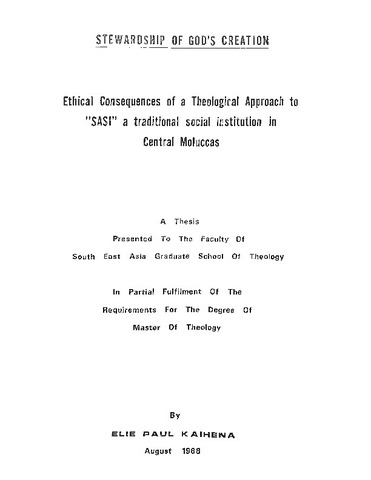
Stewardship of God's creation: Ethical consequences of a theological approach to "SASI" a traditional social institution in Central Moluccas
| dc.contributor.author | Kaihena, Elie Paul | |
| dc.date.accessioned | 2025-08-12T08:14:22Z | |
| dc.date.available | 2025-08-12T08:14:22Z | |
| dc.date.issued | 1988-08 | |
| dc.identifier.citation | Kaihena, E. P. (1988). Stewardship of God's creation: Ethical consequences of a theological approach to "SASI" a traditional social institution in central Moluccas [Unpublished master's thesis]. South East Asia Graduate School of Theology. | en_US |
| dc.identifier.uri | https://hdl.handle.net/20.500.12852/3497 | |
| dc.description | Abstract only | en_US |
| dc.description.abstract | 1. 'Sasi' is a method by which the village people in Central Moluccas preserve their living surroundings. 'Sasi' implies: prohibitions/restrictions for a certain time period, or prohibitions/restrictions of a temporary nature. These prohibitions/restrictions involve the relation of humans with their living surroundings. Meaning, that for a certain period of time people are prohibited/restricted to take plant-products from the forest as well as products from the sea. The purpose of this 'Sasi' is twofold. Firstly, in order to safeguard the availability of sufficient living-means for the inhabitants. Secondly, in reaching a fulfilment of the first purpose, the surrounding itself has to be given an opportunity to reproduce itself. From continuous experiences with nature people know that when plants are continuously disturbed, this would thus become less. The wisdom behind this ' Sasi ' tradition is: The surrounding has to be protected in order that man may receive optimal yields. The quality of the surroundings has to be improved so that the quality of life would also be guaranteed. 2. The 'Sasi' tradition is rooted in tribal religion or traditional religion of the village people. It originated in particular from a traditional belief of these people. 'Sasi' in its original form is related to the ceremony of burying the dead. People believe that death is not the end but a transitional stage of this present life to another life. The dead/time to complete their journey to their final place, a place where the souls of the dead are gathered. During the journey concerned one would need provisions. For this purpose, a certain area in the forest should be 'sasi '-ed for a dead person. People who are still living are prohibited from entering such an area. The restricted area is maintained and protected and may not be disturbed by the living, yet alone bring damage to it. The duration of a 'Sasi' or such a restriction usually varies from three months to one year. Thereafter a ceremony is held, after which the 'Sasi' or restriction is lifted. 3. Around the beginning of the 16th century foreigners from the West came to Maluku commencing with the Portugese and Spanyards. They came to trade and search for spices, i.e. cloves and nutmeg. Their arrival brought changes to the living structure of the village people. The more so when later Dutch appeared and chased away the Portuguese and Spanyards. The arrival of these western nations severely disturbed the local culture. In the economic field the system of barter-trade was replaced by a system of 'cash crop'. The people of Maluku hence become involved in a network of international trade without understanding this at all. The Dutch further introduced a policy which is known as the 'monopoly system'. What is meant by this' monopoly system' is that the village people were prohibited to sell their yields of spices to parties other than the Dutch Corporate Trading Company named the V.O.C. (Verenigde Oost Indische Compagnie = United East Indies Corporate Company). In order to achieve this end, strict regulations were enforced. All clove and nutmeg trees outside the islands of Ambon, Haruku, Saparua, Nusalaut and Banda had to be destroyed. For this purpose expeditions were regularly sent to destroy all the clove and nutmeg trees outside the above mentioned five islands. These destroyer expeditions were called 'hongi tochten' in Dutch. The islands where the planting of clove trees was required by law were also regularly controlled. For example, in order that demands of the world market could be fulfilled, people are required to plant a certain number of trees. When later the production increased and prices would fall, the village people were forced to cut down certain number of their trees which were blooming. Should later appear that production was insufficient at a time when the market demand increased, then the inhabitant were forced to again plant new clove and nutmeg trees. This continued on and on. The ' hongi tochten' were to see to it that the regulations which were enforced by the V.O.C. were kept and adhered to. The people who were used for this work were hence taken from the villages of four those islands (excluding Banda). The policy naturally caused great confusion in the village which were visited. The invading troops, which usually came from outside these villages, would go into the forests which were owned by these village people to keep watch of them. When it was found out that the number of trees exceeded the limit, these were cut down straight away, or the barks were peeled off. Meanwhile other fruits, coconuts, or plants became the victims of these expeditionary troops. Every time when these troops left a village, which usually happened once to two times a year, it can be imagined what was left behind. A destruction of the forest, as a source of living for the farmers. To the farmer, the surrounding land and nature are part of his life which cannot be separated from him. He himself and the surrounding nature are one. His identity is in his land and the surrounding nature. Actions taken against his living surroundings are of sacral value, as between the farmer and his land there exist an independency which is complete. The more so far the traditional village people, land and their living surroundings are an inheritance from their forefathers. Forefathers who have 'created' these living surroundings for them, and therefore if their descendants do not take good care of these then the forefathers will be angered. The anger of forefathers can bring disaster and calamity. A destruction of surroundings will cause a deep depression to the village people. When later towards the middle of the 19th century the prices of spices on the world market dropped sharply, the earnings of the village people who were dependent upon these spices also dropped sharply. They became poor. The 'monopoly system' was finally lifted in 1954, leaving the inhabitants in a very poor condition. Vander Capellen, Governor General of the Netherlands East-Indies described this situation as follows: The most substantial inhabitants of Ceram and the adjacent is land are wholly dependent on their creditors and compelled for temporary relief to enter the most disadvantageous contracts, to surrender all the profit of their trade and even to suffer only loss..... this losses make them poor year by year and day by day until at last they no longer show themselves because of their debts, break good faith and seek fraudulent evasion. Having no property and working for their creditors, with nest no prospects they lose heart and abandon themselves to idleness” *) The poverty which they experience began to make the village people aware that up until then they had neglected the inheritance from their forefathers and for this reason they had to accept the disaster which came upon them. 4. An attempt was made to find a way of restoring the living surroundings which, if left in that condition, was to become still worse. People who are already poor will view living surroundings as the only source of living-means for them and therefore destruction can even become worse. Here they finally found a way which was used by people of a tribal religion and which was ‘Sasi’. If 'Sasi' in its original form is connected with the dead, then this system could also be used for a protection of the natural surroundings, and thereby a means of living would also be guaranteed. The oldest written form of 'Sasi' dates from 1863. This indicates that 'Sasi', in its latest form already existed before that time. 'Sasi' is usually applied to coconut, fruits, cloves, nutmeg, fish, sea cucumbers, sea weed, and others; namely all plants or products which are seasonal, whereas it is not implied for a temporary nature (horticulture). The time period of a ‘Sasi’ or restriction depends on each product-type and usually varies from three months to one year. Interesting is the fact that 'Sasi' is applicable to everybody, to the owner as well as to other persons. This would mean that during a ' Sasi' period the owner will not to be allowed to take his own property. This wisdom of applying a restriction to the owner himself, is a conception of alliance and ownership. A person is part of a group, therefore his property is part of the group's property. A village is the realisation of a larger group which includes every individual living in it. Therefore every village regulation concerns every person who is an inhabitant of that village. As a group, a village is responsible for the protection of its property, meaning the property of each of it’s members. And the property of all the members is the property of the village inherited from the forefathers. The conception concerning an individual who stands on his own, apart from the village group, is a development of the modern world which is unknown to the traditional people. Different from the ‘Sasi’ in its original form, which has a religious-mystic substance the ‘Sasi’ in it’s latest form has duly lost these original meaning. What has become predominant is the aspect of law. Sanctions are therefore imposed upon each transgression. These sanctions are usually found in the form of a fine which to be paid by the transgressor, being money which is to be paid to the village funds. In order to control the performance of the mentioned 'Sasi', the village administration then formed a controlling body which is called 'kewang'. The meaning of the word' kewang' is most likely derived from the word 'ewang' which means the forest. The function of this 'kewang' or forest police is to safeguard the forest (and also the sea) against actions which are in violation of the law by village inhabitants as well as outsiders. They have the responsibility over the maintenance and safety of the village living surroundings. However, their function actually includes more than that. The conception behind their appointment is a safeguarding of the inheritance from their forefathers. These forefathers were not just ordinary human beings but it can be said that they are divine beings. These forefathers are always present and take part in settling village matters. They can also give blessings or curses. The blessings of the forefathers are of great importance. Therefore the function of the 'kewang' is also to act as requestor for blessings from the forefathers. This is evident from the ceremonies which are held by 'kewang' before the 'Sasi' is enforced or when it is lifted. In the ceremony which can be compared with a ceremony asking for fertility (fertility cult) prayers asking for favours are said and songs of praise to fore fathers are sung. It is believed that if a ceremony is carried out properly blessings are surely to come. 5. Because of this 'Sasi', two villages, i.e. the village of Haruku in 1982 and the village of Haruku in 1985, each, received 'Kalpataru' award, the highest award in the sector of preservation of living surroundings, which is awarded by the Government of the Republic of Indonesia. The two villages mentioned received this award in the category of 'Preserver of Environment'. The village of Ihamahu for preservation of the forest and the village of Haruku for preservation of the sea (coastal area), which became a place for cultivation of palagic fish. Here 'Sasi' is connected with the living environment, which is more and more being realised many countries as an international movement. 'Sasi' has become a means for preservation surroundings, already existed long time ago, before people even realized what the living surroundings mean to their generation as well as to the coming generations. 'Sasi' gives the surrounding nature an opportunity to produce, thereby guarantying its survival, so that it does not die out. If the acts of humans are not restricted, no opportunity will be given to other living creatures to restore themselves who will most benefit from it, for the sake of their own survival. Lately, 'Sasi' as a traditional custom started to show problems. With a few exceptions, at many places it already received less attention. The influence of religion, education, and culture which has come from outside have duly introduced new values. As mentioned before, 'Sasi' is rooted in tribal religion and tradition. Where inhabitants embrace Islam and Christian religions, forefathers are no more a source of living, but God the creator of heaven and earth is the one who cares and directs people's life. Education also influence more and more people's views concerning nature. Nature is understood as an object of science which must be known by man. Individuals free themselves more and more from group ties and an individual consciousness is being gradually developed. The influence of a consumptive life forces people to compete with each other in gaining greatest possible material richness, without caring about other persons interests, aside from other reasons which also influence the performance of 'Sasi' in the villages. 6. Did 'Sasi' later than disappear because of this? Apparently not. As a tradition which is rooted in the midst of people, it is apparently not so easy to let it easily vanish. 'Sasi' later re-appeared in a new form which is called church 'Sasi'. This church 'Sasi' is not a new kind of 'Sasi'. It is still the old 'Sasi', however, now performed by the church. The traditional function which had gradually slack down caused a later change of this institution from being performed by the 'kewang' to a performance by the church. It is indeed difficult for 'Sasi' to vanish. This is because it is related with the natural surroundings which are a source of living for the people of rural areas. Its ties with the land, vegetation, sea, sand etc. resembles a tie between life and death. Here is the true difference between the perception of the town people and the village people. Town people view nature from the side of art, recreation, an object for re- search, a useful object for their activities. Village people view nature as their source of living. It would therefore be impossible to leave 'Sasi' behind as an institution which has grown from the reality of the village people's life. Those who do not need 'Sasi' anymore are the ones whose orientation of life is already outside the village boundaries, and their main source of living is no more obtained there. Another main reason is the village structure. The administration in many villages is elected from retired government or army officials whose source of living until then did not come from the village. Yet the performance of 'Sasi' depends on the village administration which is in accordance with the prevailing regulations. A lack of attention from these administrations cause a less smooth performance of 'Sasi'. In the village structures which are uniform throughout the whole of Indonesia, there seems to be no place for original village institutions. Such an adjustment to new regulations was the reason that the 'kewang' was no more included in the village structure. On the one side, people would still need the existence of 'Sasi' but on the other side less attention is paid from the village management, this would cause 'Sasi' (kewang) neither to live nor to die. 7. In such a situation it is the church that becomes a reception centre for people's aspirations, which means that an existing social tradition should come under the perfection of the church. Such a development can only happen in Christian villages, indicating that in Muslim and Catholic villages, such a development would not occur. This is however not an unusual development. The church is duly unified with the Ambonese people through a process of development for more than four centuries. The identity of Ambon is a Christian identity, and being an Ambonese means being a Christian, and the other way around. The term 'Ambonese Christian' is an indication of this. The terms 'ke Ambonan' (=Ambonese) and 'ke seranian' (=Christian) are unified. Therefore a transition from the village to the church in a performance of 'Sasi ' is not something unusual. It can be said that the church in the village in Central Maluku is a village church (in comparison with a state church). The acceptance of 'Sasi' by the church as against many other traditions of the village people which were refused is an indication that 'Sasi' is theologically acceptable. 'Sasi' is freed from the remains of a village religion and has been given a 'new coat'. The practicing of the church 'Sasi' is progressing more and more and nearly all congregations within the Protestant church of the Moluccas are performing it. However the question at issue has not come to an end. The religious-mystic aspect, as the remains of the previous tribal religion, which was desired to be eliminated, now emerges in the church's concept of the 'Sasi'. 'Sasi' ceremonies which are usually inserted in the Sunday services include two elements. Firstly: a request for blessings from God of all products from vegetation and the sea, in order that they may multiply. A request is also made for protection, maintenance and control by God. A guardance by God would be more effective than a guardance by many people. Secondly, the element of a curse from God for those who violate 'Sasi' regulations so that God gives them a fitting punishment. The aspect of curse makes that the church 'Sasi' is very much afraid of by the people. We already recognize the all-important role of 'kewang' and ancestor worship in the original pagan concept of 'sasi'. People’s respect for the 'kewang'as a controlling power and the ancestors especially for their curses. Remnant of this basic pagan concept seems to endanger the present understanding of 'church-sasi'. It is therefore, necessary to transform those concepts into sound theological precepts. Obedience to 'church-sasi' would imply an expression of faithfulness to God who blesses and safeguards the basic needs of the people. Man's labor should be interpreted as a mandate from God (Genesis 1: 28). Crops from the garden and hauls from the sea should be accepted as blessings from the Lord. 8. Christ has become the central person who has freed 'Sasi' from the grip of various forces. 'Sasi' in this new perspective is placed as a tool in the hands of God. In the light of Christ's work as well, we obtain a new understanding concerning the people. 'Sasi' can be used by God to make us realize that the people or community does not only exist of groups of people, but that it is more widespread. The community includes humans and other creatures as well who together form one eco-system (the household of created beings.) There is not only an interaction and interdependency between one human and the other, but also between humans and other created beings. All together point to the saving God. 'Sasi', a traditional village institution, which is a tactful product of the past, can become a driving force for the development of Christian social ethics. Sasi concerns both human and world which are God's created entities. As such it should be honoured. | en_US |
| dc.format.extent | 209 leaves | en_US |
| dc.language.iso | other | en_US |
| dc.publisher | South East Asia Graduate School of Theology | en_US |
| dc.subject.lcc | BT 212 .K35 1988 | en_US |
| dc.subject.lcsh | Christian stewardship--Biblical teaching | en_US |
| dc.subject.lcsh | Creation--Biblical teaching--Study and teaching | en_US |
| dc.subject.lcsh | Natural areas | en_US |
| dc.subject.lcsh | Tribes--Religious life | en_US |
| dc.subject.lcsh | Quality of life | en_US |
| dc.subject.lcsh | Village People | en_US |
| dc.subject.lcsh | Restoration | en_US |
| dc.subject.lcsh | Paganism | en_US |
| dc.title | Stewardship of God's creation: Ethical consequences of a theological approach to "SASI" a traditional social institution in Central Moluccas | en_US |
| dc.type | Thesis | en_US |
| dcterms.accessRights | Limited public access | en_US |
| dc.description.bibliographicalreferences | Includes bibliographical references | en_US |
| dc.contributor.department | South East Asia Graduate School of Theology | en_US |
| dc.description.degree | Master of Theology | en_US |
| local.subject | "Sasi" | en_US |
| local.subject | Tribal religion | en_US |
Mga file sa item na ito
Lumilitaw ang item na ito sa mga sumusunod na (mga) Koleksyon
-
Master of Theology [75]