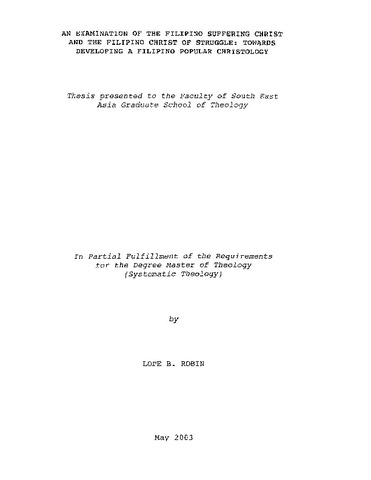

An examination of the Filipino suffering Christ and the Filipino Christ of struggle: Towards developing a Filipino popular Christology
| dc.contributor.adviser | Mendoza, Everett L. | |
| dc.contributor.author | Robin, Lope B. | |
| dc.date.accessioned | 2025-08-07T08:09:20Z | |
| dc.date.available | 2025-08-07T08:09:20Z | |
| dc.date.issued | 2003-05 | |
| dc.identifier.citation | Robin, L. B. (2003). An examination of the Filipino suffering Christ and the Filipino Christ of struggle: Towards developing a Filipino popular Christology [Unpublished master's thesis]. South East Asia Graduate School of Theology. | en_US |
| dc.identifier.uri | https://hdl.handle.net/20.500.12852/3468 | |
| dc.description | Abstract only | en_US |
| dc.description.abstract | This study seeks to bring together the two Christologies in the Philippines (Suffering Christ and Christ of Struggle) so that the Filipinos will have a unified view of Christ and a unified praxis. For the existence of the two Christologies have resulted in conflicting views and responses to socio-cultural issues affecting the lives of the people. In this regard there is a necessity for a new Christological model that can bring Filipino Christians together into a unified faith and praxis in the light of contemporary Philippine social realities. This study employs descriptive and critical-analytical methods. Firstly, it describes the Philippine historical situations when each Christology was introduced or emerged. In the description of the distinctive elements, it is obvious that each position emphasized only certain aspects of Christ that suited the interests and biases of its proponents. However, the commonly held elements of the two Christologies indicate that the two are not mutually exclusive. Secondly, the theological and social implications of the two Christologies are analyzed. Theologically, the elements of both Christologies are founded upon the testimony of the scriptures. However, due to selective emphasis on some aspects of Christ, each position has virtually fallen short in projecting the whole picture of the Christ. In as much as a person's image of Christ influences one's action, the strong emphases on the suffering and death of Christ in the traditional Christology, has contributed to passive and resigned attitudes in the face of injustice and oppression among Filipino believers. On the other hand, the contemporary Christology of struggle - by focusing on incarnation, Jesus' teaching on the Kingdom and resurrection – has inspired Filipino Christians to struggle for emancipation from the bondage of suffering with assurance that victory awaits them in the future. Finally, the findings show that since both emphases though distinct from each other, are all aspects of the Christ as witnessed by the scriptures, bringing together the two Christologies into one and new Christological model is possible and viable. Considering the socio-cultural and historical landscapes of the Philippines the people need an image of Christ who is able to endure and overcome suffering. With this image of Christ the Filipinos would find strength and hope to continue the struggle until freedom, justice and equality reign in this land. | en_US |
| dc.format.extent | 169 leaves | en_US |
| dc.language.iso | en_US | en_US |
| dc.publisher | South East Asia Graduate School of Theology | en_US |
| dc.subject.lcc | BT 212 .R63 2003 | en_US |
| dc.subject.lcsh | Suffering--Religious aspects--Christianity | en_US |
| dc.subject.lcsh | Christology | en_US |
| dc.subject.lcsh | Christianity and culture | en_US |
| dc.subject.lcsh | Religion and social problems | en_US |
| dc.subject.lcsh | Christian sociology | en_US |
| dc.subject.lcsh | Christian life | en_US |
| dc.subject.lcsh | Theology, Doctrinal | en_US |
| dc.subject.lcsh | Religion and politics | en_US |
| dc.subject.lcsh | Jesus Christ | en_US |
| dc.title | An examination of the Filipino suffering Christ and the Filipino Christ of struggle: Towards developing a Filipino popular Christology | en_US |
| dc.type | Thesis | en_US |
| dcterms.accessRights | Limited public access | en_US |
| dc.contributor.department | South East Asia Graduate School of Theology | en_US |
| dc.description.degree | Master of Systematic Theology | en_US |