
Ipakita ang simpleng tala ng item
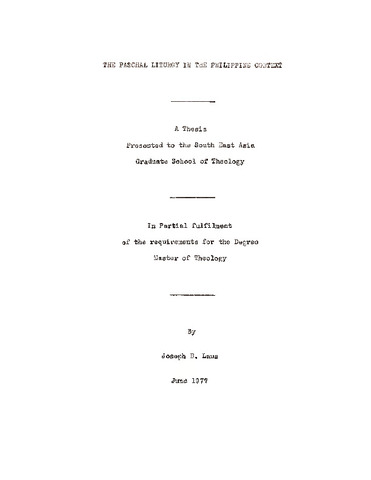
The paschal liturgy in the Philippines context
| dc.contributor.author | Laus, Joseph B. | |
| dc.date.accessioned | 2025-08-06T09:33:58Z | |
| dc.date.available | 2025-08-06T09:33:58Z | |
| dc.date.issued | 1977 | |
| dc.identifier.citation | Laus, J. B. (1977). The paschal liturgy in the Philippines context [Unpublished master's thesis]. South East Asia Graduate School of Theology. | en_US |
| dc.identifier.uri | https://hdl.handle.net/20.500.12852/3466 | |
| dc.description | Abstract only | en_US |
| dc.description.abstract | One of the most noticeable features of the present liturgical monument is the recovery, restoration, reformation or enrichment of the Paschal Liturgy of Holy Week and Easter as the crown of the Christian liturgical year. The paschal liturgy is the heart of the Christian liturgical year. It is the unitive celebration of the Christian Passover accomplished in Jesus Christ and into which all Christians are plunged by virtue of their baptism. It is the liturgical celebration of the one saving act of Christ in which the Church as his mystical body dies and rises again with him. The Paschal Liturgy consists of the Rites of Palm Sunday, Maundy Thursday, Good Friday and the Great Easter Liturgy of the Easter Night. When the Church celebrates the paschal rites of Holy Week and Easter, she is not keeping a series of antique rites of considerable beauty. It is by means of the liturgy that the Church makes present here and now the redeeming power of Christ's saving acts in the past. Holy Week and Easter is not chiefly the time for recollecting upon the last events our Saviour's life; nor is it a time for individual corporate retreats. It is all these, but it is chiefly a time for the renewal of the Church. And the Church in celebrating the paschal liturgy is concerned with the central facts of its existence and faith. By celebrating the liturgy, the Church lives more intensely than at any other time of the year the central facts of her existence and faith so that she may be drawn more closely to her redemption in Christ, and at the same renew herself to the very depths of her existence and faith. Year by year, the Church is renewed as she recalls in Holy Week the point of her redemption the cross and resurrection of Christ. It is the occasion of the Church’s corporate awareness of the events of her redemption. It is during Holy Week and especially the Sacred Triduum of Maundy Thursday, Good Friday and Holy Saturday in which the people of God enter into, and are renewed as the people of God by the triumphant passion of our Lord. Thus the paschal rites are the unique means by which the Church proclaim the Word of God to men, and the mighty acts of God in Christ for man's salvation accomplished in Christ once for all in history. The Church does this in rites and ceremonies, word and action, placarding the events of holy history, exposing and meditating upon it, and at the same time becoming identified with that which she proclaims and celebrates as present, passing from death to life, and becoming the new creation in the Risen Lord. The underlying theme of Holy Week and Easter is the Passover of Christ and the passover of his Christian brothers. Just as Christ passed over from death to life to the glory of the Father, so now the Church is making her passover through the liturgical celebration so that she may come to a new phase of her existence. In the first Holy Week, Christ redeemed us and every Holy Week He renews our redemption. Thus on Palm Sunday, the Church recalls the triumphal entry of our Lord to Jerusalem to accomplish his passover. On Maundy Thursday, the Church recalls the betrayal of our Lord and the institution of the Holy Eucharist in which Christ gave his body and blood as his anamnesis until He comes again. Then on Good Friday, the Church dies with Christ, she rises to life again, now filled with the life of the Risen Christ on Holy Saturday at the Great Easter Vigil. This work is a liturgiological study which is concerned with the origins and development of the liturgy as lived in the Church. Thus the basic thesis of this study is that true liturgical renewal must always return to the sacred sources, original and development of the liturgy. This grounding has a practical bearing on the present because it tells us how the Christians prayed and worshipped through the living centuries of the Church, providing a connecting link with the present as far back to the life and worship of the Primitive Church. And it is when we understand the primitive origins, the development of the liturgy through the centuries of the living Church, and this connecting link from the present to the primitive origins that we can know and understand best our present forms of divine worship. Thus the Given Liturgy, the Paradosis is a necessary ingredient in any liturgical renewal. What has been done in the liturgy and what is being done now must be tested against the given or the Paradoses. The work is divided into eight chapters. The first chapter is on the background and the origins of the Paschal; and then reconstructs the Primitive Рaschа as given especially by the writings of Justin Martyr and the Apostolic Tradition of Hippolytus. The second chapter deals with the development of the complex observance of the paschal liturgy, and the reconstruction of the same, especially as that which developed as the Jerusalem Holy Week pattern. The succeeding chapters outline the historical development of the Holy Week observance in the Western Church as a whole before Vatican II. The chapter on "Holy week" in the Orthodox Church” is to bring us to the liturgical traditions of the East as they have received the Paradosis from the Primitive Church. However, this section is very limited because of the lack of texts available, except the English translation of the Holy Week services from the service book of the Holy Orthodox Catholic (Greco-Russian) Church by Isabel Hapgood (1906 edition). The chapter on "The Paschal Liturgy in the Philippines" is important and its main concern is a description of the major customary religious practices that have been associated with the Holy Week observance in the Philippines. Thus this chapter gives the context of the Philippines, that in addition to the official rites of Holy Week many extra-liturgical or quasi-liturgical services are being observed by the people. This chapter poses a problem to the Church: “How should the traditional Holy Week practices be adapted, or redirected, or re-oriented so that they are not celebrated separately from and unrelated to the paschal liturgy of Holy Week and Easter?" This problem has become more serious because some of these religious practices which the people value so much have become tourist attractions in the streets, or they may fade away in the future years ahead. Some solutions to this problem is suggested on the chapter on "The Paschal Liturgy In The Liturgical Renewal." The main concern of this chapter is liturgical and practical. It reconstructs the restored and reformed paschal liturgy of the Church, especially as represented by the Roman Catholic Church, the Anglican Church and the Reformed Church Tradition. Then it proceeds to give the principles for the adaptation of the liturgy to the norms and traditions of the people. First, a profound knowledge of Christian Tradition is necessary to discern in the custom what is universal from what is particular to a given civilization or culture. Second, the norms governing liturgical laws must be followed. Third, the substance of the liturgy must be kept intact; and fourth, indigenous practices and traditions must not be indissolubly bound up with superstition. With these norms in mind, the Church can carefully adapt or re-orient some of the meaningful traditional practices of the people into the liturgy of the Church, keeping what is valuable in them, correcting what is wrong and elevating them to the Gospel. Integrating some of the more meaningful traditions and practices of the people will involve them actively to participate and share in the paschal mystery which the paschal liturgy proclaims and celebrates. And the christian will be able to experience a continuity between his daily life and customs, and the Church. The paschal liturgy will then evidently be celebrated as the summit of the liturgical celebration of the Christian Year will be celebrated with reality and great awareness that we are truly a sacred people and members of Christ's body, which is highlighted in the liturgy of Christian Initiation (baptism, confirmation and the Eucharist of the Great Easter Liturgy. In effect, this brings to focus the meaning of the Christian life, making it clear that the Christian is incorporated into the body of Christ through the sacrament of Christian Initiation. Thus the Christian will be able to worship Christ, whose property he has become, because he will be able to understand Sunday better as a weekly Easter, the Eucharist and the prayers of the Church. The christian who participates in the paschal rites of Holy Week and Easter will not fail to understand the meaning of the Christian life, proclaimed and celebrated experienced in word and action through the effective symbolism of the liturgy. The concluding section of the chapter attempts to suggest for possibilities and areas of adaptation and liturgical renewal, orienting some of the traditional practices to the paschal liturgy of the Church as celebrated through the living ages of the Church. The final chapter is on "The Theology Of The Paschal Liturgy." Foremost is the Passover motif, and the death and resurrection of Christ. It was because the angel of the Lord passed over the land of Egypt killing the first-born of the Egyptians that the Israelites were enabled to pass over the Red Sea to Mount Sinai where God made covenant with them to be His Chosen People and He will be their God. This was the most important of all the saving acts of God among the people of the Old Testament. Now, when Christ came, what he did was in essence as that which God has done for Israel. It was a Passover, Israel in Egypt was hopeless, and except that God would intervene and do something. God intervened and delivered Israel. In like manner, the sinless man Christ, making himself in all things like man chose the way of the guilty though utterly guiltless, in order that men might be saved, becoming the Passover of his sinful brothers. | en_US |
| dc.format.extent | xi, 219 leaves | en_US |
| dc.language.iso | en | en_US |
| dc.publisher | South East Asia Graduate School of Theology | en_US |
| dc.subject.lcc | BT 212 .L38 1977 | en_US |
| dc.subject.lcsh | Paschal triduum--Liturgy | en_US |
| dc.subject.lcsh | Liturgical movement | en_US |
| dc.subject.lcsh | Passover--Liturgy | en_US |
| dc.subject.lcsh | Baptism--Reaffirmation of covenant | en_US |
| dc.subject.lcsh | Salvation | en_US |
| dc.subject.lcsh | Christians | en_US |
| dc.subject.lcsh | Tradition (Theology) and Christian union | en_US |
| dc.title | The paschal liturgy in the Philippines context | en_US |
| dc.type | Thesis | en_US |
| dcterms.accessRights | Limited public access | en_US |
| dc.description.bibliographicalreferences | Includes bibliographical references | en_US |
| dc.contributor.department | South East Asia Graduate School of Theology | en_US |
| dc.description.degree | Master of Theology | en_US |