
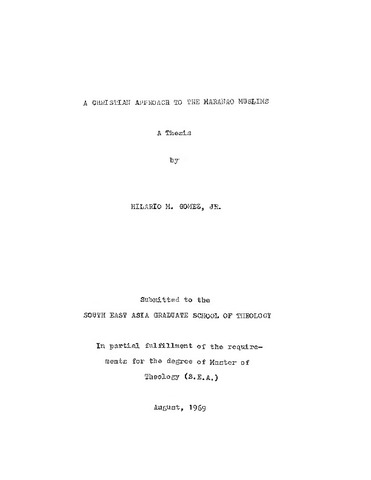
A Christian approach to the Maranao Muslims
| dc.contributor.author | Gomez, Hilario M., Jr. | |
| dc.date.accessioned | 2025-08-06T08:52:08Z | |
| dc.date.available | 2025-08-06T08:52:08Z | |
| dc.date.issued | 1969 | |
| dc.identifier.citation | Gomez, H. M., Jr. (1969). A Christian approach to the Maranao Muslims [Unpublished master's thesis]. South East Asia Graduate School of Theology. | en_US |
| dc.identifier.uri | https://hdl.handle.net/20.500.12852/3465 | |
| dc.description | Abstract only | en_US |
| dc.description.abstract | The Moro problem is one of the most vexing problems of the Republic of the Philippines today. The present discontent of the Moros – Filipino Muslims -- is a thorn in the flesh of the Filipino nation. Historically and sociologically, the Muslims have been separated from Christian Filipinos. The gulf between them is truly not only the problem of the Philippine government but is every Filipino' s concern. Seen from the viewpoint of the Christian Church, the problem is essentially ethical. Thus far, the Christian Church in the Philippines has not adequately performed its task of love and understanding with respect to the Moros. It can do more in the area of Christian service among them. The purpose of this study is to seek a fresh and more effective Christian approach to the Maranao Muslims in Lanao. The Moro problem is, for the purpose of this thesis, considered in a limited geographical context, namely, the relations between Muslims and Christians in Lanao. In the past, Muslim-Christian contacts in Lanao very largely involved warfare, resulting in a deep animosity between the two groups. The nature of Muslim-Christian hostility is reflected in the negative Moro (Muslim) and Bisaya (Christian) images. Maranao social structure shows some basic similarities with other Filipino groups as well as marked differences. An attitudinal survey of Muslims and Christians with regard to their interrelations reveals generally more positive attitudes among the Muslims than among the Christians. Because of historical, socio-cultural and religious factors, a missionary approach to the Maranao with conversion as the major purpose is not only undesirable but also impractical. The Christian task in Lanao should not be to recruit the Maranao into institutional Christianity, for doing so would only uproot him from his own culture. The Maranao is rooted in his own community. One of the " givens" of membership in Maranao society is adherence to Islam. This is protected by the principle of maratabat, the honor or the " face" of the community. Moreover, the unhappy history between Muslims and Christians in the Philippines has deepened the impression on the Maranao that Christianity is the religion of the enemy. Thus, for a Maranao to be converted from Islam to Christianity is to invite the anger of his own people, making him even a traitor to his own society. The improvement of relationship s between Muslims and Christians should be the first task of Christians in Lanao. But this can be done only if Christian Filipinos will strive to understand and love the Maranao as neighbors, friends, and brothers. Dialogue should be encouraged. Service projects for the benefit of the Maranao should be sponsored by the Christian Church (both Roman Catholic and the denominations affiliated with the National Council of Churches) working together with government and private agencies. The Christians in the diaspora should show the Maranao the inner worth of the Christian Gospel by living exemplary lives of love and service. The Christian mission to the Maranao Muslims in Lanao can be made lasting only if and when Filipino Christians will shoulder full responsibility for reaching the Maranao. Because the Filipino Christian can be the missionary par excellence to the Maranao, then a "Filipino First " missionary approach should be adopted. | en_US |
| dc.format.extent | 109 leaves | en_US |
| dc.language.iso | en | en_US |
| dc.publisher | South East Asia Graduate School of Theology | en_US |
| dc.subject.lcc | BT 212 .G66 1969 | en_US |
| dc.subject.lcsh | Christianity and other religions | en_US |
| dc.subject.lcsh | Christianity | en_US |
| dc.subject.lcsh | Maranao (Philippine people) | en_US |
| dc.subject.lcsh | Christian Mission | en_US |
| dc.subject.lcsh | Christianity and culture | en_US |
| dc.subject.lcsh | Conversion--Christianity | en_US |
| dc.subject.lcsh | Ethnology--Religious aspects--Islam | en_US |
| dc.subject.lcsh | Indigenous peoples | en_US |
| dc.subject.lcsh | Muslims | en_US |
| dc.title | A Christian approach to the Maranao Muslims | en_US |
| dc.type | Thesis | en_US |
| dcterms.accessRights | Limited public access | en_US |
| dc.contributor.department | South East Asia Graduate School of Theology | en_US |
| dc.description.degree | Master of Theology | en_US |
Files in this item
This item appears in the following Collection(s)
-
Master of Theology [66]
Related items
Showing items related by title, author, creator and subject.
-
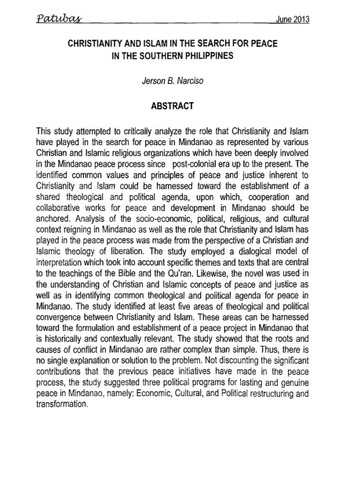
Christianity and Islam in the search for peace in the Southern Philippines
(Central Philippine University, 2013-06)This study attempted to critically analyze the role that Christianity and Islam have played in the search for peace in Mindanao as represented by various Christian and Islamic religious organizations which have been deeply ... -
Factors influencing the young people’s interest and involvement in Christian education programs under the Convention of Philippine Baptist Churches (CPBC) in Sara, Iloilo
(2004)This descriptive study determined the forty-six young people’s interest and involvement in Christian Education Programs (CEP) under the Convention of Philippine Baptist Churches, Inc. in Sara, Iloilo. The level of interest ... -
A study of disciple training in the Bible for Vietnam mission
(South East Asia Graduate School of Theology, 2000-02)The attempt in this study is to investigate the principles and model of biblical disciple training. This paper reilluminated the mission trends in the present and showed the desirable mission model in the future through a ...