
Показать сокращенную информацию
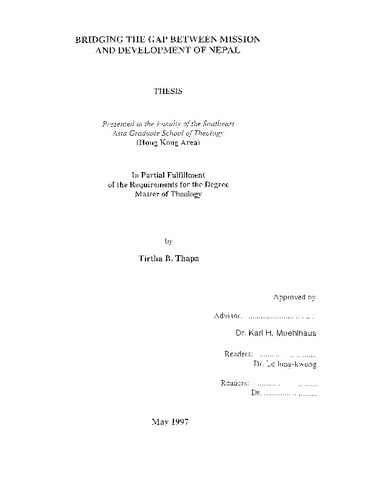
Bridging the gap between mission and development of Nepal
| dc.contributor.adviser | Muehlhaus, Karl H. | |
| dc.contributor.author | Thapa, Tirtha B. | |
| dc.date.accessioned | 2025-08-04T08:48:22Z | |
| dc.date.available | 2025-08-04T08:48:22Z | |
| dc.date.issued | 1997-05 | |
| dc.identifier.citation | Thapa, T. B. (1997). Bridging the gap between mission and development of Nepal [Unpublished master's thesis]. South East Asia Graduate School of Theology. | en_US |
| dc.identifier.uri | https://hdl.handle.net/20.500.12852/3461 | |
| dc.description | Abstract only | en_US |
| dc.description.abstract | This thesis is an examination and the suggestion for the mission involvement in evangelism and economic development from the Biblical angle. The work is based on original materials collected by the author. It makes an important contribution not only to the analysis of the mission and economic development of Nepal but also to the study of underdevelopment in general, concerned as it is with the determinants and implications of economic stagnation and environmental deterioration in one of the least developed countries of the world. In this regard, it is the first attempt at correlating mission to do evangelism through social and economic development of the nation. The beauties of Mount Everest of Nepal have attracted the attention of missions since Nepal was opened to the outside world in the early 1950s. Comparatively, little is known about the Christianity of Nepal, despite the fact that Christianity is indigenous in establishment, leadership and church organization in its kind without any influence of foreign Christians. This first systematic interdisciplinary study of the mission and development of Nepal tries to provide a framework for studying the process of national integration in Nepal. It draws pointed attention to the various government policies designed to link the cultural and economic matters. Nepal has a heteronomous society with a complex ethnic mix. In certain areas of Nepal can be found the positive social qualities that can generate and sustain progress: a commitment to productive labour, a high capacity for endurance, efficient cooperative organizational styles, and a high adaptive propensity at individual and social levels. But these positive elements are threatened by an alien culture; it is the culture of fatalism, which has an inherent conflict with development. This culture devalues the concept of productivity. Since this culture is becoming more pervasive, the productive sector of the society is getting discouraged in the proportion that the fatalistic sector is being encouraged, as a result, development activity is due to an infusion of external aid, whose beneficiaries are not always those who contribute to growth. The study may interest all who are interested in mission work and social development of Nepal, but perhaps not only South Asian scholars but those involved with the problems of underdevelopment, not only those who wish to understand the world, but also those who hope to change it. From this research reader learn the extent of the damage and how to respond. This, however, is more than an ecological assessment. This is an urge to the Christians who apply all of Scripture to their understanding of what Christ’s lordship over creation implies as stewards of the earth. The conclusion, which derive from studying the history and contemporary realities of Nepalese economy and society, and which suggest the need for fundamental changes within the political economy of Nepal if the crisis identified to be beaten, rest firmly on a full appreciation of the limitations of intervention from above, whether through government action or foreign aid. | en_US |
| dc.format.extent | iii, 124 leaves | en_US |
| dc.language.iso | en_US | en_US |
| dc.publisher | South East Asia Graduate School of Theology | en_US |
| dc.subject.lcc | BT 212 .T43 1997 | en_US |
| dc.subject.lcsh | Christianity--Social aspects | en_US |
| dc.subject.lcsh | Rural development | en_US |
| dc.subject.lcsh | Economic development | en_US |
| dc.subject.lcsh | Community development | en_US |
| dc.subject.lcsh | Missions | en_US |
| dc.subject.lcsh | Evangelistic work | en_US |
| dc.subject.lcsh | Sustainable development | en_US |
| dc.subject.lcsh | Christianity and culture | en_US |
| dc.subject.lcsh | Social change--Religious aspects--Christianity | en_US |
| dc.title | Bridging the gap between mission and development of Nepal | en_US |
| dc.type | Thesis | en_US |
| dcterms.accessRights | Limited public access | en_US |
| dc.contributor.department | South East Asia Graduate School of Theology | en_US |
| dc.description.degree | Master of Theology | en_US |
Файлы в этом документе
Данный элемент включен в следующие коллекции
-
Master of Theology [75]
Связанные элементы
Просмотр элементов, связанных по названию, автору, создателю или теме.
-
Developing a competency index for librarians: Benchmark for capacity building, LIS education, and continuing professional development
(Nazarbayev University, 2020-09)Competence is always an evolving issue as it needs to adapt to the transformation in society. Library and information professionals are faced with the same societal changes in dealing with information, technology, and ... -
Assessment of tourist destination potential of Cuyo Islands: Inputs to developing an integrated tourism development plan
(2022)The economic benefits of tourism have spurred government officials to identify places of interest within their territorial jurisdiction and to develop a tourism development plan. Doing so requires an assessment of the ... -
Whole person development status of students in four universities in Iloilo, Philippines: Inputs for the development of an enhanced learning environment program
(Central Philippine University, 2020-12)This descriptive-correlational study determined the whole person development (WPD) status of students in terms of social, spiritual, psychological, intellectual, professional, and physical domains. Nine hundred twenty-six ...