
Ipakita ang simpleng tala ng item
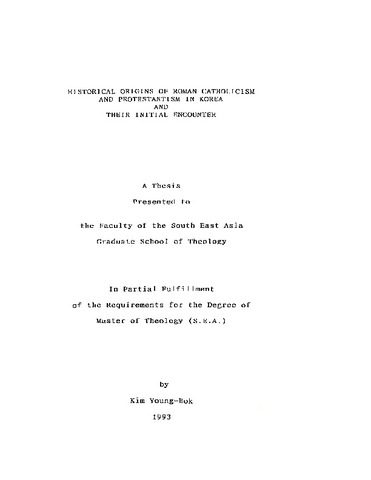
Historical origins of Roman Catholicism and Protestantism in Korea and their initial encounter
| dc.contributor.adviser | Sitoy, Valentino T. | |
| dc.contributor.author | Kim, Young-Bok | |
| dc.date.accessioned | 2025-07-31T08:28:02Z | |
| dc.date.available | 2025-07-31T08:28:02Z | |
| dc.date.issued | 1993 | |
| dc.identifier.citation | Kim, Y. B. (1993). Historical origins of Roman Catholicism and Protestantism in Korea and their initial encounter [Unpublished master's thesis]. South East Asia Graduate School of Theology. | en_US |
| dc.identifier.uri | https://hdl.handle.net/20.500.12852/3456 | |
| dc.description | Abstract only | en_US |
| dc.description.abstract | There was a Catholic mission under Franciscan friars in what is now Beijing from 1294 to the end of Yuan (Mongol) dynasty in 1368. But it is not known whether there were Koreans converted to Catholicism at that time. Following Pope Alexander VI's division of the world into two spheres of influence between Spain and Portugal, Portuguese expansion began in Asia. In no time, the Portuguese claimed missionary jurisdiction over the entire continental coastline from north western Africa to Japan. With the coming of the Portuguese to Asia, one of its results was the establishment, by the Jesuit Father Francis Xavier, of the Catholic mission in Japan by 1549. The various Spanish religious orders also established their own missions in the Philippines beginning 1565. Later, the Portuguese Jesuits in Japan, as well as the Spanish Dominicans in the Philippines, sought entry into Korea, but failed because Korea was closed to the outside world. It was not until the Japanese invasion of Korea in 1592- 1598 that the first Catholic missionaries set foot in Korea. The first Japanese expeditionary force was led by a converted Catholic, Gen. Konishi Yukinaga, and upon his arrival he sent a request to Japan for a for a priest to minister to his Catholic soldiers. The first Jesuits to land in Korea were Father Gregorio de Cespedes and a Japanese, Father Hanban Eion. However, due to the intrigues by Konishi's mortal enemy, the Buddhist commander Kato Kiyomasa, Cespedes and Eion could remain only a year, and in fact, they had to preach and baptize only in secret. During that Japanese invasion, thousands of Koreans were taken captive to Japan. Some re- turned, though most were sold to slavery. But the first permanent foothold by Catholicism in Korea was made through China. The Jesuits, after the Nestorians and the Franciscans, introduced Christianity for the third time into China. The success of this endeavor was due to the missiological method of "inculturation" by the Italian Jesuit Father Matteo Ricci. When the Manchus overran both Korea and China in the first half of the 17th century, they took the Korean Crown Prince So-hyon and his brother as hostages in the new Manchu capital in Peking. There the two princes met a Jesuit priest who at that time was the Director of the Imperial Board of Mathematics and Astronomy in Peking. The Crown Prince was so impressed with the Jesuit, that when he and his brother were at last allowed to go back to Korea, he asked for a European priest to teach Christianity to his kingdom. Unfortunately, he died suddenly, and the Chinese Christians who came with him had to return to Peking, and all the religious books and other articles things brought in their entourage were burnt, as these were believed to have caused his sudden death. By this time, Korean had become a nominal vassal of China. The Korean kings were obligated to send annual tributary embassies to Peking at the end of each Chinese year. The envoys, who were mostly leading Korean Confucian scholars, came in contact with the Jesuits, Western science and Christianity. Some of them were deeply impressed by Christianity, and they were inspired to write books on different themes and subjects related to it. The famous Sirhak scholars arose after a study of "Western Studies" which were introduced to China by the Jesuits, and the Han School of Learning. The Sirhak scholars demanded an end to empty formalism and the concern with ritual trivialities, and sought a return to the true spirit of Confucianism. Their studies encompassed not just proposals for reforms of state institutions but also agriculture, history, astronomy and medicine. The Sirhak and Sohak were new intellectual trends which aimed at pursuing a new system of values, norms and mores in the late Yi Dynasty. By the later part of the 18th century, a group of scholars (Nam-in), belonging to the Southern faction who had plenty of time at their disposal, became engrossed in Sohak and began to take it as a religion. They began to put the Catholic observances they learned into practice, had morning and evening prayers and services, and observed days of fasting and meditations. Thus was Christianity practiced by some of the Nam-in scholars, as best they understood it. The very first round of persecution in Korea took place in 1785, when the police raided a house where the Catholic converts were holding a service. All books and articles were confiscated, and house-owner was arrested, exiled and tortured, but the rest, majority of whom belonged to the nobility, were sent home untouched. From then on, however, public attacks were hurled against Catholic practices and the converts, who were shunned by society and totally excluded from political positions and offices, especially as more scholars were found to be studying Western books. A further cause that triggered persecution was the ban against ancestral veneration imposed by the Catholic authorities in China. In fact, because of this, many Korean converts apostatized. It was also at this time that leadership in the Korean Catholic church transferred from the yangban to the middle class. To strengthened the faith of the Korean Christians, the Catholic Bishop of Peking sent to Korea a Chinese priest. But the government authorities heard of the latter's secret entry, though he managed to escape arrest for a span of six years. Meanwhile, by the second half of the 18th century, the rivalry between the Si Party and the Pyok Party intensified, the Si Party being composed mostly of Christian yangbans. With rise of the Pyok Party into power, Christianity was banned as an "evil learning." Once again, the Christians of Korea appealed to the Bishop in Peking for help. Unfortunately, the so-called "Silk Letter," which compromised the converts, was confiscated by the authorities. The resulting second round of persecution in 1801, which was political motivated and was directed against the Si Party, concentrated mostly on the arrest and execution of church leaders. The Chinese priest decided to give himself up, hoping it would minimize if not stop the executions. But his own martyrdom did not alter the situation. A total of 100 Korean Catholics were beheaded and 400 were exiled. If this persecution was politically instigated, the others which soon followed and which spread into the provinces were the result of disputes between the local authorities and the Christians, emanating from agriculture and domestic difficulties and controversies. The return to power in 1849 of the Kims of Andong, who belonged to the Si Party and were mostly Christians, gave relief to the Korean Church. By 1864 the number of converts had soared to 20,000. But during these times, the rulers were met by domestic tribulations and western challenges which threatened Korean traditional systems and institutions. Korea was also faced with a new set of pressures as western ships commenced appearing along its coasts. When a Russian vessel appeared in north-eastern Korea in 1866, the Catholics, who were the only ones knowledgeable of foreign affairs through the Western missionaries, suggested a Korean alliance with France and England against Russia. The government at first appeared amenable, but the danger passed with the departure of the Russian ship. The result instead was the government attention was once more focussed on the Catholics, resulting in another round of persecution lasting eight years. This was the longest and most severe persecution in Korea, with about 8,000 church members being executed or exile. In 1876 Japan forced Korea to open to trade. This led beginning 1882 to a number of Korean treaties with other Western powers. Of the various countries, it was France, which asked not only for commercial concessions but also freedom of religion. After the signing of the Korean-French treaty, the Catholic mission in Korea not only recovered but also greatly advanced, especially with the training of more Korean candidates for the priesthood. While Japan was opening Korea to foreign trade, the first Protestant attempts to evangelize Koreans were made from across the border in Manchuria. This came through missionaries of the United Presbyterian Church of Scotland, especially Rev. John Ross, who were laboring in Manchuria, and also acted as agents of the National Bible Society of Scotland. Thus the first not so commonplace attempt by Protestantism to reach the Koreans was through literature. It was at this time that the first Korean translation of some Scripture portions were made, and also the baptism of the first Korean Protestants (Presbyterians). The signing of the U. S. Treaty of 1882 was the event which eventually turned the attention of American Protestant Churches to Korea. The first Protestant missionary to be sent to Korea was the Presbyterian medical missionary, Dr. Horace Allen. Other American missionaries stationed in Japan or China were soon commissioned to go to Korea, and were not long afterwards joined by others from Europe, Australia and Canada. Because they at first were not free to do evangelistic work, the Protestant missionaries started with medical and educational work, and in so doing introduced modern medicine and modern education into Korea. As Korea was then seeking to modernize itself, these contributions by the missionaries made them very welcome. This, plus their adoption of the Nevius Plan of mission, which worked very successfully in Korea, and the various Protestant missions agreement to cooperate in various ways among themselves, were some of the reasons for the rapid rise of Protestantism in Korea. From the beginning, Catholics and Protestants in Korea saw themselves not as allies but as rivals. Although the Catholics preceded the Protestants in Korea by 100 years, the progress of the former was soon overtaken by the latter. After some minor incidents of conflicts or exclusion by one of the other, the incidents between Catholics and Protestants gradually increased in seriousness. For example, there was the case of a newspaper publisher, a Korean Protestant, whom the Catholics detained illegally in the Catholic cathedral in Seoul, because his paper published articles considered derogatory by the Catholics. The more serious conflicts took place in Hwang-hai province in 1903, and eventually involved not only the Protestant and Catholic missionaries but also the Korean government. During the Korean struggle for independence during Japanese rule, the Catholics and the Protestants, particularly the Presbyterian majority, found themselves in opposing camps, with respect to their relations to the Japanese government in Korea. Roman Catholics and Protestants share the same task of winning Korea to Christianity. But these differences, which were aggravated by historical events, widened the gap between them. In trying to outdo each other in their endeavors to draw followers, they resorted to everything except the most effective one -- which is, sitting down and starting a dialogue. This study hopes to contribute to opening the way for better and closer relations between Catholics and Protestants in Korea in the future. | en_US |
| dc.format.extent | 177 leaves | en_US |
| dc.language.iso | en | en_US |
| dc.publisher | South East Asia Graduate School of Theology | en_US |
| dc.subject.lcc | BT 212 .K56 1993 | en_US |
| dc.subject.lcsh | Protestantism--Influence | en_US |
| dc.subject.lcsh | Roman Catholic, active 1826 | en_US |
| dc.subject.lcsh | Missionaries | en_US |
| dc.subject.lcsh | Protestant churches--Doctrines | en_US |
| dc.subject.lcsh | Old Catholic Church--Doctrines | en_US |
| dc.subject.lcsh | Dialogue--Religious aspects | en_US |
| dc.subject.lcsh | Christianity--Origin | en_US |
| dc.subject.lcsh | Koreans--Religious life | en_US |
| dc.subject.lcsh | Koreans--Religion | en_US |
| dc.title | Historical origins of Roman Catholicism and Protestantism in Korea and their initial encounter | en_US |
| dc.type | Thesis | en_US |
| dcterms.accessRights | Limited public access | en_US |
| dc.description.bibliographicalreferences | Includes bibliographical references | en_US |
| dc.contributor.department | South East Asia Graduate School of Theology | en_US |
| dc.description.degree | Master of Theology | en_US |
Mga file sa item na ito
Lumilitaw ang item na ito sa mga sumusunod na (mga) Koleksyon
-
Master of Theology [67]