
Ipakita ang simpleng tala ng item
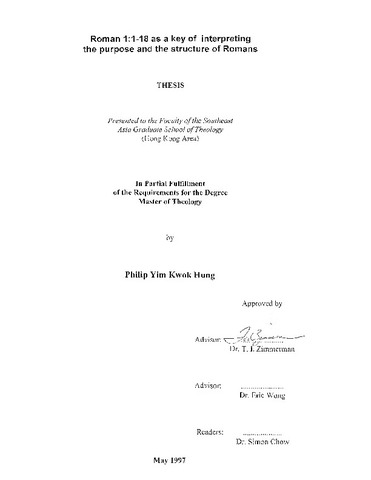
Roman 1:1-18 as a key of interpreting the purpose and the structure of Romans
| dc.contributor.adviser | Wong, Eric | |
| dc.contributor.author | Hung, Philip Yim Kwok | |
| dc.date.accessioned | 2025-04-15T09:19:56Z | |
| dc.date.available | 2025-04-15T09:19:56Z | |
| dc.date.issued | 1997-05 | |
| dc.identifier.citation | Hung, P. Y. K. (1997). Roman 1:1-18 as a key of interpreting the purpose and the structure of Romans [ Unpublished master's thesis]. South East Asia Graduate School of Theology. | en_US |
| dc.identifier.uri | https://hdl.handle.net/20.500.12852/3277 | |
| dc.description | Introduction only | en_US |
| dc.description.abstract | The Christians in the Earliest Christian Churches have developed some peculiar forms and vocabularies in communicating among themselves. These special uses of the Greek language are a kind of sociolect. According to the Microsoft’s electronic Encyclopedia, Encarta 97, "Sociolects are dialects determined by social factors rather than by geography. Sociolects often develop due to social divisions within a society, such as those of socioeconomic class and religion." Due to the progressive opposition from the Jews and the Roman government, the Christians have finally developed a system of code language, similar to argot and jargon. According to Encarta 97, “Argot refers to a nonstandard vocabulary used by secret groups, particularly criminal organizations, usually intended to render communications incomprehensible to outsiders. A jargon comprises the specialized vocabulary of a particular trade or profession, especially when it is incomprehensible to outsiders, as with legal jargon. As Stowers rightly points out the onset of the Christianity among the Roman Empire is demanding a self-understanding among others. “Through their Judaism, the earliest Christians bequeathed the self-identity of resident aliens to later Christians. Jews of the Diaspora were alien nationals living permanently in the cities and towns of the Roman Empire. Christians thought of themselves as the third race, neither Greek nor Jewish. This meant that they were to form their own self-governing communities. They would mark their own celebrations and write their own literature. In the first three centuries C. E., this drive toward self-definition produced remarkably for their movement toward political and theological consolidation and uniformity. With any generalization about early Christian letter writing, an exception lurks just around their corner." The self-definition of the Christian movement has developed a sociolect for itself, revealing itself in the use of peculiar epistolary forms and style with peculiar vocabularies. In the first part of this thesis we will strive to find the peculiar epistolary forms in Romans 1:1-18. The style with peculiar vocabularies in light of Sociolinguistics is a complex work which is beyond the scope of this thesis. Besides, the material cannot by reach by the writer. | en_US |
| dc.format.extent | 79 leaves | en_US |
| dc.language.iso | en | en_US |
| dc.subject.lcc | BT 212 .H86 1997 | |
| dc.subject.lcsh | Bible. Romans | en_US |
| dc.subject.lcsh | Jewish Christians--Early church | en_US |
| dc.subject.lcsh | Slang | en_US |
| dc.subject.lcsh | Language and languages--Religious aspects | en_US |
| dc.subject.lcsh | Christian Government Movement | en_US |
| dc.title | Roman 1:1-18 as a key of interpreting the purpose and the structure of Romans | en_US |
| dc.type | Thesis | en_US |
| dcterms.accessRights | Limited public access | en_US |
| dc.description.bibliographicalreferences | Includes bibliographical references | en_US |
| dc.contributor.department | South East Asia Graduate School of Theology | en_US |
| dc.description.degree | Master of Theology | en_US |
| local.subject | Roman 1:1-18 | en_US |