
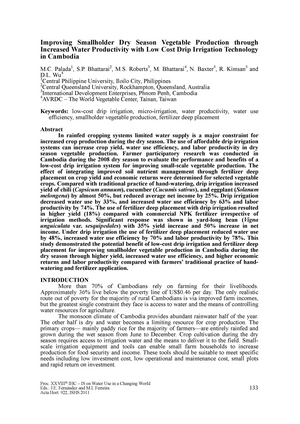
Improving smallholder dry season vegetable production through increased water productivity with low cost drip irrigation technology in Cambodia
Abstract
In rainfed cropping systems limited water supply is a major constraint for increased crop production during the dry season. The use of affordable drip irrigation systems can increase crop yield, water use efficiency, and labor productivity in dry season vegetable production. Farmer participatory research was conducted in Cambodia during the 2008 dry season to evaluate the performance and benefits of a low-cost drip irrigation system for improving small-scale vegetable production. The effect of integrating improved soil nutrient management through fertilizer deep placement on crop yield and economic returns were determined for selected vegetable crops. Compared with traditional practice of hand-watering, drip irrigation increased yield of chili (Capsicum annuum), cucumber (Cucumis sativus), and eggplant (Solanum melongena) by almost 50%, but reduced average net income by 25%. Drip irrigation decreased water use by 33%, and increased water use efficiency by 63% and labor productivity by 74%. The use of fertilizer deep placement with drip irrigation resulted in higher yield (18%) compared with commercial NPK fertilizer irrespective of irrigation methods. Significant response was shown in yard-long bean (Vigna unguiculata var. sesquipedales) with 35% yield increase and 50% increase in net income. Under drip irrigation the use of fertilizer deep placement reduced water use by 48%, increased water use efficiency by 70% and labor productivity by 78%. This study demonstrated the potential benefit of low-cost drip irrigation and fertilizer deep placement for improving smallholder vegetable production in Cambodia during the dry season through higher yield, increased water use efficiency, and higher economic returns and labor productivity compared with farmers’ traditional practice of hand-watering and fertilizer application.
Description
Conference paper
Suggested Citation
Palada, M. C. , Bhattarai, S. P. , Roberts, M. S. , Bhattarai, M. , Baxter, N. , Kimsan, R. and Wu, D. L. (2012). Improving smallholder dry season vegetable production through increased water productivity with low cost drip irrigation technology in Cambodia. In Fernández, J. E. & Ferreira, M. I. (Eds.), XXVIII International Horticultural Congress on Science and Horticulture for People (IHC2010): International Symposium on CLIMWATER 2010: Horticultural Use of Water in a Changing Climate (pp. 133-140). International Society for Horticultural Science. https://doi.org/10.17660/ActaHortic.2011.922.16
Type
Conference paperISSN
0567-7572; 2406-6168ISBN
978-90-66055-34-6Subject(s)

Keywords
Series
ISHS Acta Horticulturae;922Collections
- Conference papers [17]
Related items
Showing items related by title, author, creator and subject.
-
A case study on the product distribution and market performance of Guimaras Bottlers Inc. as indicated by its patronage in New Poblacion, Buenavista, Guimaras
(2005)This study was conducted among the 247 consumers of New Poblacion, Buenavista, Guimaras which were randomly selected to answer a researcher-made questionnaire-checklist. Data on marketing strategies were gathered from the ... -
Design, fabrication and performance evaluation of two recirculating aquaculture systems for the production of tilapia
(2019)This system was fabricated and conducted at the Tilapia Hatchery of the Southeast Asian Fisheries Development Center (SEAFDEC) in Tigbauan, Iloilo from December 16, 2018 to February 7, 2019. This system was evaluated using ... -
Production practices of sugarcane planters in Passi City, Iloilo
(2020)This study was conducted in Passi City in order to determine the farming practices of the sugarcane farmers, the negative effects to the environment, and their problems and recommendations. Data were gathered from 130 ...