

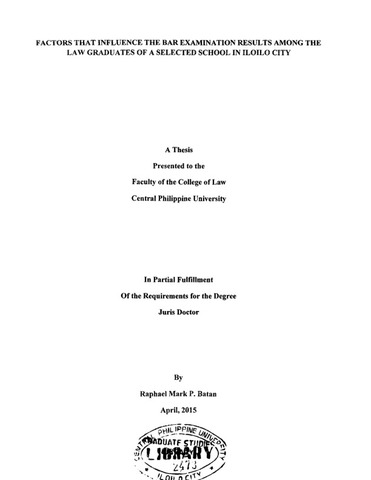
Factors that influence the Bar examination results among the law graduates of a selected school in Iloilo City
Abstract
Background and Rationale
The long wait for the result of last year’s bar examination was finally over when the Philippine bar examinations results of October 2014 Bar Examinations was released on Thursday, March 26th 2015 by Supreme Court (SC). Supreme Court said that 1,126 out of 5,984 (18.82 %) examinees passed 2014 bar exams, passing percentage being lowered from 75% to 73%.
The 2014 examination was conducted on the four Sundays of October (5, 12, 19 and 26) at the University of Sto. Tomas in Manila. The Philippine Bar Examination consists of eight law subjects and it covers 20% multiple choice questions and 80% essay type questions, same with previous year examination structure.
Of the 6,370 law students who applied for the last year’s bar exams only 6,344 made it to the final cut. More than 300 backed out during the four Sundays of the exams conducted at the University at Santo Tomas in Manila in October.
A student at San Beda College of Law, Irene Mae Alcobilla, score a grade of 85.5 and topped among the 1,126 graduates who passed the 2014 bar examinations.
For years, law professionals, and related-people had their own prediction of which students’ status was more positively associated with passing results in taking the bar exam. Law professors, specifically from CPU, expressed their prediction about which students’ status is associated with success in the Bar exam. While Law professors are more informed and experienced to make predictions on which students would pass the Bar, their statements are still merely opinions and are not empirically proven.
Legal profession is a privilege not easily attained. According to Ruben E. Agpalo, “The Law is not trade nor a craft but a profession. Its basic ideal is to render public service, secure justice for those who seek its aid. If it has to remain an honorable profession and attain its basic ideal, those enrolled in its rank should not only master its tenets and principles but should also, by their lives, accord continuing fidelity to them. This obligation is not an easy task, and its performance is made difficult by the ever growing pressure of commercialism in all fields of human endeavor as well as by the fact that those tenets and principles had steadily grown through the years from numerous and scattered sources.”
With the amount of money, time and effort expended by bar examinees, it is an ideal expectation that bar results would be higher and more lawyers will be produced so as to answer the crying need of society. However, past and current data show that bar exam results are far way down from ideal expectations. According to Wikipedia, after the end of the Second World War, the passing rate in the succeeding years was remarkably high, ranging from 56 to 72% percent. However, after Associate Justice J.B.L. Reyes, a noted scholar, was appointed Chairman of the 1955 Bar Examinations, the passing rate for that year dropped dramatically to 26.8%, with a mortality rate of 73.2%. That ratio has been invariably maintained in the 50+ years since.
The gaps or discrepancies between the ideal turn out of more passing the bar examinations and the barely 20% of the total number of examinees becoming lawyers justifies the conduct of this study.
This study is aimed at finding out the Factors that influence the bar examination results among the Law Graduates in a selected school in Iloilo City. This study is also designed to know whether or not a significant relationship exists between students’ working status, gender, and civil status and the bar examination results.
Statement of the Problem
The purpose of this study was to find out the Factors that influence the bar examination results Among the Law Graduates in a selected school in Iloilo City. In this study, variables such as students’ status, gender, and civil status are properly considered and described. This study is also designed to know whether or not a significant relationship exists between the stated variables and the bar examination results.
Specifically, this study sought answers to the following research questions:
1. What are the characteristics of the bar examinees in terms of a.) Gender b.) Civil Status and c.) Working Status?
2. What is the bar performance of the examinees when taken as a whole?
3. Is there a significant relationship between bar examination results when students are classified according to a.) Gender b.) Civil Status and c.) Working Status?
Description
Introduction and statement of the problem
Suggested Citation
Batan, R. M. P. (2015). Factors that influence the Bar examination results among the law graduates of a selected school in Iloilo City (Unpublished Postgraduate thesis). Central Philippine University, Jaro, Iloilo City.
Type
ThesisSubject(s)

Keywords

Department
College of LawDegree
Juris DoctorShelf Location
GSL Theses 340.72 B311
Physical Description
vi, 45 leaves
Collections
- Juris Doctor [144]