

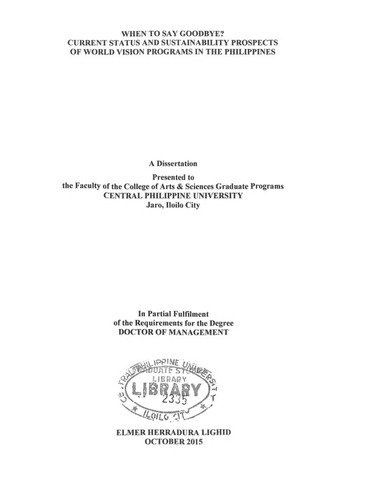
When to say goodbye? Current status and sustainability prospects of World Vision programs in the Philippines
Abstract
Program phase-out is one of the major concerns of NGOs. Using a case study approach, six programs of World Vision (WV) in the Philippines were examined to determine the conditions that should be put in place for NGOs to decide when to disengage from the communities. This research analyzed data from the completed household surveys of the six programs and complemented them with FGDs, KII and document review. A total of 3,846 respondents provided inputs in the research.
Below are the highlights of the research findings:
1. Program Effectiveness. Overall, WV was able to provide 96 percent of the necessary financial, human and in-kind inputs it has committed to its programs. Although about 80 percent of children and adults were involved in program management, below 15 percent cited high level of participation. Finally, none of the programs were able to achieve all their output indicator and outcome indicator targets for all projects.
2. Program Sustainability. None of the programs was able to breach all threshold levels of all outcome indicators for all projects. Some programs, however, were able to reach the threshold levels of all indicators of a particular sector indicating that some programs were stronger in some sectors while weak in others. Similarly, in terms of community capacity, none of the programs were able to achieve all indicators for all assessment dimensions used.
3. Community Capacity. Based on the findings of this research, none of the programs had the capacity to sustain the positive changes at the time of phase out. Communities could have been prepared more adequately for the phase-out especially in the areas of financial security and organizational viability.
WV should not have bid goodbye to the programs in 2013. WVDF could have gradually reduced its program inputs while intentionally transferring responsibilities to partners.
Three key lessons were learned from the programs. First, community's mindset about phase-out needs to be changed from being perceived as a threat to an opportunity for celebration of development journey and achievements. Second, achieving sustainability does not happen organically nor overnight; it needs to be intentionally integrated in program plan and persistently pursued. Finally, capacity development must be linked to transfer of responsibilities from WV to local partners and community members.
The following are the recommendations of the study: First, it is recommended that the decision to transition be not based only on the age of the program, but on progress towards the sustainability indicators. As such, phase-out may happen gradually and by projects rather than the entire program allowing for adequate focus on areas that need more attention. Second, WV needs to develop a clear guidance on sustainability and phase out. Third, communities need to factor in resilience in sustainability planning to ensure that development investments in communities are protected. Finally, WV needs to strengthen its capacity on economic development especially in financial security aspect.
In the final analysis, despite the programs’ inability to demonstrate full sustainability, the author believes that WV’s theory of change remains viable. The programs were able to contribute to the achievement of communities’ overarching aspirations. However, there are operational programming aspects that need to be revisited to ensure that processes are meaningful and communities are adequately prepared prior to WV’s disengagement.
Paglalarawan
Abstract only
Mungkahing Sipi
Lighid, E. H. (2015). When to say goodbye? Current status and sustainability prospects of World Vision programs in the Philippines (Unpublished Doctoral dissertation). Central Philippine University, Jaro, Iloilo City.
Uri
DissertationMga Paksa

Kagawaran
School of Graduate StudiesDegree
Doctor of ManagementLokasyon ng Istante
GSL Theses 658.0072 L626
Pisikal na paglalarawan
xvi, 204 leaves
Collections
- Doctor of Management [20]