

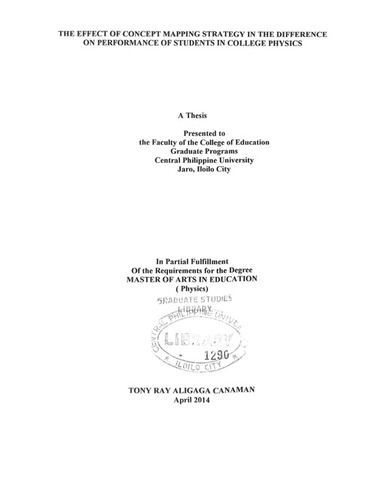
The effect of concept mapping strategy in the difference on performance of students in College Physics
Résumé
This study investigated the effect of concept mapping strategy on the performance of Nursing students in physics specifically on transfer test on kinematics, forces, dynamics and friction. An experimental pretest-postest control group design was used in this study. Two intact classes in physics served as research subjects and were randomly assigned as experimental and control groups. The sample consisted of twenty-three matched pairs selected from both groups based on sex and the students’ final grades in College Algebra and English 1.
A 50-item teacher-constructed test covering topics on kinematics, forces, dynamics and friction was utilized to measure performance. It was administered as pretest and posttest to determine the effectiveness of the concept mapping strategy on the students’ performance in physics.
The experiment covered a period of eight weeks. The same lessons on motion were discussed in both the experimental and control groups. The experimental group was introduced to the concept mapping strategy and taught the techniques of constructing concept map. Students were taught how to use their map as guide in determining the conditions required for various types of motion and identified the appropriate or corresponding mathematical formula for each type. The ultimate goal was to promote better retention for better scores in the transfer test (posttest). Students in the control group used the “hybrid” traditional method that included exposition, analogy, peer tutoring and discussion. Metacognitive strategies were utilized for both groups in the development of knowledge of kinematics, dynamics, forces, and friction.
Both the experimental and control were administered the pretest before the experimental phase and the posttest after the completion of the intervention.
The t-test for paired samples and t -test for dependent samples were used to test for difference in the pretest and posttest scores. Interpretation of the results of the study was based on the 5% level of significance.
The findings of this study revealed that the students in the experimental and control groups had similar cognitive understanding of the concepts of kinematics, dynamics, forces and friction before the intervention. After the intervention, the students in the experimental group significantly scored better compared to those in the control group. Concept mapping enabled students to engage in higher order thinking skills such as comprehension, analysis, and application. There is evidence that concept mapping provided students an opportunity to engage in cognitive processes such as attending to relevant information about motion, mentally organizing information to coherent structure, and integrating to prior knowledge about motion. The concurrent presentation in textual and visual display of students’ understanding of motion allowed them to correct their misconceptions and strengthened their understanding of the concept of motion. This resulted to better retention and better performance of students in the transfer test. Concept mapping, therefore, is a better teaching strategy and an effective learning tool than the “hybrid” traditional method in teaching and learning physics specifically on kinematics, dynamics, forces, and friction.
Description
Abstract only
Suggested Citation
Canaman, T. R. A. (2014). The effect of concept mapping strategy in the difference on performance of students in College Physics
(Unpublished Master's thesis). Central Philippine University, Jaro, Iloilo City.
Type
ThesisSujet

Keywords
Department
School of Graduate StudiesDegree
Master of Arts in Education (Major in Physics)Shelf Location
GSL Theses 378.242 C16
Physical Description
x, 158 leaves