

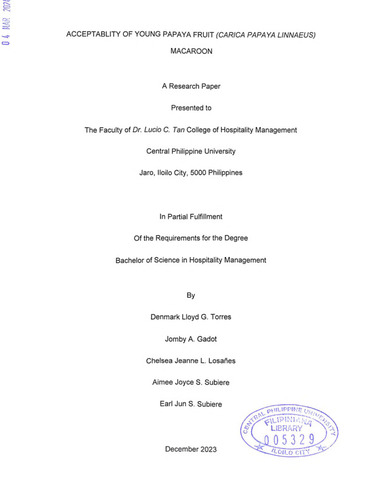
Acceptability of young papaya fruit (Carica papaya Linnaeus) macaroon

Résumé
The purpose of this study was to determine the acceptability of young papaya fruit (Carica Papaya Linnaeus) as macaroons. Specifically, it determined the personal profile of the respondents as classified according to age and sex; the level of acceptability of young papaya fruit (Carica Papaya Linnaeus) as macaroons in terms of appearance, aroma, flavor, texture and overall acceptability; and the significant difference in the level of acceptability of young papaya fruit (Carica Papaya Linnaeus) as macaroons in terms of appearance, aroma, flavor, texture and overall acceptability when the respondents were grouped according to age and sex. Based on the results, most of the respondents were female, young aging 18-32 years old and were students. The papaya macaroon was extremely acceptable in terms of appearance, aroma, flavor, texture and overall acceptability. As to aroma, it has a fruity and sweet smell. In terms of appearance, it holds its shape although it has no golden brown edges. With regards to flavor, it is appetizing but has a tangy taste. With respect to texture, it is hard outside but chewy inside. Moreover, there is no significant difference in the level of acceptability of papaya macaroons, in terms of appearance, aroma, flavor, texture and overall acceptability when the respondents were grouped according to age and sex. Thus, the null hypothesis was accepted.
Description
Abstract only
Suggested Citation
Torres, D. L. G., Gadot, J. A., Losañes, C. J. L., Subiere, A. J. S., & Subiere, E. J. S. (2023). Acceptability of young papaya fruit (Carica papaya Linnaeus) macaroon [Unpublished bachelor's special paper]. Central Philippine University.
Type
Special paperSujet

Keywords
Department
College of Hospitality ManagementDegree
Bachelor of Science in Hospitality ManagementShelf Location
TX 911 .T67 2023
Physical Description
xi, 109 leaves