
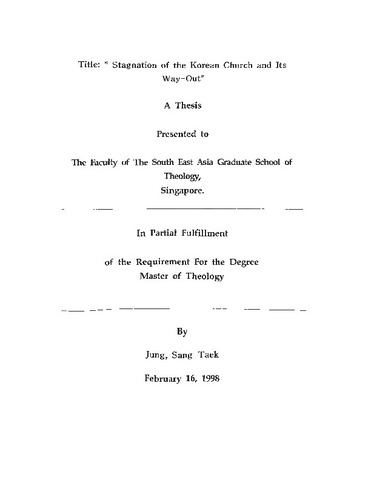
Stagnation of the Korean church and its way-out
Résumé
For the past few decades, the Korean church has been recognized world-widely for its rapid growth. Some were amazed at its quantitative explosion while others were anxious about its lack of internal quality. These two positions are reasonable, yet its critical perspective should be fully considered. A church quantitatively grown is not always kept in such a growth. There are numerous examples of rapid growth and rapid disappearance in church history. For instance, North Africa, once having become a center of Christianity, declined by way of the Moslem invasion and now remains occupied by Islamic countries.
The same is true of the Nestorian sect in China. The Nestorian missionary Alopen entered Tang in 635 with the royal approval. Later in struggle with Buddhism, the Nestorian sect disappeared from Chinese history after it continued two hundred years of life. It was not until 1623 that the Nestorian inscription was discovered and detected the trace of the sect in Chinese history. The Nestorian sect and Christianity in North Africa declined simply because it failed to set its root deeply in the midst of people’s life. This serves as a precious lesson for the Korean church. The Protestant Church in Korea has about 110 years of history and it has not been deeply rooted until now. Its outward growth should not be reckoned with as a ground for self-pride since its historical root is still inferior to other traditional religions. Rather, Christianity in Korea should be conscious of the critical time in which all churches are to be mature in internal quality, while reflecting all trials and errors in the past.
This thesis aims to deal with all negative elements generated from the growth of the Korean church while analyzing them from the sociological point of view and offering some alternatives. For this purpose, I will state the purpose, method, and scope of the study in chapter I. In chapter II, I will sort through the process of church growth in Korea, from the initial stage of mission in Korea to the 1990s. Here, I will analyze the main factors of the growth in the Korean church. Then, in the next chapter, I will deal with the reasons for the recent stagnation of the Korean church from the sociological perspectives, reckoning with the elements such as its internal structure, tradition, internal split, leadership, spirituality, culture, and social change. In the fourth chapter, I will offer some prescriptions in response to the need of improvement. Finally, I will envision how the Korean church should respond in the forthcoming 21st century.
Description
Abstract only
Suggested Citation
Jung, S. T. (1998). Stagnation of the Korean church and its way-out [Unpublished master's thesis]. South East Asia Graduate School of Theology.
Type
ThesisSujet

Keywords
Department
South East Asia Graduate School of TheologyDegree
Master of TheologyShelf Location
BT 212 .J86 1998
Physical Description
65 leaves
Collections
- Master of Theology [51]
Related items
Showing items related by title, author, creator and subject.
-
A historical theological survey of neo-Pentecostalism in the light of the Lutheran understanding of the work of the holy spirit with reference to the charismatic impact in the Evangelical Lutheran Church in Malaysia
(South East Asia Graduate School of Theology, 2001-10)The objective of this dissertation is to make a historical and theological analysis of neo-Pentecostalism, in the light of the Lutheran understanding of the work of the Holy Spirit, with reference to the charismatic impact ... -
The role of the Church on the present Philippine society
(Institute of Advanced Theological Studies (IATS) and College of Theology, 2005)On January 19, 2000, College of Theology Students and Faculty/Staff members participated in the Central Philippine University Indignation Rally; and in the afternoon, they marched from Central Philippine University to ... -
A model text for education & caring new family members of growing church
(2000-02)The thesis is aimed at looking into development of teaching materials for the new believer’s care and education. Every pastor’s саn't help thinking of church growth. Generally we say that the missions of church are two ...