

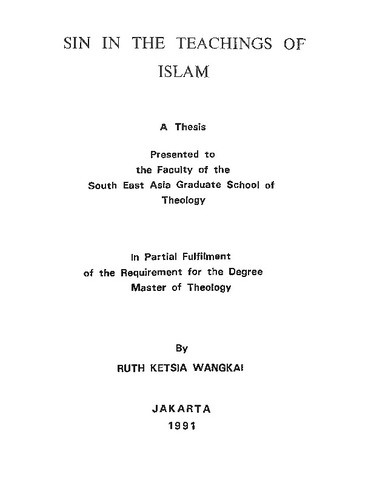
Sin in the teachings of Islam
摘要
Islam believes that sin is not from within but from outside of the human being. This conclusion is clear from the following studies.
The Qur'an, as stated in the first chapter of this thesis, teaches that human being was created more lofty than other creatures. Everyone has a fithra (nature) which enables him or her to recognize God and his uniqueness; accordingly the human being is able to fulfil god's will. To everyone, therefore, God has given responsibilities to act as khalifah (God's agent) in this world. On the other side, the Qur'an teaches about the rebellion of the human being against God. Yet, the idea in the teaching is that the rebellion happened not because of the person, but because of the temptation from satan as well as of circumstances which led persons to commit sins.
The second chapter of this Thesis contains some investigations to several important terms which are used in the Qur'an namely: dhand, ithm, khati'a, jirm, jinah, zulm. These terms were used so often by Mohammed to refer to the sins of the people of Mecca and Medina which consisted of the people of the jahiliyah, Jews, Christians and Moslems. Learning from the way of Mohammed as he used the above mentioned terms, it could be said that all these terms indicate human wickedness which break God's norm and law. So, according to the Qur'an, sin is any bad act of a human being which is not centered in human mind or human inner self.
The Qur’an distinguished the understanding of sin in two categories: 'heavy sin' and 'light sin’. Yet, the Qur' an, does not explain the differences and characteristics of 'heavy sin' and 'light sin' except that syirk is a kind of 'heavy' and unforgivable sin.
The third chapter contains some observations on the understanding of sin according to the mutakallimun (Islamic theologians). The history of theology in Islam especially after Mohammed, shows the development and differences of understanding about 'heavy sin'. It became clear by the emergence of theological streams such as Khawarij, Murji'ah, Mu'tazila, Asy'ariah and Maturidiah. The last two streams are now practiced by Ahl as-Sunnah wa-I-jama'ah.
To the Khawarij, 'heavy sin' belongs to the kufr category. It means that those who commit 'heavy sin' are kafir. They are not regarded as Moslems anymore and accordingly, they are considered to be apostate (formerly Moslem', then kafir or murtadd). In difference from the Khawarij, the Murjia'ah states that those who commit 'heavy sin' are total mu'min who not loose their faith. The Murji'ah, therefore, underlined and developed the understanding of faith more than the understanding of 'heavy sin'.
According to the mu'tazila, those who commit 'heavy sin' is not kafir, neither mu'min. They are fasiq. They took the position between the two, al-manzila bain al-manzilatain. Probably a fasiq still has faith, but, on the contrary, she or he is not a 'mu'min, anymore for her or his 'heavy sin'. Neither is a fasiq regarded as a kafir since she or he still confesses the syahadah and is doing good deeds.
The Mu'tazila is well known in Islamic theology as a rationalistic movement which emerged under the influences of Greek philosophy and the idea of Qadariah for which the main emphasis is on free will and the responsibility of humankind for her of his deeds. This idea emerged as a reaction to the Jabariah which emphasizes the absolute authority of God, while the human being is merely an actor or actress of God's will. These ideas were accepted by the Asy'ariah, as a reaction to the Mu'tazila. The asy'ariali stream itself underlines that everyone who commits a 'heavy sin' still remains a mu'min for the faith she or he still has, but at the same time she or he is also regarded as fasiq for the 'heavy sin' she or he commits. This understanding is also adopted by the Maturidiah.
This thesis also contains a special chapter about a theological reflection. This subject needs to be discussed in this thesis in order to achiere a comparison and a clear picture of the understanding of sin in Islam and Christianity. For this purpose, special concentration will be given to Paul's understanding of sin since he contributes a lot to this issue in Christian theological development. But his thought about sin will be studied in relation to his teaching on salvation which is rooted in a Christology.
Paul's thoughts regarding sin and salvation are clearly proclaimed in his letters to the Galatians, Corinthians and Romans. They are based on his experience on the way to Damascus where he received a revelation from the Risen Lord, after which he repented. Previously, Paul was a persecutor of Christians. He was a strict Pharisee. His life changed afterwards, and he confessed that his passed activities were rebellion to God’s will.
Paul emphasized, therefore, that The Torah, although if teaches the will of God it could not help one to be delivered from sin. There is need of a Divine initiative and the initiative has been taken and realized in the "christ event' in which He came to save humankind and transform this world. Paul explains the "Christ event" as a grace within which human being is free from sin. To this event, according to Paul, humankind needs to give a positive response, that is, to have faith in Him, for by and through this event humankind receives salvation (shalom), spiritually and physically. Paul proclaims the meaning of salvation by using metaphorical terms such as: redemption, justification and reconciliation.
This thesis concludes with a chapter about the difference of understanding of sin Islam and Christianity.
描述
Abstract only
建议引文
Wangkai, R. K. (1991). Sin in the teachings of Islam [Unpublished master's thesis]. South East Asia Graduate School of Theology.
文件类型
Thesis主题

部
South East Asia Graduate School of Theology学位
Master of Theology货架位置
BT 212 .W36 1991
物理描述
viii, 110 leaves
集合
- Master of Theology [51]