

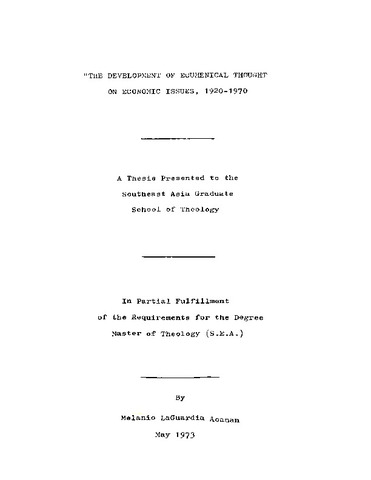
The development of ecumenical thought on economic issues, 1920-1970
요약
There is an increasing concern for economic issues among the churches within the Ecumenical Movement today. A great deal of serious thinking on the churches' task of promoting economic and social justice has been done in the last half century. The significance of economic issues in the total life and work of the Church has repeatedly been underscored by leaders of the Ecumenical Movement. Thus, pronouncements on the subject, which have been issued quite regularly during the last five decades, have become an important gauge in determining the faithfulness of the Church to the demands of her Lord.
The problem of this study is to examine the economic pronouncements of two ecclesiastical entities considered to constitute main parts of the Ecumenical Movement, namely, the World Council of Churches and the Roman Catholic Church.
It stressed the fact that economic issues have been recognized as legitimate areas of Church concern and have been given special attention by the churches within the Ecumenical Movement.
Three basic hypotheses are used in this study. Firstly, the churches within the Ecumenical Movement, except the Roman Catholic Church, put emphasis on their attitude of humble repentance as an acknowledgement of their failure to be faithful to the demands of Christ. Secondly, the foregoing affirmation have drawn together the churches into a theologically profound and socially perceptive Ecumenical Movement as they are increasingly involved in the task of social and economic development. Finally, while economic issues are constantly changing and while churches come from different backgrounds, there are remarkable points of convergence in their economic pronouncements.
After the introductory chapter, the background, the emergence, and the achievement of a stronger and more profound theological basis of ecumenical thought on economic issues are discussed in the second and third chapters. Starting in 1920, corporate efforts to achieve a consensus among Protestant, Anglican and Orthodox churches on economic issues have rapidly increased until the formation of the World Council of Churches in 1948 The leaders of the Ecumenical Movement, from the start, have repeatedly invited the Roman Catholic Church to participate in these endeavors only to receive a courteous but stern refusal. Thus, the Ecumenical Movement was, at first, limited to the Protestant, Anglican and Orthodox churches.
Chapters four and five discuss two key concepts in ecumenical social thought, "responsible society", and "development", respectively. The concept of "responsible society" became the key concept in ecumenical social thought for over a decade after the World Council of Churches was formed in 1948. Arising during a time when the Western industrial society was on the decline, the concept as defined stressed a balance between individual freedom and social justice, a goal for which the churches must work in order to seek new and creative solutions for the problems in society.
The increasing participation of the Younger Churches in the Ecumenical Movement led to a broadened understanding of "responsible society" which is relevant not only to Western society but to areas undergoing rapid social changes. In 1955, a four-year study program was launched on rapid social change, and was followed up by a more ambitious and action-oriented study program which culminated in the Geneva 1966 World Conference on Church and Society.
These studies signalled the beginning of a well-developed and theologically sound ecumenical thought on economic issues focusing on the concept of "development." The understanding- of this concept recognizes the following: a) the need for rapid and efficient economic development program in the less developed countries; b) the central role of the state in the task of economic development; c) the fact that the goal of economic development is not only production of goods but also the enrichment of the dignity of human life.
As result of these studies, the concept and task of "development" has become officially the heart of the World Council's social policy as demanded by the Uppsala Assembly in 1968.
On the side of the Roman Catholic Church, general statements on economic issues have been developed since the great encyclical Rerum Novarum of Pope Leo XIII. However, Catholic scholars themselves admit that Catholic social thought before Vatican II was too provincial, rigid, and reflecting a very limited experience. The ornament brought about by Vatican II not only broadened this limited perspective but even led to significant points of agreement with World Council social thought. Both ecclesiastical entities emphasize the central importance of the dignity of the human person, the need for a world-wide perspective in the task of development, and the important role of the state in the task of economic development particularly in the less developed countries. These points of convergence call for an increasing collaboration between the World Council of Churches and the Roman Catholic Church on study and action, and on the promotion of social justice, development and peace. This cooperative effort has become more or less permanently organized through the Commission on Society, Development and Peace or SODEPAX.
기술
Abstract only
추천 인용
Aoanan, M. L. (1973). The development of ecumenical thought on economic issues, 1920-1970 [Unpublished master's thesis]. South East Asia Graduate School of Theology.
유형
Thesis주제

학과
South East Asia Graduate School of Theology정도
Master of Theology선반 위치
BT 212 .A53 1973
물리적 설명
167 leaves
Collections
- Master of Theology [51]