
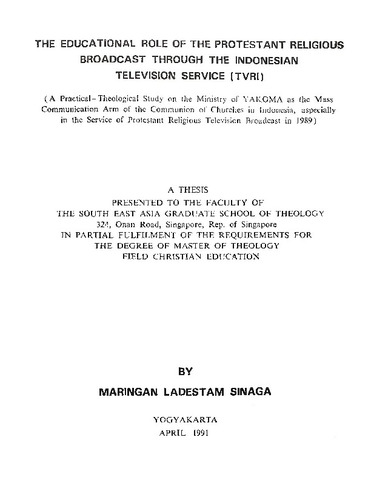
The educational role of the Protestant religious broadcast through the Indonesian television service (TVRI): A practical-theological study on the ministry of YAKOMA as the mass communication arm of the communion of churches in Indonesia especially in the service of Protestant religious television broadcast in 1989
Page views
135Date
1991Share
Metadata
Afficher la notice complèteRésumé
This thesis on Pendidikan Agama Kristen (PAK) (Christian Education) specifically makes a practical-theological study of the role of Mimbar Agama Kristen Protestan (MAKP), the Forum for Protestant Christianity via Siaran Televisi Republik Indonesia (the Television Broadcasting of the Republic of Indonesia), by Yayasan Komunikasi Masyarakat (YAKOMA) the Foundation of Social Communication) from Persekutuan Gereja-gereja di Indonesia (the Communion of Churches in Indonesia). The materials of MAKP studied include 22 programs which constitute the service materials broadcasted during the year of 1989. MAKP-TVRI becomes the focus of the Study, starting from the struggles of churches in Indonesia since 1976 in their effort to take part in the development of communication media in Indonesia. Gradually, the effort finally born fruit via the production of MAKP agenda through many radios, printed media and the Central and Regional TVRI's.
Before 1988 nearly most Regional TVRI's broadcast MAKP. At that time the Churches in the regions took part according to the cooperation between the Local TVRI and Bimas Kristen Protestant Depag Tingkat I (the Provincial Social Guidance Directorate of the Department of Religion for Protestant Christian) and PGIW (formerly DGIW). The Local MAK- TVRI demonstrated its regional quality and spirit. The materials and its pattern of presentation tended to be in accordance with the characteristic and identity of the region/church. Then the Government centralized the MAKP and the YAKOMA PGI was appointed to organize it. Under such a situation, the MAKP-TVRI underwent a big change, concerning its materials, its insight, its pattern, its communicators and its obedience to the roles and regulations of the Government. Seen from this change, the position of the MAKP as a Proclamation of Salvation by God, needs to be questioned again. How far the YAKOMA PGI presents the MAKP as a communication initiated by God (1 Timothy 2:5-6; Hebrews 1:1-2; 1 Peter 3:9)? How far Christians can show positive and dialogical responses? How far the MAKP introduces the Son of God concretely as the Way, the Truth, and the Life (John 14:6; 3:16; 1 John 4:9+14)?
The Proclamation of Salvation is communicated to the whole context of human beings. The YAKOMA PGI should utilize appropriately the system, the situation and the opportunity available. The completeness and potency of the Church, that is, members of the Church in various skills and mass-communication tasks, are demanded to become the major performers/executives. The Gospel Communicators should become the concretization of the functions of the Apostle, the Prophet, the Evangelist, the Pastor and the Teacher (Ephesians 4:11-16) who have already been inaugurated as God's fellow-workers (1 Corinthians 3:9). They are provided with power for communicating the Bible and the Syalom (2 Corinthians 5:18-20; Matthew 28:19-20) they, organizationally and officially, become a potential part of the Church. A Communicator absolutely needs two things, namely "competence/skill" and "the Spirit of God which generates power, love and discipline (2 Timothy 1:7) which work simultaneously, without being able to distinguish between the fruit of the Spirit and the fruit of the competence/skill.
To communicate the Salvation properly, one should adhere to the Christian principles in communication. Via the YAKOMA PGI, churches in Indonesia unite to advance, motivate and educate Christians (audience) to live in accordance with the Commandment of God and to be active in Christian communication. These tasks constitute the essence and identity of the Church, from its position as "the Summoned" to "the Summoner" and from its position as "the Delegate" it becomes "the Sender". That process is running in the middle of old or traditional cultures and in the middle of new cultures or cultures created by mass media of communication. Under such a situation the development of mass media in communication becomes an important part for the existence of the Church.
The MAKP should contextually testify in the middle of society which undergoes rapid change. For this task every Christian has the authority to become a Communicator who attempts to create a communication of "I-THOU" pattern, that is a responsive and dialogical relationship, requiring agreement, responsibility, togetherness, like-minded- ness, interest and empathy. The freedom enjoyed by churches in Indonesia, on the basis of Pancasila and UUD 1945 (the Constitution of 1945), makes them free to choose facilities and communication of the Gospel which are considered suitable and viable. In this case television becomes the right medium. Utilization of mass media enables the Church at once to create interest in media. The church may utilize the mass media and also has the chance of saving the victim of the mis-appropriation of the mass communication. The mis-appropriation includes the use of economic and political media for purposes, such as manipulation and distortions of facts, pornography advertising and domination in the field of communication by the power- full industries.
The MAKP program by the YAKOMA PGI, constitutes a concrete fact that churches in Indonesia have already performed their mission. Generally the materials and presentation patterns of the MAKP are relevant to the needs of society, particularly Protestants in Indonesia. The concrete evidence of this conclusion is indicated by the response of the audience via several direct letters which welcome the MAKP positively. And there are no responses which refuse or criticize the MAKP via other media. From this fact it is concluded that the materials, theme and presentation patterns of the MAKP are still regarded as in accord with the needs of the audience contextually.
However, it is still felt that the YAKOMA PGI do not yet fully make a full cooperation with the churches which are members of the PGI, as it should. The involvement of many members of the PGI through their "human resources" are not yet given the same opportunity. Theologians, Priests and members of Church Services who are categorized as “competent” and who are experts in the field of communication are not yet fully involved. In the case of spreading information on its programs, the YAKOMA PGI is still dependent upon the TVRI. Via other media besides the TVRI, at least via the PGI's magazine Berita Oikoumene, the planning and activities calendar of the YAKOMA PGI should be communicated in detail. Besides using such media, the YAKOMA PGI, however, should publish a kind of magazine that will be distributed to Protestant Communities and audiences. Via the above supporting facilities, input for the YAKOMA PGI may be obtained properly.
In the last chapter, the writer suggests that all church servants must understand themselves and should be prepared to become communicators, both in words and deeds in their lives. Since communication has become an integral part of the development of life of human beings, so the Church should try, as far as possible, to anticipate the development of mass media, so that the media communicate peace, justice and truth. To train the communicator to become skillful, the presence of Pusat Pelatihan Komunikasi (a Centre for Communication Training) is needed. Evaluation via listeners and watchers group should be established by the YAKOMA PGI to know how far the audience understands and accepts the MAKP. In accordance with this, it is the time that all churches which are members of the PGI have calendars and themes of activities collectively. In the cooperation between the YAKOMA PGI and various institutions and Church Communication Media (internal and external), such program called KELOMPENCAPIR MAKP (Listeners and Watchhers Group) should be created by the Churches. This program should become an educational venue for all members of the Church.
Finally, the Church should make preparations and effort in order to have a freedom of having television broadcasting. If this becomes true, the Church may use it in communicating the Gospel optimally. The Communication of the Gospel (evangelism) should be understood in its widely sense, which concerns the whole existence of the Church.
Description
Abstract only
Suggested Citation
Sinaga, M. L. (1991). The educational role of the Protestant religious broadcast through the Indonesian television service (TVRI): A practical-theological study on the ministry of YAKOMA as the mass communication arm of the communion of churches in Indonesia especially in the service of Protestant religious television broadcast in 1989 [Unpublished master's thesis]. South East Asia Graduate School of Theology.
Type
ThesisSujet

Department
South East Asia Graduate School of TheologyDegree
Master of Theology Field Christian EducationShelf Location
BT 212 .S56 1991
Physical Description
xiii, 251 leaves
Collections
Related items
Showing items related by title, author, creator and subject.
-
TV networks producing the most reliable news as perceived by adults from Brgy. La Furtuna, Barotac Viejo, Iloilo
(2017-04)This study aimed at the determining the most reliable news as perceived by adults from Brgy. La Furtuna, Barotac Viejo. The study was anchored on Uses and Gratification wherein the approach is central focus on active ... -
Significance of radio as a source of information and entertainment to education students of Central Philippine University
(2019-03)The study was conducted to determine the significance of radio as a source of information and entertainment among the 3rd year and 4th year education students of Central Philippine University. Among 100 prospective ... -
The Church's responsibility to equip parents as religious educators: A study about the role and effectivity of parents with younger children in family education
(South East Asia Graduate School of Theology, 1992-06)This study discusses the church's responsibility and church's effort to educate parents who have children under five years of age. The first step of the discussion is the theological background of parental education. ...