
An analysis of the Batak family structure according to Adat and its implication to Christian ethics
요약
This study is an analysis of the Batak family structure according to adat and its implication to Christian Ethics.
The Batak tribe has a unique kinship system called the Dalihan na tolu which is not found in the other tribes in the world. The Dalihan na tolu" (literally three corner-stones) shows the division of the family structure in three functional groups: the "Dongan sabutuha" (the same belly or the same clan), the "Hulahula" (father-in-law's clan), and the "Воrи" (son-in-law's clan). In addition to representing the Batak family structure, it also makes up the social organization in the Batak society. It cannot be separated from the Batak adat because it is the basis of the implementation of all adat ceremony.
Adat has a very important role in the life of the Batak tribe. It is related to the central occurrences in the life of the community from birth to death for it is a determinant part of the Batak culture embracing all spheres of life. Thus, adat and Dalihan na tolu largely determine each Batak member' s attitude, action, behavior, conduct, social relation, and obligation toward another person in his family and in his society. At this point, the study attempts to answer the question on how far the adat and Dalihan na tolu of the Bataks can support the concept of Christian Ethics and at the same time can help forward Christian Ethics to the Batak Christian.
With the selective method of investigation, this thesis is developed into five chapters: Chapter one is the introduction which includes the statement of the problem, scope and delimitation, and method of the study.
Chapter two presents an investigation of the Batak family structure which involves adat as the (law) and "patik" (ordinance) of Batak life. It is the law and the norm in the Batak society life which has been passed on from generation to generation. Adat has a specific characteristic; i.e, "mutual and cooperative, " that makes it imperative for all Bataks to follow and observe adat's rules. The Batak' s attitude toward adat is expressed in the phrase "to respect it will bring life and to ignore it will bring death". Thus, one who obeys gets a good life and one who ignores it will suffer disaster or misfortune.
Concepts of sex, marriage and family according to adat are highlighted in this study. The Batak adat regards sex as an ethical issue and punishes violators, those who enter into sexual relationships outside of marriage. On the other hand, marriage is a lifetime commitment based primarily on the ability to procreate because the main purpose of a marriage is procreation. In the family, the husband is the head and the wife is the husband's partner. Division of tasks and determination of roles in the family are hinged on differentiation of sexes. The family prefers a son to a daughter merely in relation to the family line not in relation to dignity.
The Batak family structure which is likened to the three stones of a traditional stove makes everybody aware of his/her status in relation to other members for his status determines one’s attitude, action and obligation toward familial or societal relations. The Batak family structure creates and builds mutual cooperation among the family members as is described by the three corner-stones (stove) which should cooperate in order to function well.
Chapter three juxtaposes the Christian views of sex, marriage and family with that of the Bataks by way of evaluating the Batak family structure and the issues arising from it. The theological and positive Christian concepts of sexuality, marriage and family are emphasized. This is because as creations of God, these three issues have religious aspects. In the Old Testament the mark of the covenant of God with His people is put in the sex organ as the token that the whole physical body has been dedicated to God. It should be emphasized that the sexual act is sanctioned only within the bounds of marriage. Marriage, on the other hand, is a covenant between a man and a woman which approximates the covenant God has with His people; and Christ with the Church. In the meantime, the family symbolizes the relationship between God as the Father and His people and also stands for the family of God (believers in Jesus Christ).
Chapter four of this thesis elucidates the ethical issues arising from the Batak family structure and gives an evaluation of these. Since the main aim of marriage is to beget offsprings, the Batak adat considers a childless marriage not blessed and willed by God; hence, it tolerates divorce, polygamy and adultery to remedy the situation. Another issue concerns spinsterhood/bachelorhood According to adat, man is created to m any thus, those who do not many are as having a lower status in society and are also considered as being "not a true man". Still another issue is on the role of the woman in the family. The adat concept of the role of the sexes is not based on dignity, worth, value but sex differentiation, and although it prefers a son to a daughter, this preference is only in relation to lineage and not in affection for both the son and the daughter are treated equally in the family. The two previous views do not correspond to the word of God because the biblical view does not solely emphasize procreation; it is just one of the purposes of marriage. In addition, the dignity and stature o f a person in the eyes of God is not determined by one’s status in life but by his/her relationship with God. The third view however corresponds with the biblical view regarding the role of a woman in the family.
Chapter five states the conclusions and evaluations arrived at in this study. The two most important conclusions are: that the Batak adat and family structure constitute the philosophical idea and norm of ethics for the Batak society. The other is that the Batak adat value system and the Dalihan na tolu foster love, respect, unity, fellowship and mutual understanding among members of the family and the society at large. With everything above given due consideration, this study proposes that the concepts of "Dalihan na tolu" or family structure as embodied in the Batak adat should be preserved and be implemented today so that the structure d intrinsic values will not get lost as the Batak Christians face the negative effects and relentless onslaught of modernization The Batak adat and the family structure can very well support the concept of Christian ethics and help the Batak Christians to use these in their daily life. Nonetheless, the backward beliefs accompanying the family structure such as the emphasis on offsprings as the "being of marriage"; the idea that a childless marriage is not blessed by God; the seeming discrimination against female offsprings with the " only-a-son-can-carry-on-the-family-name" idea; and the insult heaped on people who for one reason or another remain single all their lives should be reevaluated in order for the Batak adat and the family structure to become a truer expression of the Batak Christian 's love and faith.
기술
Abstract only
추천 인용
Manurung, K. (1996). An analysis of the Batak family structure according to Adat and its implication to Christian ethics [Unpublished master's thesis]. South East Asia Graduate School of Theology.
유형
Thesis주제

학과
South East Asia Graduate School of Theology정도
Master of Theology선반 위치
BT 212 .M36 1996
물리적 설명
149 leaves
Collections
- Master of Theology [51]
Related items
Showing items related by title, author, creator and subject.
-
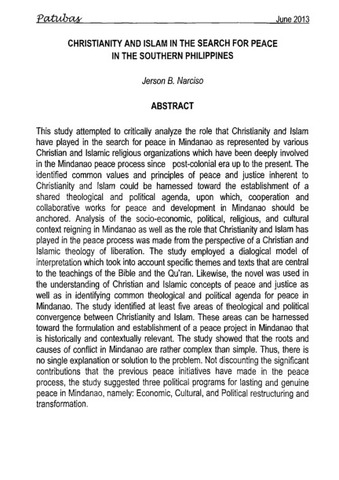
Christianity and Islam in the search for peace in the Southern Philippines
(Central Philippine University, 2013-06)This study attempted to critically analyze the role that Christianity and Islam have played in the search for peace in Mindanao as represented by various Christian and Islamic religious organizations which have been deeply ... -
A Christian approach to the Maranao Muslims
(South East Asia Graduate School of Theology, 1969)The Moro problem is one of the most vexing problems of the Republic of the Philippines today. The present discontent of the Moros – Filipino Muslims -- is a thorn in the flesh of the Filipino nation. Historically and ... -
Factors influencing the young people’s interest and involvement in Christian education programs under the Convention of Philippine Baptist Churches (CPBC) in Sara, Iloilo
(2004)This descriptive study determined the forty-six young people’s interest and involvement in Christian Education Programs (CEP) under the Convention of Philippine Baptist Churches, Inc. in Sara, Iloilo. The level of interest ...