

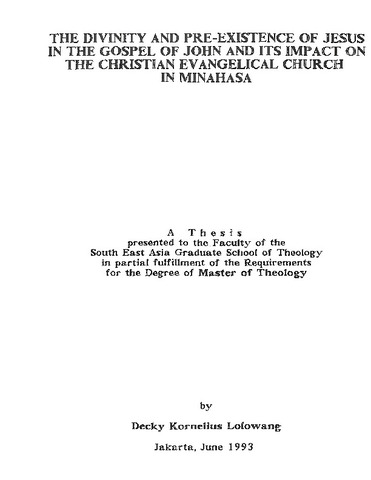
The divinity and pre-existence of Jesus in the Gospel of John and its impact on the Christian evangelical church in Minahasa
Page views
215Date
1993-06Share
Metadata
Afficher la notice complèteRésumé
The conviction of Jesus’ divinity and pre-existence (from now on referred to as JDP) is one of the topics of theology which, on the one side, led to the rise of Christianity, but, on the other side, has been a confusing problem. The problem has been especially felt since rationalism has challenged JDP as it has been found in the church's witness and teaching. JDP has also been a problem for the church's encounter and dialogue with other religions.
Today, the question arises as to the relevance of the J DP doctrine in the life, witness, and service of the contemporary church. Can the thought that everything written in the Bible must be accepted as the one and only criterion of true faith be maintained today? Or does the church have to reformulate her faith contextually, just as the writer of the Bible were always thinking and writing contextually? These are the questions which are discussed in this thesis.
Historically, discussion of JDP occurred more frequently in post-New Testament writings. But NT texts were always used in these discussions. Therefore, the question needs to be asked as to how far and in what ways the NT writers thought of Jesus as divine and pre-ex existent.
Within the NT, there are a number of passages which do seem to be marked by JDP, particularly in Colossians, Ephesians, and Hebrews. In Col. 1:5-10, Jesus is presented as the picture of the invisible God, as that which was before all else, for in him everything was created. In this hymn, the impression is given of Jesus as mediator between God and human beings together with all of creation. But JDP is not explicitly stated in this hymn; its main concern is with the role of God in creation and salvation, and not with Jesus’ divine and pre-existent nature.
The same is true of Ef.1:3-14 which seems to point to Jesus ' r ole in the maintenance and salvation of the created order. The reference to the secret purpose of God before the creation of the world does not contain any explicit statement about the pre-existence of Jesus. What is stressed here is redemption in and by Jesus as part of God's plan which was determined in the beginning.
Of more interest is the hymn in Heb.1:1-3. At a glance, JDP seems to be included in it, especially because of the statement that Jesus is the light of God's glory destined to declare God's will from the beginning. But the hymn is not dealing with JDP; rather it is stating God’s plan of salvation and God’s activity of redemption as looked at from the angle of its beginning and not of its ending that is related to Jesus.
Therefore, if these hymns are carefully looked at, it cannot be said that they are expressions of JDP. But such expression for the first time clearly does occur in the gospel of John. For the reason, this thesis is concerned primarily with that NT writing.
The hymn in the prologue (Jn.1:1-8) is concerned with the logos which existed before creation and through which creation occurred. The logos became human flesh for the purpose of salvation, and this incarnate logos is identified with Jesus. With this identification, it is clear that this section expresses JDP. Yet, the main emphasis here is not on pre- existence but on incarnation--logos sarx egeneto.
The other passages in the gospel which seem to refer to JDP are those which speak of "the sending of the son by the father" ( see esp. 4: 34; 5:37; 6:44; 8:18,42; 13:3; 17:8) and of "the son of man descending into the world and then ascending again to the place from where he came” ( see esp. 3:2,13; 6:31,41, 62; 13:31-32). In addition to these, the frequent use of the phrase ego eimi -- a phrase which most likely refers to God’s or divine being's revelation (as found both in the Old Testament and in Hellenistic religious literature) -- conveys the impression that the writer is trying to express Jesus’ divinity as the one who comes from God and from the divine world. Statements such as " I am the bread of life which came down from heaven" (6:35,41), and "I am the door of the sheep" (10:7), or "I am the way, and the truth, and the life” (14:6) seem to contain the understanding of Jesus' function as the one who came from above to become the mediator between God and humankind.
Then there are several verses where JDP is explicitly expressed, such as 3:13; 6:38; 8:38, 58; 17:5,24. The clearest of these is that in 8:58, "Truly, truly I say to you, before Abraham was, I am.
Nevertheless, much of the gospel of John gives the impression that its main concern is not the nature of Jesus as the one who has come from the divine world, but rather the meaning of Jesus' presence in this world. The concern of the writer is not so much who Jesus is, but what Jesus does. By looking at what Jesus does during his time of being in the world, one can know the real God, that is, the loving and merciful God who has come to encounter human beings through Jesus. So it can be said that the christology which John developed to express his conviction about the loving God is really a functional, not an ontological, christology.
By analysing the subject of JDP, I have tried to contribute to the church's understanding of her mission and teaching, especially that of my own church, the Christian Evangelical Church in Minahasa. If the church learns from the gospel of John, she realises that her christology should be more "functional rather than christological in character and that, however that may be, it is most important that she always try to do christology in a contextual way. I have tried to point to some traditional elements in Minahasan culture and religion that might well be part of the context for contemporary christology in Minahasa.
The organisation of the thesis is as follows: Chapter I is description of the understanding of pre-existence as found in Judaism and Hellenistic thought at the time of the NT. Chapter II contains exegesis of those parts of the Gospel of John which seem related to JDP. Chapter III attempts to ascertain the causes for the appearance of JDP in the community which produced the Gospel of John. Chapter IV discusses the effect of JDP in the life, witness, and service of the Christian Evangelical Church in Minahasa (GMIM) and tries to point to the possibility of the development of a more contextual christology.
Description
Abstract only
Suggested Citation
Lolowang, D. K. (1993). The divinity and pre-existence of Jesus in the Gospel of John and its impact on the Christian evangelical church in Minahasa [Unpublished master's thesis]. South East Asia Graduate School of Theology.
Type
ThesisSujet

Keywords
Department
South East Asia Graduate School of TheologyDegree
Master of TheologyShelf Location
BT 212 .L65 1993
Physical Description
xiii, 205 leaves