
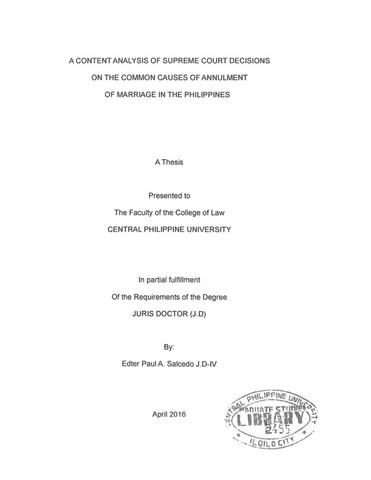
A content analysis of Supreme Court decisions on the common causes of annulment of marriage in the Philippines
요약
This study was conducted to find out the different common causes of annulment in the Philippines. It aims to find out the reasons why nullification of marriages are on rise as marriage is highly regarded in the Philippines both by law and its people’s culture.
The Philippines, as its Constitution proceeds to express, recognizes that “marriage, an inviolable social institution, is the foundation of the family. ’’The government “recognizes the sanctity of family life and declares to protect and strengthen the family as a basic autonomous social institution. ’’Marriage and the family are considered so crucial to the stability and peace of the nation that their nature, consequences, and incidents are governed by law and not subject to the whim of the parties.
In more explicit terms, the Family Code characterizes marriage as - “a special contract of permanent union between a man and a woman entered into in accordance with law for the establishment of conjugal and family life. It is the foundation of the family and an inviolable social institution whose nature, consequences, and incidents are governed by law and not subject to stipulation, except that marriage settlements may fix the property relations during the marriage within the limits provided by this Code.”
To be a valid contract, a marriage must have all the essential and formal requisites prescribed by law. The two essential requisites for a valid marriage are: (1) contracting parties must be male and female and have the legal capacity to enter into marriage, and (2) consent of the contracting parties must be freely given before a solemnizing officer. The absence of at least one essential requisite renders the marriage void ab initio. A defect in any of them, however, will not affect the validity of the marriage. The formal requisites, on the other hand, are as follows: (1) presence of authority of the solemnizing officer;(2) valid marriage license; and (3) an actual marriage ceremony where the contracting parties appear before the solemnizing officer, with no less than two witnesses of legal age. Should any of these three be absent, the marriage shall also be considered void ab initio. In the same manner, any irregularity will have no effect on its validity, other than rendering the party or parties responsible therefor as being civilly, criminally and administratively liable.
Under Philippine law, a marriage adjudged to be valid from the start cannot be terminated under any ground. This, notwithstanding, there exist the remedies of nullity and annulment which both legally sever a particular marriage bond. In a nullity action, a spouse seeks to prove that the marriage is void dating back to the time of its celebration, while in an annulment action, he or she must establish that the marriage is afflicted with a defect that already existed when the marriage was formalized. The Family Code provides for nine (9) exclusive grounds upon which a marriage may be declared null and void ab initio by a competent court: (1) it was contracted by parties below eighteen years of age; (2) it was solemnized by a person without legal authority; (3) it was solemnized without a marriage license; 106 (4) it is bigamous or polygamous in nature; (5) it was contracted through mistake of identity; (6) it was subsequently contracted without prior recording with the appropriate civil registry and registry of properties of the judgment of annulment or nullity of marriage, partition and distribution of the properties of the spouses from a previous marriage, together with delivery of the children’s presumptive legitimes; (7) it was contracted by any party who, at the time of the celebration, was psychologically incapacitated to comply with the essential martial obligations of marriage; (8) it is incestuous in nature; and (9) it was contracted against public policy. An action or defense for declaration of nullity does not prescribe.
기술
Abstract only
추천 인용
Salcedo, E. P. A. (2016). A content analysis of Supreme Court decisions on the common causes of annulment of marriage in the
Philippines (Unpublished postgraduate thesis). Central Philippine University, Jaro, Iloilo City.
유형
Thesis
키워드
학과
College of Law정도
Juris Doctor선반 위치
GSL Theses 340.72 Sa31
물리적 설명
ii, 64 leaves
Collections
- Juris Doctor [144]
Related items
Showing items related by title, author, creator and subject.
-
A comparative study of the common grounds for annulment in canon law and civil law and the possibility of a legal accommodation
(2019)This study conducted a point-by-point comparison of law of the Roman Catholic Church and the law of the Republic of the Philippines with regard to the grounds for annulment and the process that is involved in their respective ... -
Attitude towards the legalization of same sex marriage among law students of a selected school in Iloilo City
(2015)This study was conducted to determine the attitude towards the legalization of same sex marriage among law students of a selected school in Iloilo City. The study specifically aims to find out the percentage of CPU law ... -
Feasibility of legalizing third sex marriages in the Philippines: Ethico-moral and legal implications
(2018)This descriptive-correlational study, conducted in February 2017, aimed at ascertaining the feasibility of legalizing third sex marriages in the Philippines, as well as its ethical, moral and legal implications. It likewise ...