

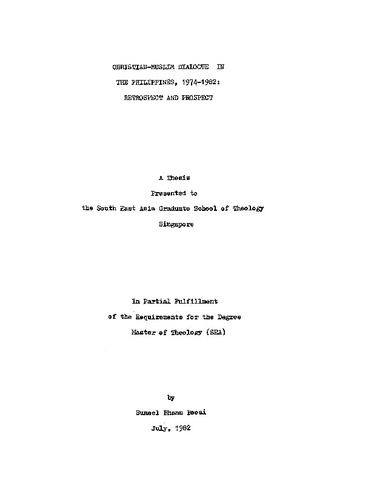
Christian-Muslim dialogue in the Philippines, 1974-1982: Retrospect and prospect
摘要
More than three centuries of hostility between Christian Filipinos and Muslim Filipinos, involving extensive loss of life and damage to property, is one tragic aspect of the history of the Filipino people. This sad situation, which to some extent continues to this day, casts a dark shadow on the life of these two communities of faith which claim to be obedient to God’s will and whose members profess that the essence of worship to God is care, concern and love for fellowmen. On the political sphere, the gulf between Muslim and Christian Filipinos has become an obstacle to the achievement of national unity, adversely affecting the order of society. In their daily lives, both Muslim and Christian Filipinos, particular in Mindanao, encounter each other in everyday life situations. But their meeting is superficial, and the two communities of faith do not seem to recognize their interdependence on one another. Because of their long history of conflict, each side looks at the other with suspicion and distrust.
There are a few from both sides, however, who feel that Muslims and Christians, who to a considerable extent share the same religious experience of One God, cannot afford to live in isolation from one another. Nor can they ignore the teachings of their respective religions as regards the duty to show goodwill to others. These advocates for peace and reconciliation affirm that Muslims and Christians ought to come out of their shells, share their resources and talents, and cooperate with one another for harmonious living and nation-building.
But the question is, how to break the barriers raised between them by past history? How to tear down the prejudices and misperceptions, and the accumulated misunderstanding each has had of the other? One possible and promising way is dialogue-- dialogue of life and words. The beginnings of Muslim-Christian dialogue in the Philippines can be traced to some attempts under the auspices of the Philippine government in the 1900's. By 1974, the idea, of a national-level dialogue was conceived, to supplement the various local and regional ones, both formal and informal in nature. To date, four national dialogues had been held. By 1976, these dialogues had begun to bear significant fruits.
In a sense, the dialogues in the Philippines are a reflection and have received inspiration from Muslim-Christian dialogues on the international scene (a list of which may be found in the Appendices). On the whole, it appears that the idea of dialogue is gaining ground in the Philippines. The increase in the number of interested participants, the growing frequency with which formal and informal dialogues are being held, plus the fact that the dialogues are now being conducted at various levels local, Regional and national-- all these indicate the effectiveness and attraction offered by dialogue as a possible solution to conflict in southern Philippines.
The dialogues also show that if given an opportunity to do so, Muslims and Christians would be willing to listen to and share their sentiments with one another. Through dialogue, Muslims and Christians have begun to know each other better and are learning to cooperate with one another for the peace and well-being of society. The enthusiasm with which they often speak of the "new friendship" gained through formal or informal dialogue, reflects their ardent desire to live in peace and harmony as brothers. Indeed, dialogue and its results are most encouraging to all people of goodwill who earnestly look forward to better Muslim-Christian relations.
Of course, it is too early to assess fully the results and total impact of dialogue in this country. The overwhelming majority of Filipinos, especially the Christians, still do not pay that attention to dialogue that it deserves. Some even suspect the motive behind dialogue. And yet, dialogue has undoubtedly become in the Philippines an instrument for defusing existing tensions and for slowly breaking down the barriers erected over the long centuries of conflict. The important thing is that a beginning has been made in finding another alternative to violent confrontation; and it can only be hoped that in time dialogue, this other alternative, will bear full fruit in terms of the hoped-for peace, reconciliation, and harmony between the two communities of faith.
描述
Abstract only
建议引文
Boosi, S. B. (1982). Christian-Muslim dialogue in the Philippines, 1974-1982: Retrospect and prospect [Unpublished master's thesis]. South East Asia Graduate School of Theology.
文件类型
Thesis
部
South East Asia Graduate School of Theology学位
Master of Theology货架位置
BT 212 .B66 1982
物理描述
119 only
集合
- Master of Theology [51]