

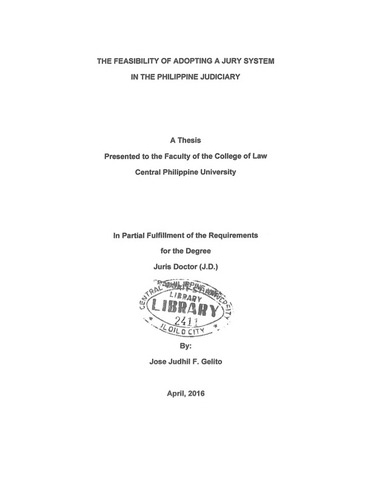
The feasibility of adopting a jury system in the Philippine judiciary
Abstract
This study focused on the feasibility of adopting a Jury System in the Philippine Judiciary and how it will affect the speedy disposition of cases. Both the advantages and disadvantages were considered similarly with the aspects that hinder or the rationale that supports the adoption of the Jury System. The study was conducted through contemplation of the readings, views, opinions and jurisprudence available about the Jury System.
For this study, the appropriate research design is qualitative study. Hence, the researcher focused on the interpretation rather than quantification.
The type of qualitative study that the researcher used was meta-analysis. The basic tenet of a meta-analysis is that there is a common truth behind all conceptually similar scientific studies, but which has been measured with a certain error within individual studies. The aim in meta-analysis then is to use approaches from statistics to derive a pooled estimate closest to the unknown common truth based on how this error is perceived.
The meta-analysis type of qualitative study, as applied, had made the researcher determine the different results from different views, opinions and studies.
From the facts gathered, various observations were considered both favorable and conflicting. Generally, the most beneficial result of using the jury system is that, indeed, it assists different countries in the speedy disposition of cases. Corruption was also said to be less likely possible by using the Jury System as there are twelve jurors to be bribed, by whoever wishes to, unlike in a one-judge-trial. The diversity in the composition of the jurors is favorable in the sense that there are different cultures and minds working toward a verdict. Conversely, diversity is a dilemma in the Philippines, being an archipelago diversity is not attainable without spending so much. It is noteworthy that the jury system, likewise, posits disadvantages. The major difficulty for its adoption is its being costly. Sufficient fund must be provided to reciprocate the services of the jurors. Moreover, Filipinos are known to be so friendly and this, also, creates a crisis in the adoption of the Jury System as this may affect their impartiality.
Description
Abstract only
Suggested Citation
Gelito, J. J. F. (2016). The feasibility of adopting a jury system in the Philippine judiciary (Unpublished postgraduate thesis). Central Philippine University, Jaro, Iloilo City.
Type
ThesisSubject(s)

Keywords
Department
College of LawDegree
Juris DoctorShelf Location
GSL Theses 340.72 G282
Physical Description
ii, 60 leaves
Collections
- Juris Doctor [144]