

• English
    • Filipino
    • 中文
    • 한국어
    • français
    • русский
  • 한국어 
    • English
    • Filipino
    • 中文
    • 한국어
    • français
    • русский
  • Login
View Item 
  •   BAHÁNDÌAN 홈
  • Central Philippine University (CPU) In-House Publications
  • Journals
  • Southeast Asia Quarterly
  • View Item
  •   BAHÁNDÌAN 홈
  • Central Philippine University (CPU) In-House Publications
  • Journals
  • Southeast Asia Quarterly
  • View Item
JavaScript is disabled for your browser. Some features of this site may not work without it.

The story of ancient Panay: Its settlement and pre-Spanish culture
Thumbnail
전망/Open
Journal Article (439.9Kb)
Downloads: 1,494
Page views
1,547
데이트
1966-07
저자
Regalado, Felix B.
공유 
 
Metadata
Show full item record

요약
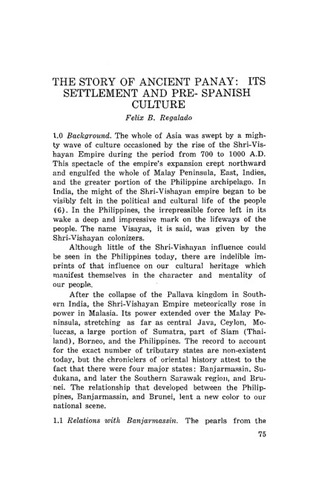
The whole of Asia was swept by a mighty wave of culture occasioned by the rise of the Shri-Vishayan Empire during the period from 700 to 1000 A.D. This spectacle of the empire’s expansion crept northward and engulfed the whole of Malay Peninsula, East, Indies, and the greater portion of the Philippine archipelago. In India, the might of the Shri-Vishayan empire began to be visibly felt in the political and cultural life of the people (6). In the Philippines, the irrepressible force left in its wake a deep and impressive mark on the lifeways of the people. The name Visayas, it is said, was given by the Shri-Vishayan colonizers. Although little of the Shri-Vishayan influence could be seen in the Philippines today, there are indelible imprints of that influence on our cultural heritage which manifest themselves in the character and mentality of our people. After the collapse of the Pallava kingdom in South ern India, the Shri-Vishayan Empire meteorically rose in power in Malaysia. Its power extended over the Malay Peninsula, stretching as far as central Java, Ceylon, Mo luccas, a large portion of Sumatra, part of Siam (Thai land), Borneo, and the Philippines. The record to account for the exact number of tributary states are non-existent today, but the chroniclers of oriental history attest to the fact that there were four major states: Banjarmassin, Sudukana, and later the Southern Sarawak region, and Brunei. The relationship that developed between the Philippines, Banjarmassin, and Brunei, lent a new color to our national scene.
기술
Journal Article
URI
https://hdl.handle.net/20.500.12852/2695
추천 인용
Regalado, F. B. (1966). The story of ancient Panay: Its settlement and pre-Spanish culture. Southeast Asia Quarterly, 1(1), 75-87.
유형
Article
주제
Southeast Asia--History OCLC - FAST (Faceted Application of Subject Terminology); Philippines--Panay Island--History OCLC - FAST (Faceted Application of Subject Terminology); Philippines--History OCLC - FAST (Faceted Application of Subject Terminology)
Collections
  • Southeast Asia Quarterly [33]

문의하기 | 피드백 보내기 | https://creativecommons.org/licenses/by/4.0/ Logo by HLL
Central Philippine University © 2025
Managed by 
Henry Luce III LibraryHenry Luce III Library


Links
BAHÁNDÌAN Repository GuideDisclaimerFAQsSubmit your workNews and Updates

검색

BAHÁNDÌAN 전체커뮤니티 및 컬렉션발행 일별저자타이틀과목이 컬렉션발행 일별저자타이틀과목

내 계정

로그인레지스터

Statistics

View Usage Statistics
CPU Henry Luce III Library

문의하기 | 피드백 보내기 | https://creativecommons.org/licenses/by/4.0/ Logo by HLL
Central Philippine University © 2025
Managed by 
Henry Luce III LibraryHenry Luce III Library


EXTERNAL LINKS DISCLAIMER

This link is being provided as a convenience and for informational purposes only. Central Philippine University bears no responsibility for the accuracy, legality or content of the external site or for that of subsequent links. Contact the external site for answers to questions regarding its content.

If you come across any external links that don't work, we would be grateful if you could report them to the repository administrators.

Click DOWNLOAD to open/view the file. Chat Bertha to inform us in case the link we provided don't work.

Download