
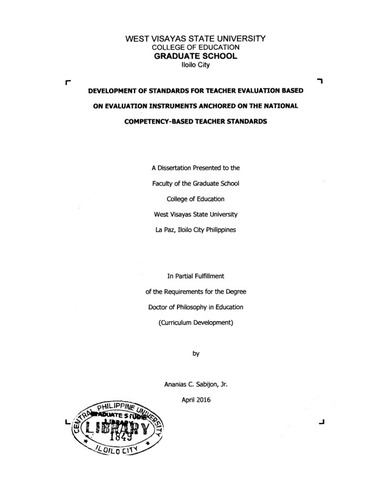
Development of standards for teacher evaluation based on evaluation instruments anchored on the National Competency-Based Teacher Standards

Abstract
This multimethod or mixed study examined the components of the evaluation instrument utilized by selected Centers of Excellence (COEs) for teacher education using the NCBTS as interpretive lens; and based on its results, the researcher developed the standards for evaluating teaching performance of basic education teachers. Two top performing Centers of Excellence (COEs) for teacher education in the country were utilized using the non-random purposive sampling technique. To gather both qualitative and quantitative data, survey research and content analysis were employed. Framework analysis, comparison of lexical units (phrasal and whole-text definitions), frequency count, percentages and ranking were used to analyze data. Results showed that although the hierarchical format and the terms used in the components of the QCE NBC No. 461 are not exactly the same (verbatim) as that of the NCBTS—the government prescribed teaching effectiveness and evaluation framework, questionnaire and content analysis data revealed that the components of the QCE NBC No. 461 teacher evaluation instrument and the NCBTS framework have similarities and actual alignments. Based on the alignments and similarities (using the components and comparison units) between the teacher evaluation instrument and the NCBTS, the phenomenon of teaching effectiveness can be captured and defined using the prescribed domains, strands and performance indicators. Likewise, teaching effectiveness can also be captured using the assessment areas and criteria of the QCE NBC No. 461. In terms of NCBTS themes (domain, strands and indicators) utilization, data showed that the NCBTS domain that is most utilized in the QCE NBC No. 461 is Curriculum. The Community Linkages is the least utilized domain. Moreover, based on the results of the study (clusters or groups of teaching effectiveness/ evaluation domains which have evolved and on percentages of NCBTS themes utilization), and using the National Competency-Based Teacher Standards as the anchor, two standards— Commitment as It Affects Teaching, and Facilitating Learning—cannot be overemphasized.
Description
Abstract only
Suggested Citation
Sabijon, A. C. , Jr. (2016). Development of standards for teacher evaluation based on evaluation instruments anchored on the National Competency-Based Teacher Standards [Unpublished Doctoral dissertation]. West Visayas State University, La Paz, Iloilo City.
Type
DissertationSubject(s)

Department
Graduate SchoolDegree
Doctor of Philosophy in Education (Curriculum Development)Shelf Location
GSL Theses 378.242 Sa13
Physical Description
294 leaves
Collections
- Dissertations [6]
Related items
Showing items related by title, author, creator and subject.
-
A study of the association of the leadership styles of elementary school principals in the Division of Iloilo as perceived by their teachers with teachers' job satisfaction
(1993)It is the purpose of this study to go into the leadership styles of elementary school principals as seen by themselves and by their teachers. It is hoped that leaders and their subordinates jointly discover ways by which ... -
Efficacy of hagonoy (Chromolaena odorata L.) leaf powder extract against coconut leaf beetle (Brontispa longissima Gestro) larvae
(2018)The insecticidal properties of Hagonoy was used against the Coconut Leaf Beetle (Brontispa longissima, Gestro) larvae using distilled water as extractant from the powder prepared from dried mature leaves. The treatments ... -
Efficacy of seaweed liquid fertilizer on the germination and seedling growth of rice (Oryza sativa L.) raised on wet bed
(2019)The experiment was conducted at the College of Agriculture, Resources and Environmental Sciences Research and Development Center, Central Philippine University, Jaro, Iloilo City on April 23 to May 13, 2019. This study ...