
Rural electrification: its effects on people's soicoeconomic life and aspirations
Résumé
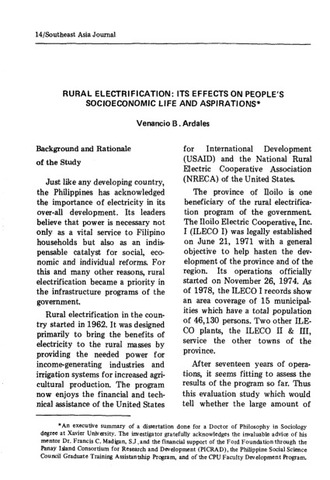
An executive summary of a dissertation done for a Doctor of Philosophy in Sociology degree at Xavier University. The investigator gratefully acknowledges the invaluable advice of his mentor Dr. Francis C. Madigan, S.J. and the financial support of the Ford Foundation through the Panay Island Consortium for Research and Development (PICRAD), the Philippine Social Science Council Graduate Training Assistant ship Program, and of the CPU Faculty Development Program.
Just like any developing country, the Philippines has acknowledged the importance of electricity in its over-all development. Its leaders believe that power is necessary not only as a vital service to Filipino households but also as an indispensable catalyst for social, economic and individual reforms. For this and many other reasons, rural electrification became a priority in the infrastructure programs of the government.
Rural electrification in the country started in 1962. It was designed primarily to bring the benefits of electricity to the rural masses by providing the needed power for income-generating industries and irrigation systems for increased agricultural production. The program now enjoys the financial and technical assistance of the United States for International Development (USAID) and the National Rural Electric Cooperative Association (NRECA) of the United States.
Description
Journal article
Associated Content
Unpublished Doctoral dissertationSuggested Citation
Ardales, V. B. (1982). Rural electrification: its effects on people's soicoeconomic life and aspirations.Type
ArticleSujet

Collections
- Southeast Asia Journal [188]
Related items
Showing items related by title, author, creator and subject.
-
Rural electrification: Its effects on people's socioeconomic life and aspirations
(1981)The study wanted to find out whether households, institutions, and communities which have been exposed to electricity are socially and economically more progressive than those deprived of electrification. With the use ... -
Church's responsibility in rural development
(Central Philippine University, 1967-01)Rev. C. C. Ganchorre teached Genetic Psychology and Psychology of Adolescence at Central Philippine University. He was an ordained minister of the United Church of Christ. He obtained his A.B., major in English at Silliman ... -
Rural land registration in Inner Mongolia of China: Status, perceptions and intentions
(2015)This study was conducted to determine the relationship between attitude towards the requirements for registration, registration status, and intention to register their land, among farmers in Inner Mongolia. Specifically, ...