

• English
    • Filipino
    • 中文
    • 한국어
    • français
    • русский
  • English 
    • English
    • Filipino
    • 中文
    • 한국어
    • français
    • русский
  • Login
View Item 
  •   BAHÁNDÌAN Home
  • College of Engineering
  • Collaborative Researches
  • Journal articles
  • View Item
  •   BAHÁNDÌAN Home
  • College of Engineering
  • Collaborative Researches
  • Journal articles
  • View Item
JavaScript is disabled for your browser. Some features of this site may not work without it.

Scale inhibitors for industrial circulating water systems: A review
Thumbnail
Request
Request a full text copy
Page views
677
Date
2022-02-03
Author
Guo, Xinyu
Jaspe, Christsam Joy S.
Cheng, Yamin ORCID
Zhao, Xiaowei
Liu, Zongyang
Xu, Ying
Share 
 
Metadata
Show full item record


Abstract
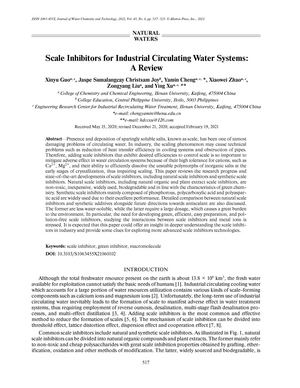
Presence and deposition of sparingly soluble salts, known as scale, has been one of utmost damaging problems of circulating water. In industry, the scaling phenomenon may cause technical problems such as reduction of heat transfer efficiency in cooling systems and obstruction of pipes. Therefore, adding scale inhibitors that exhibit desired efficiencies to control scale is so important to mitigate adverse effect in water circulation systems because of their high tolerance for cations, such as Ca2+, Mg2+, and their ability to efficiently dissolve the unstable polymorphs of inorganic salts at the early stages of crystallization, thus impairing scaling. This paper reviews the research progress and state-of-the-art developments of scale inhibitors, including natural scale inhibitors and synthetic scale inhibitors. Natural scale inhibitors, including natural organic and plant extract scale inhibitors, are non-toxic, inexpensive, widely used, biodegradable and in line with the characteristics of green chemistry. Synthetic scale inhibitors mainly composed of phosphorous, polycarboxylic acid and polyaspartic acid are widely used due to their excellent performance. Detailed comparison between natural scale inhibitors and synthetic additives alongside future directions towards antiscalant are also discussed. The former are less water-soluble, while the latter require a large dosage, which causes a great burden to the environment. In particular, the need for developing green, efficient, easy preparation, and pollution-free scale inhibitors, studying the interactions between scale inhibitors and metal ions is stressed. It is expected that this paper could offer an insight in deeper understanding the scale inhibitors in industry and provide some clues for exploring more advanced scale inhibitors technologies.
Description
Journal article
URI
https://hdl.handle.net/20.500.12852/2514
Suggested Citation
Guo, X., Jaspe, C. J. S., Cheng, Y., Zhao, X., Liu, Z., & Xu, Y. (2022). Scale inhibitors for industrial circulating water systems: A review. Journal of Water Chemistry and Technology, 43(6), 517-525.
DOI
10.3103/S1063455X21060102
Type
Article
ISSN
1063-455X; 1934-936X
Subject(s)
Macromolecules OCLC - FAST (Faceted Application of Subject Terminology); Incrustations OCLC - FAST (Faceted Application of Subject Terminology); Incrustations--Prevention OCLC - FAST (Faceted Application of Subject Terminology); Descaling OCLC - FAST (Faceted Application of Subject Terminology)
Keywords
Scale inhibitor; Green inhibitor; Macromolecule
Collections
  • Journal articles [6]

Contact Us | Send Feedback | https://creativecommons.org/licenses/by/4.0/ Logo by HLL
Central Philippine University © 2025
Managed by 
Henry Luce III LibraryHenry Luce III Library


Links
BAHÁNDÌAN Repository GuideDisclaimerFAQsSubmit your workNews and Updates

Browse

All of BAHÁNDÌANCommunities & CollectionsBy Issue DateAuthorsTitlesSubjectsThis CollectionBy Issue DateAuthorsTitlesSubjects

My Account

LoginRegister

Statistics

View Usage Statistics
CPU Henry Luce III Library

Contact Us | Send Feedback | https://creativecommons.org/licenses/by/4.0/ Logo by HLL
Central Philippine University © 2025
Managed by 
Henry Luce III LibraryHenry Luce III Library


EXTERNAL LINKS DISCLAIMER

This link is being provided as a convenience and for informational purposes only. Central Philippine University bears no responsibility for the accuracy, legality or content of the external site or for that of subsequent links. Contact the external site for answers to questions regarding its content.

If you come across any external links that don't work, we would be grateful if you could report them to the repository administrators.

Click DOWNLOAD to open/view the file. Chat Bertha to inform us in case the link we provided don't work.

Download