

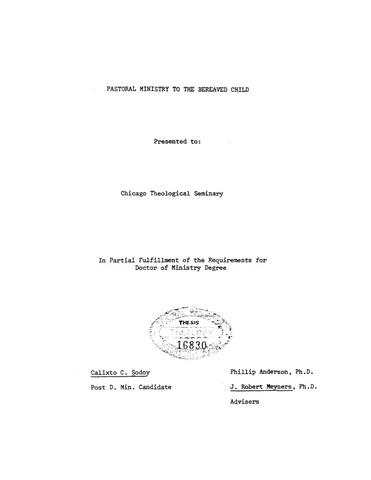
Pastoral ministry to the bereaved child
요약
Man perceives death in different ways depending on his religious beliefs and culture, his age, his socioeconomic status, and other factors. Modern technological man has, to an increasing degree, sought to deal with death in ways that will take such differential perceptions into account. In this context the minister of God has acquired responsibilities that challenge his dedication and his interpersonal skills more than ever before.
The challenge has been viewed as particularly demanding where children are concerned. Modern psychology and psychiatry agree that the child's reactions to the death of a "loved other" may affect that child's later adjustment to both life and death. The child as mourner "passing through the depressive position is struggling, in his unconscious mind, with the task of establishing and integrating his inner world..." In many cases, unless wise assistance is forthcoming, the child may be scarred in deeply subtle ways by the death experience.
The minister approaching the task of providing aid or counsel—one is a phase of the other—where a child or children are involved has an immense tradition on which to draw. The ancient Christian view of Christ as the One Who overcame death no longer survives in its pristine form. But contemporary thought at least permits the view that "the wide gap, marked by the doctrine of the fall, between man's actual state and the state intended for him in God's purpose, is indeed a reality." The corollary is that "the ideal state, representing the fulfillment of God's intention for man, is not a lost reality, forfeited long ago in 'the vast backward and abysm of time' but something lying before us as a state to be attained in the... future."
Life thus becomes a journey to a higher state. While acknowledging immeasurable diversity in the attitudes of those who must look on death at close range—whether child, adolescent, or adult—the minister can act out of his own understanding that the goal of life is not attained during man's earthly exile. Rather, that goal can only be achieved after death. There must, in this view, be a life or lives after death so that man can fulfill his immortal destiny.
From such a base in theology a structure of effective approaches to the task of helping the bereaved child through his period of mourning can be built. With members of the other helping professions, the minister or pastor can admit the absolute need for the child to face and deal with death. Complexities must also be considered as a matter of course; and these will vary from child to child. One bereaved may feel that he or she has been abandoned by the decedent, for example; the need for security may focus more strongly on the surviving parent, and may require special attention. Others will react differently; expressions of emotion may range
"from a silent withdrawal and isolation to a wild loud mourning which attracts attention and thus a replacement of a loved and needed object. Since children cannot yet differentiate between the wish and the deed... they may feel a great deal of remorse and guilt... they may... take the separation relatively calmly..."
The Problem and Method of Exploration
The fact of complexity only intensifies the need for careful preparation for the task of ministering to the bereaved child, or of advising parents or others on ways of meeting the emotional and psychosomatic problems that may arise. The child's long-term development is at issue and must be kept in mind. The formation of "values that make healthy adjustment to reality a natural process" may be aided or impeded depending on the forms of assistance provided.
Such is the core problem of the present study: the development of a set of guidelines that will aid the minister or pastor in his quest for the appropriate responses where bereaved children are in need of help. The guidelines must be formulated on the basis of certain assumptions—for example, that those young people to whom one mediates the Christian tradition in the period of stress following a death have already made at least minimal contact with the ethical content of life. The minister will also want to proceed from a knowledge of certain long-range values.
"We need to know that we are helping the child to develop some discriminating values concerning death, for not all death is the same. There is a difference between the death that comes to an aged person at the end of the natural cycle of life and death and the death that comes with untimely suddenness to a young person through a tragic accident... If children learn that death is natural for the aged but unnatural for the young, they have gained a resource for learning caution and valuing health."
The method of exploration of the problem as enunciated was evolved from two main points of approach: the experiential and the theoretical or textual. The former rests on the author's own experiences in pastoral work. Effort will be made to distill the lessons of those experiences to determine their essential meanings and, secondly, to phrase those meanings in terms that have significance for the pastor or minister.
Equally important is the data base on which the guidelines will be constructed. In-depth research of the literature was seen as indispensable to development of that data base. Specific lines of inquiry included the areas of the child's concepts of death, ways of providing aid and counsel, and the minister's traditional role. Extrapolation from personal experience was to be undertaken in light of the findings in such key areas.
기술
Dissertation introduction
추천 인용
Sodoy, C. C. (1978). Pastoral ministry to the bereaved child [Unpublished Doctoral dissertation]. Chicago Theological Seminary, Chicago.
유형
Dissertation주제

학과
Doctor of Ministry Program정도
Doctor of Ministry선반 위치
TheoLib Theses 207.2 So17
물리적 설명
i, 33 leaves
Collections
- Dissertations [7]