

• English
    • Filipino
    • 中文
    • 한국어
    • français
    • русский
  • Filipino 
    • English
    • Filipino
    • 中文
    • 한국어
    • français
    • русский
  • Login
Tingnan ang Item 
  •   BAHÁNDÌAN Home
  • Central Philippine University (CPU) In-House Publications
  • Journals
  • Southeast Asia Journal
  • Tingnan ang Item
  •   BAHÁNDÌAN Home
  • Central Philippine University (CPU) In-House Publications
  • Journals
  • Southeast Asia Journal
  • Tingnan ang Item
JavaScript is disabled for your browser. Some features of this site may not work without it.

Paradox in artistic unity
Thumbnail
Tingnan /Open
Journal article (272.4Kb)
Downloads: 54
Page views
267
Petsa
1976
May-akda
Baban, Florencia Reyes
Magbahagi 
 
Metadata
Ipakita ang buong tala ng item

Abstract
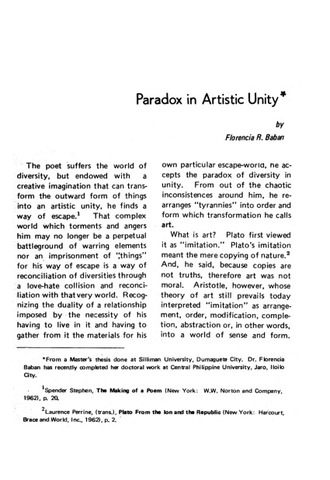
The poet suffers the world of diversity, but endowed with a creative imagination that can transform the outward form of things into an artistic unity, he finds a way of escape. That complex world which torments and angers him may no longer be a perpetual battleground of warring elements nor an imprisonment of “things” for his way of escape is a way of reconciliation of diversities through a love-hate collision and reconciliation with that very world. Recognizing the duality of a relationship imposed by the necessity of his having to live in it and having to gather from it the materials for his own particular escape-world, he accepts the paradox of diversity in unity. From out of the chaotic inconsistences around him, he rearranges “tyrannies” into order and form which transformation he calls art.

What is art? Plato first viewed it as "imitation.” Plato’s imitation meant the mere copying of nature. And, he said, because copies are not truths, therefore art was not moral. Aristotle, however, whose theory of art still prevails today interpreted “imitation” as arrangement, order, modification, completion, abstraction or, in other words, into a world of sense and form.
Paglalarawan
Journal article
URI
https://hdl.handle.net/20.500.12852/2411
Mungkahing Sipi
Baban, F. R. (1976). Paradox in artistic unity. Southeast Asia Journal, 9(1), 48-56.
Uri
Article
ISSN
0038-3600
Mga Paksa
Art OCLC - FAST (Faceted Application of Subject Terminology); Artists OCLC - FAST (Faceted Application of Subject Terminology); Art--Philosophy OCLC - FAST (Faceted Application of Subject Terminology)
Collections
  • Southeast Asia Journal [188]

Contact Us | Send Feedback | https://creativecommons.org/licenses/by/4.0/ Logo by HLL
Central Philippine University © 2025
Managed by 
Henry Luce III LibraryHenry Luce III Library


Links
BAHÁNDÌAN Repository GuideDisclaimerFAQsSubmit your workNews and Updates

Mag-browse

Lahat ng BAHÁNDÌANMga Komunidad at KoleksyonSa Petsa ng IsyuMga May-akdaMga pamagatMga PaksaAng Koleksyon na ItoSa Petsa ng IsyuMga May-akdaMga pamagatMga Paksa

Aking Account

Mag log inMagparehistro

Statistics

View Usage Statistics
CPU Henry Luce III Library

Contact Us | Send Feedback | https://creativecommons.org/licenses/by/4.0/ Logo by HLL
Central Philippine University © 2025
Managed by 
Henry Luce III LibraryHenry Luce III Library


EXTERNAL LINKS DISCLAIMER

This link is being provided as a convenience and for informational purposes only. Central Philippine University bears no responsibility for the accuracy, legality or content of the external site or for that of subsequent links. Contact the external site for answers to questions regarding its content.

If you come across any external links that don't work, we would be grateful if you could report them to the repository administrators.

Click DOWNLOAD to open/view the file. Chat Bertha to inform us in case the link we provided don't work.

Download