

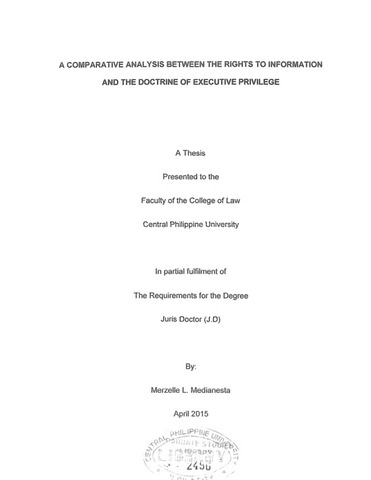
A comparative analysis between the rights to information and the doctrine of executive privilege
摘要
“Once executive privilege is asserted, co-equal branches of the government are set on a collision course.’’-Justice Anthony Kennedy
The Executive Order No. 464 was enacted in the exercise of the executive privilege of the President as the head of state. Such power however, though ever emergent and expanding cannot grow faster that the fundamental law of the state, nor violate the express inhibition of the people’s law - the Constitution. It will be a mockery if through the Executive Order or any presidential orders, the freedom of the Filipino people for information will be put into oblivion.
The purpose of this study was to expose the provisions in the EO 464 which are vague when applied and to explain its effect to the Constitutional rights. While there is undoubtedly a call for observation for the president to secure that information not of public concern should be in secrecy for safety and security, as well as Congress in exercising an oversight function in aid of legislation to secure the testimony or the attendance of any government official subpoenaed to appear before its hearing, it will be self-defeating if other priorities such as right to information will be sacrificed in the process.
This study thus aimed to begin work in clearly identifying EO 464 vague provisions by exploring and understanding the law itself and the spirit of the law.
Using information provided in the Supreme Court decided cases, Legislative Journal, official publications, on-line resources and numerous articles, the data gathered were analyzed in order to assess the probable impact and legal implications of said provisions and to make a recommendation that would help in interpreting and construing the provisions of EO 464.
In response to the need for setting parameters for assertion of executive privilege, some advocate the adoption of a statutory definition of executive privilege, and others express the hope that future court decisions will provide more guidance and specificity over executive privilege.
In the modem days, executive privilege has become a widely accepted presidential prerogative. Concerns about its constitutional underpinnings had faded into oblivion. The only relevant question now pertains to the parameters for the exercise of this power so as to curtail the misuse and abuse of this power.
Accordingly, courts must begin with a presumption against rather than for secrecy, and put the burden on the government to rebut it. Needless to say, secrecy in the government runs counter to our tradition, time and again it has proved to be an abomination; and it is to be admitted only after the government has put to proof it is essential for the good of the nation, not merely for that of a President and his plumbers.
The researcher in the conduct of this study concluded that Congress undoubtedly has a right to information from the executive branch whenever it is sought in aid of legislation. If the executive withholds such information on the ground that it is privileged, it must so assert it and state the reason therefore and why it must be respected.
The infirm provision of EO 464 however, allow the executive branch to evade congressional requests for information without need to clearly asserting the right to do so. By the mere expedient of invoking said provisions, the power of Congress to conduct inquiries as well as the right of the people to information is frustrated. Thus, as decided, Sections 2(b) and 3 of EO 464 are declared void and the rest of the provisions are deemed valid and constitutional.
描述
Abstract only
建议引文
Medianesta, M. L. A comparative analysis between the rights to information and the doctrine of executive privilege (Unpublished
postgraduate thesis). Central Philippine University, Jaro, Iloilo City.
文件类型
Thesis关键字
部
College of Law学位
Juris Doctor货架位置
GSL Theses 340.72 M468
物理描述
i, 74 pages
集合
- Juris Doctor [144]