
• English
    • Filipino
    • 中文
    • 한국어
    • français
    • русский
  • français 
    • English
    • Filipino
    • 中文
    • 한국어
    • français
    • русский
  • Ouvrir une session
Voir le document 
  •   Accueil de DSpace
  • Central Philippine University (CPU) In-House Publications
  • Journals
  • Southeast Asia Journal
  • Voir le document
  •   Accueil de DSpace
  • Central Philippine University (CPU) In-House Publications
  • Journals
  • Southeast Asia Journal
  • Voir le document
JavaScript is disabled for your browser. Some features of this site may not work without it.

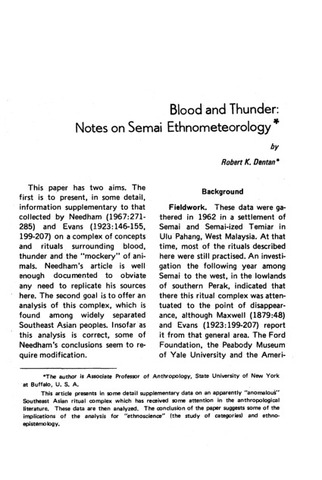
Blood and thunder: Notes on Semai ethnometeorology
Thumbnail
Voir/Ouvrir
Journal article (795.9Ko)
Downloads: 100
Page views
538
Date
1976
Auteur
Dentan, Robert K.
Share 
 
Metadata
Afficher la notice complète

Résumé
This paper has two aims. The first is to present, in some detail, information supplementary to that collected by Needham (1967:271- 285) and Evans (1923:146-155, 199-207) on a complex of concepts and rituals surrounding blood, thunder and the “mockery” of animals. Needham’s article is well enough documented to obviate any need to replicate his sources here. The second goal is to offer an analysis of this complex, which is found among widely separated Southeast Asian peoples. Insofar as this analysis is correct, some of Needham’s conclusions seem to require modification.

Background

Fieldwork. These data were gathered in 1962 in a settlement of Semai and Semai-ized Temiar in Ulu Pahang, West Malaysia. At that time, most of the rituals described here were still practised. An investigation the following year among Semai to the west, in the lowlands of southern Perak, indicated that there this ritual complex was attentuated to the point of disappearance, although Maxwell (1879:48) and Evans (1923:199-207) report it from that general area. The Ford Foundation, the Peabody Museum of Yale University and the American Museum of Natural History supported this research. The Singapore Botanic Gardens and the zoology department of the University of Malaysia helped identify plant and animal specimens.

The Ulu Pahang Semai. The economy of these Semai and their Temiar neighbors to the north rests on swidden agriculture, with sup­ plementary hunting, fishing and gathering. As Austroasiatic-speakers, they are related, albeit rather dis­tantly, to the nomadic “Semang,” with whom there seems to have been some cultural contact. Their technology is rather simple.
Description
Journal article
URI
https://hdl.handle.net/20.500.12852/2184
Suggested Citation
Dentan, R. K. (1976). Blood and thunder: Notes on Semai ethnometeorology. Southeast Asia Journal, 9(2), 32-55.
Type
Article
ISSN
0038-3600
Sujet
Senoi (Southeast Asian people) OCLC - FAST (Faceted Application of Subject Terminology); Ethnometeorology OCLC - FAST (Faceted Application of Subject Terminology); Malaysia OCLC - FAST (Faceted Application of Subject Terminology); Squalls OCLC - FAST (Faceted Application of Subject Terminology); Indigenous peoples--Social life and customs OCLC - FAST (Faceted Application of Subject Terminology); Senoi (Southeast Asian people)--Rites and ceremonies OCLC - FAST (Faceted Application of Subject Terminology); Indigenous peoples OCLC - FAST (Faceted Application of Subject Terminology); Senoi (Southeast Asian people)--Social life and customs OCLC - FAST (Faceted Application of Subject Terminology); Folklore OCLC - FAST (Faceted Application of Subject Terminology); Thunderstorms OCLC - FAST (Faceted Application of Subject Terminology)
Keywords
Semai
Collections
  • Southeast Asia Journal [188]

Related items

Showing items related by title, author, creator and subject.

  • Thumbnail

    Relocating "Waterbuffalo Theology" theological framework to the liturgical life of Desawo Christ Church, Brgy. Desawo, T'Boli, South Cotabato 

    Morales, Jehiel Arthur B. (2015)
    This study sought to relocate “Waterbuffalo Theology” to the worship life of the T’boli in Desawo Christ Church. Particularly, it sought to critically analyze on how Christianity have changed the T’boli people in their ...
  • Thumbnail

    Kinship system and social organization of the Sulod of Central Panay, Philippines 

    Jocano, F. Landa (1963)
    The Sulod are a relatively small group of non-Christians inhabiting the banks of Panay River between Mt. Siya and Mt. Baloy in Central Panay, Philippines. Unless otherwise indicated, this essay deals with the social ...
  • Thumbnail

    A critical analysis on correlation between land title and optimisation of use of the traditional land after the implementation of the Indigenous People’s Right Act (IPRA) of 1997 

    Sarceno-Aspela, Joelyn P. (2018)
    The fundamental development of indigenous people lies in the recognition of their rights to their traditional territories. This study was conducted to examine the experiences of indigenous communities after the recognition ...
Contactez-nous | Faire parvenir un commentaire | https://creativecommons.org/licenses/by/4.0/ Logo by HLL
Central Philippine University © 2025
Managed by 
Henry Luce III LibraryHenry Luce III Library


Links
BAHÁNDÌAN Repository GuideDisclaimerFAQsSubmit your workNews and Updates

Parcourir

Tout DSpaceCommunautés & CollectionsPar date de publicationAuteursTitresSujetsCette collectionPar date de publicationAuteursTitresSujets

Mon compte

Ouvrir une sessionS'inscrire

Statistiques

Statistiques d'usage de visualisation
CPU Henry Luce III Library

Contactez-nous | Faire parvenir un commentaire | https://creativecommons.org/licenses/by/4.0/ Logo by HLL
Central Philippine University © 2025
Managed by 
Henry Luce III LibraryHenry Luce III Library


EXTERNAL LINKS DISCLAIMER

This link is being provided as a convenience and for informational purposes only. Central Philippine University bears no responsibility for the accuracy, legality or content of the external site or for that of subsequent links. Contact the external site for answers to questions regarding its content.

If you come across any external links that don't work, we would be grateful if you could report them to the repository administrators.

Click DOWNLOAD to open/view the file. Chat Bertha to inform us in case the link we provided don't work.

Download