

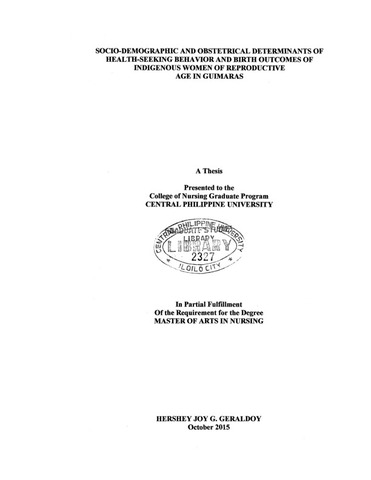
Socio-demographic and obstetrical determinants of health-seeking behavior and birth outcomes of indigenous women of reproductive age in Guimaras
摘要
The main objective of this study was to determine the socio-demographic and obstetrical determinants of health-seeking behavior and birth outcomes of indigenous women of reproductive age (WRA) in the Province of Guimaras. This is a qualitative and quantitative research that utilized a one-shot survey design. The respondents of this study were 50 Indigenous WRAs, aged 15-44 years, who had pregnancy and delivery, living in any of the five settlement areas in the Province of Guimaras. All 50 respondents were included in the quantitative study and six of them were taken as participants for the qualitative study. Majority of the indigenous mothers in Guimaras were 17-27 years old, 28 years old on average, married and high school educated. Most of them were earning less than Php3,000 per month and are living in areas with no indigenous traditional healer. Majority of the mothers had their first birth when they were 15-21 years old, only a few of them had history of premature birth or miscarriage. Most of them had 1-3 living children, and a little more than half of them had unplanned pregnancy. Interestingly, only a few still smoked and drank alcoholic beverage during pregnancy. Majority of them travel less than 20 minutes to reach a health care facility during prenatal care visit.
In addition, only two indigenous mothers did not receive any prenatal care with reasons of financial constraint and absence of problem during pregnancy. Nearly half of the indigenous mothers got ill when they were pregnant, mostly did not consult a professional health care provider during their periods of illness. The highest proportion of those who had consultation went to a hospital or to either a BHS or RHU. Results of the study show that there were more younger mothers, married, elementary educated, mothers with lower income, those who were living in areas with traditional healer, mothers who had their first birth when they were 22-33 years old, those with no previous pregnancy complication, mothers with lesser children, had unplanned pregnancy, nondrinker mothers, smoker mothers and those who travelled less time going to health facility had better practices regarding seeking prenatal care.
The findings further reveal that regardless of age, civil status, educational attainment, monthly family income, presence of traditional healer, age of the mother at first birth, experience of previous maternal complication, number of children, plan of pregnancy, alcohol use and smoking status and duration of travel to a health facility, the majority of the mothers consulted a caregiver during illness when they were pregnant. FGD participants claimed that they also sought professional health care providers if the illness worsens. One of the mothers said that they are still using the herbs as the primary treatment for any illness during pregnancy, one mother who had a college degree claimed that seeking a professional help is the best decision to make and reasoned out that doctors have studied well, thus they prefer to go to the hospital than to an RHU or BHS. FGD participants claimed that they sought professional health care providers if the illness worsens. One of the mothers said that they are still using the herbs as the primary treatment for any illness during pregnancy. During the FGD, one mother with a college degree claimed that seeking a professional help is the best decision to make and reasoned out that doctors have studied well, thus they prefer to go to the hospital than to an RHU or BHS.
Results of the study further reveal that more older mothers, married, even those with only elementary and higher education, mothers with lower income, those who were living in areas with no traditional healer, mothers who had their first birth when they were 22-33 years old, those who had previous maternal complication, those with more children, had unplanned pregnancy, drinker and smoker mothers as well as those who travelled lesser time going to a health facility had favorable maternal health outcome. Furthermore, it was found out in the study that majority of younger and married mothers, those with better education, those with higher monthly family income, those who were living in areas with traditional healer, older mothers during first birth, those with no complications during previous pregnancy, mothers with lesser children, mothers with unplanned pregnancy, mothers who did not consume alcoholic beverages when they were pregnant, non-smoker mothers and those who travelled longer time going to a health facility had healthy babies during birth.
描述
Abstract only
建议引文
Geraldoy, H. J. G. (2015). Socio-demographic and obstetrical determinants of health-seeking behavior and birth outcomes of indigenous women of reproductive age in Guimaras (Unpublished master thesis). Central Philippine University, Jaro, Iloilo City
文件类型
Thesis主题


部
School of Graduate Studies学位
Master of Arts in Nursing货架位置
GSL Theses 610.73072 G311
物理描述
ix, 134 leaves