

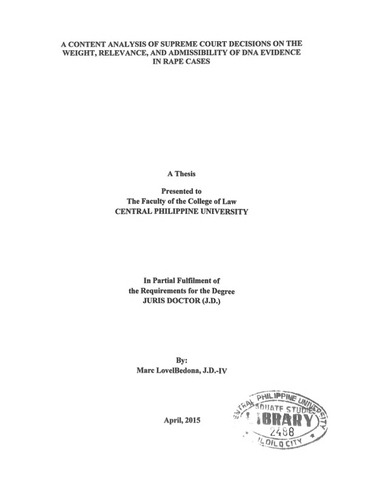
A content analysis of Supreme Court decisions on the weight, relevance, and admissibility of DNA evidence in rape cases
Аннотации
The idea of using DNA evidence as a tool in resolving legal disputes has long existed in the history of our courts. The topic alone was plagued with many controversies and issues which involved the Constitution and the technicalities of law. It was only in recent years that the Supreme Court established the Rule on DNA Evidence to finally put to rest the endless debates that sprung from the subject. In rape cases, DNA evidence may play a vital role in settling controversies, since oftentimes the evidence presented in such cases is the sole testimony of the rape victim and the results of the medical examination.
The purpose of this study was to determine three issues about DNA evidence in relation to rape cases: Is it admissible as evidence? Is its weight enough to convict the accused in crimes of rape? Is DNA evidence relevant in the crime of rape?
This study examined the Supreme Court rulings on cases of rape where DNA evidence was used, determining how DNA evidence was treated before the Rule on DNA Evidence was established. In effect, this study also examined that pertinent rules of the Rules of Court with regards to DNA evidence as well as important provisions found in the Rule of DNA Evidence.
Using information from legal sources, related studies, and online articles, the data gathered were analyzed in line with this study’s objectives in order to determine the how DNA evidence should be treated
The results of this study showed that DNA evidence is admissible as evidence in rape cases so long as it satisfies the two-fold requirement: relevance and competence. In order to be admissible, the DNA evidence must be relevant to the case and must have been taken through legal means. DNA evidence is also relevant to rape cases as such may determine whether certain acts have been performed that are necessary or incidental to the crime of rape. The weight of DNA evidence is not enough to convict a person of the crime of rape. It is only treated as corroborative evidence which merely supports other evidence.
This study further showed that pertinent provisions of the Rules of Court were already applicable to DNA evidence, and that the subsequent Rule on DNA Evidence was established to clarify certain issues.
Although the established Rule on DNA Evidence may shed some light on the shadows of uncertainty looming over DNA evidence, it should be noted that additional provisions are needed to further bolster clarity on the subject. Relying on the Rules of Court to supplement what is lacking is acceptable, but providing for similar provisions in the Rule on DNA Evidence is better.
Описание
Abstract only
Suggested Citation
Bedona, M. L. C. (2015). A content analysis of Supreme Court decisions on the weight, relevance, and admissibility of DNA evidence in rape cases (Unpublished postgraduate thesis). Central Philippine University, Jaro, Iloilo City.
Type
ThesisТематика

Keywords
Department
College of LawDegree
Juris DoctorShelf Location
GSL Theses 340.72 B391
Physical Description
iii, 48 leaves
Collections
- Juris Doctor [144]