

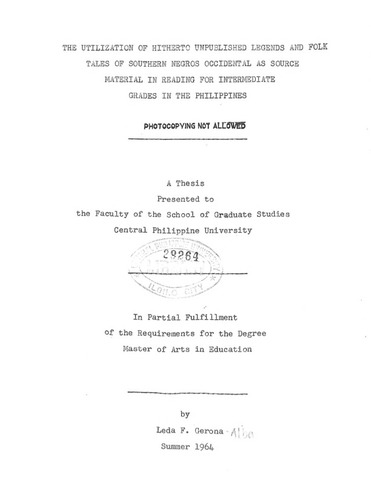
The utilization of hitherto unpublished legends and folk tales of southern Negros Occidental as source material in reading for intermediate grades in the Philippines
요약
The purpose of this study is twofold: to help conserve local legends and folk tales and to utilize them as source materials in reading for the intermediate grades in the Philippines.
Statement of the problem. The research was first prompted by a desire to help remedy the inadequacies either felt or observed in the field. It was once felt that those who could, should help relieve the textbook shortage, for this was a problem in education for many years, but recent reports tend to show that "the field is literally flooded now with textbooks." If this be the case, the present problem with textbooks has to do with selection of appropriate materials from among the many on the market.
Good reading matter for the intermediate grades is needed. Furthermore, the curriculum laboratories which are responsible for the collection of Filipiniana for the nation’s school libraries are interested in such materials as are presented in this study because most of the textbooks used in Philippine elementary schools are by foreign authors. This observation does not imply that foreign authors are not good enough. Rather, it is pointed out that there are not enough good reading materials by Philippine authors from Philippine sources to fill the needs of intermediate school children. The collection of tales in this study, which has been adapted for the intermediate grades, is presented with a view to partly filling this need.
The present outlook in the nation, moreover, demands the use of local stories to foster moral values and love of country. With the new trends in educational philosophy, the teaching of love of country has gained great emphasis. Teachers in public schools are encouraged by their principals and supervisors to submit original stories with local color, in the hope that a start could be made toward a collection for local school libraries. Through these stories, moral lessons can be taught and nationalism emphasized. There is a need, however, for writers to put in good form the stories to be included in the textbooks that should be produced.
There are two imperative reasons for the present study. Since legends and folk tales are handed down orally from generation to generation, there is danger that they will be forgotten if not put down in writing. The elderly storytellers are fast disappearing. They belong to a different generation and are irreplaceable. The younger generations either are too busy to care about these tales or have lost the art of telling stories the way the older folk used to do. The new generation, attracted to the more modern forms of entertainment, has discovered other ways of keeping themselves occupied. Gone are the days when a storyteller would be surrounded by a group of eager listeners. No more are the times when an able storyteller was the children’s hero. The time has passed when even a tall tale is listened to with gusto and repeated in many a candle-lit home or around a campfire. It is imperative, therefore, that these stories be put in a more permanent form before they are lost entirely. This study is one attempt to preserve some.
Fortunately for story collectors, the Philippines is rich in legends and folk tales. Every nook and cranny seems to have a particular story. In the early days, when the inhabitants of a locality became aware that they did not have a folk story to call their own, they constructed some, colored by their imagination. Sometimes the stories were based on fact; more often, they were not; but whether "true" or ficti tious, the stories are nevertheless rich in tradition and reflect the ideals, attitudes and humor of the people. Some stories are sad, some are gay; this ambivalence is true of life.
For this particular study, southern Negros Occidental was selected to be the site for collection because of its not being very well represented in extant anthologies. On the other hand, several other studies have been conducted on tales of Luzon and Mindanao.
Another good reason for this study is the importance of the stories themselves. Stories that depict Philippine culture and ideals, customs and traditions; stories of local heroes and gods; stories that reflect the philosophy and nationalism of the Filipino people have a distinct place in Philippine literature. A comprehensive collection should even preserve indigenous stories that only entertain. These stories will prove highly useful when utilized as source materials in reading for the intermediate grades.
기술
Introduction and statement of the problem
추천 인용
Gerona, L. F. (1964). The utilization of hitherto unpublished legends and folk tales of southern Negros Occidental as source material in reading for intermediate grades in the Philippines (Unpublished Master’s thesis). Central Philippine University, Jaro, Iloilo City.
유형
Thesis주제

학과
School of Graduate Studies정도
Master of Arts in Education선반 위치
GSL Theses 378.242 Al28
물리적 설명
188 leaves