

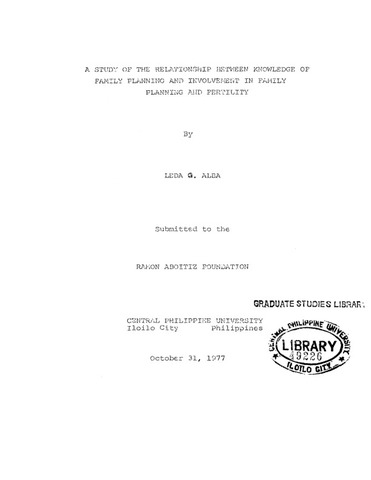
A study of the relationship between knowledge of family planning and involvement in family planning and fertility
요약
The world is beset with numerous problems, but one of the most serious is the explosive growth of human population. If this problem is not solved, man may face starvation, poverty or even extinction. A book on population mentioned:
“No geological event in a billion years, hot the emergence of mighty mountain ranges, not the submergence of entire subcontinents, nor the occurrence of periodic glacial ages - posed a threat to tesrrestial life comparable to that of human overpopulation.”
Ecologists are sometimes called "prophets of doom," but their warnings are timely and we should think seriously of the future of the world by heeding their warnings.
War is not a very good solution to minimize population growth; neither is pestilence desirable. One of the most logical solutions to this problem of overpopulation is family planning. Several countries have realized this and have gone into intensive programs of controlling population growth. In developing countries, there is a need to improve the standard of living of the people. This can partly be achieved if population is low in proportion to the total income of the country. Perhaps family planning is the answer.
Family planning, sometimes called "population control," is not a new area of concern in the Philippines since history mentioned that population control, Philippine style, dates back to the 12th Century A.D., when Datu Sumakwel, a Visayan ruler, embodied in his code a provision limiting population growth.(U.P. College of Education, et. al. (1976) Manual on Population Education for Research and Evaluation Supervisors, pp. 91)
Yet, in spite of this practice, our population has multiplied several times.
Lately, however, family planning has received added impetus when the President issued several decrees and one of these is P.D. 69 where the total number of dependents for which additional exemption may be claimed shall not exceed four dependents (Lydia Quirolgia-Luque, and Maria Fe Manguera-De Leon; Textbook on Family Planning Rex Book Store, 1974. p. 33 Quoting See 23, NIRC.) This necessitates family planning practices if husbands and wives take this seriously. In his State of the Nation Message at the opening of the Seventh Congress on January 26, 1970, President Marcos stated:
The task of government in the control of population is three fold: The first is education, in order to impress on the people the urgent need for controlling the population; the seccpnd is the dissemination of knowledge in the techniques of birth control sanctioned by scientific and medical practice; the third is the provision of facilities especially in the rural areas, where assistance in the use of birth control methods, may be extended to the poor (U.P. College of Education. Manual on Population Education for Research and Evaluation Supervisors N.D. p.71.)
This statement further reiterates the government stand on population control,
In line with this program of population control, President Marcos issued Letter of Instruction No. 47, dated December 8, 1972 regarding the integration of Family Planning in the curricula of schools especially in college courses, realizing that the students are the potential parents of the country, the Department of Education and Culture (DEC) made family planning a required subject in schools.
With this program the government has set up, family planning is assured of strong support. Would knowledge of and involvement in the use of contraceptives methods help to stop the increasing population growth,
1.1 Statement of the Problem.
This study deals with knowledge of and involvement of women in Iloilo Province, in the use of contraceptives. Hopefully, this study intends to find out if knowledge and involvement are associated with fertility; fertility being defined as the number of pregnancies a woman has had. The variables to be discussed, in this particular study are knowledge and involvement in contraceptives of women in Iloilo Province.
기술
Introduction and statement of the problem
추천 인용
Alba, L. G. (1977). A study of the relationship between knowledge of family planning and involvement in family planning and fertility (Research report). Jaro, Iloilo City: University Research Center, Central Philippine University.
유형
Technical Report주제

키워드

선반 위치
GSL Theses 301.426072 Al13
물리적 설명
53 leaves
Collections
- Research reports [167]