

• English
    • Filipino
    • 中文
    • 한국어
    • français
    • русский
  • français 
    • English
    • Filipino
    • 中文
    • 한국어
    • français
    • русский
  • Ouvrir une session
Voir le document 
  •   Accueil de DSpace
  • College of Arts and Sciences
  • Graduate Researches
  • Master's Theses
  • Master of Arts in English Language and Literature
  • Voir le document
  •   Accueil de DSpace
  • College of Arts and Sciences
  • Graduate Researches
  • Master's Theses
  • Master of Arts in English Language and Literature
  • Voir le document
JavaScript is disabled for your browser. Some features of this site may not work without it.

Determining the pronunciation problems and Kinaray-a speakers learning English through contrastive analysis
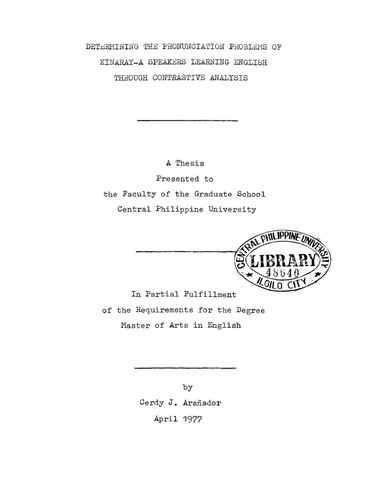
Thumbnail
Voir/Ouvrir
Thesis introduction (361.1Ko)
Downloads: 996
Page views
4,126
Date
1977
Auteur
Arañador, Cerdy Jutare
Thesis Adviser
Ruiz, Macario B.
Defense Panel Chair
Griño, Eliza U.
Defense Panel Member
Herradura, Elma S.
Sobrepeña, Lucila P.
Share 
 
Metadata
Afficher la notice complète

Résumé
Kinaray-a is one of the three dialect variants of Panayan Bisayan, the two others being Aklanon and Hiligaynon, the latter being spoken by 10.2 percent of the Philippine population. Panayan Bisayan, like the other major Philippine languages, belongs to the great Malayo-Polynesian family of languages.

A study by Griño shows this classification of Kinaray-a: Deep Kinaraya (which is of three subtypes; namely, Deep Antique Kinaraya-a, Deep Aklan Kinaray-a, and Deep Iloilo Kinaray-a (the last with two sub-subtypes, Central Deep Iloilo Kinaray-a and Coastal Deep Iloilo Kinaray-a), Dumalagnon, Lemerinhon, Central Iloilio Kina- ray- a, Pototanon, and East Coast of Iloilo Kinaray-a. The Kinaraya-a in this study belongs to the Central Iloilo type.

a. Statement of the problem. The study hopes to answer the following questions and point out some pedagogical implications of the results of the comparisons

1. What are the differences and similarities between the Kinaray-a and the English sound systems?

2. How will knowledge of contrastive analysis help a teacher of English solve pronunciation problems of a Kinaray-a speaker learning English?

3. What are the expected pronunciation problems of Kinaray-a speaker learning English?

4. How have these differences and similarities actually hindered or helped the Kinaray-a speaker learning English?

b. Scope and limitations of the study. This study involved only the Kinaray-a spoken in Central Iloilo, the informants being natives of Tina, Badiangan, Iloilo.

Because the grammatical structure of Kinaray-a and Hiligay- non are very highly similar, only their sound systems will be covered by the study. Intonation, which is suprasegmental feature of the dialect, was likewise excluded. This study then included only the segmental phonemes and their phonetic features, the accentual system, and syllable structure.
Description
Introduction and statement of the problem
URI
https://hdl.handle.net/20.500.12852/1562
Suggested Citation
Arañador, C. J. (1977). Determining the pronunciation problems and Kinaray-a speakers learning English through contrastive analysis (Unpublished Master’s thesis). Central Philippine University, Jaro, Iloilo City.
Type
Thesis
Sujet
Kinaray-a language OCLC - FAST (Faceted Application of Subject Terminology); English language--Pronunciation OCLC - FAST (Faceted Application of Subject Terminology); English language--Pronunciation by foreign speakers OCLC - FAST (Faceted Application of Subject Terminology); English language--Study and teaching--Foreign speakers OCLC - FAST (Faceted Application of Subject Terminology)
Department
School of Graduate Studies
Degree
Master of Arts with major in English
Shelf Location
GSL Theses 378.242 Ar135 1977
Physical Description
149 leaves
Collections
  • Master of Arts in English Language and Literature [26]

Contactez-nous | Faire parvenir un commentaire | https://creativecommons.org/licenses/by/4.0/ Logo by HLL
Central Philippine University © 2025
Managed by 
Henry Luce III LibraryHenry Luce III Library


Links
BAHÁNDÌAN Repository GuideDisclaimerFAQsSubmit your workNews and Updates

Parcourir

Tout DSpaceCommunautés & CollectionsPar date de publicationAuteursTitresSujetsCette collectionPar date de publicationAuteursTitresSujets

Mon compte

Ouvrir une sessionS'inscrire

Statistiques

Statistiques d'usage de visualisation
CPU Henry Luce III Library

Contactez-nous | Faire parvenir un commentaire | https://creativecommons.org/licenses/by/4.0/ Logo by HLL
Central Philippine University © 2025
Managed by 
Henry Luce III LibraryHenry Luce III Library


EXTERNAL LINKS DISCLAIMER

This link is being provided as a convenience and for informational purposes only. Central Philippine University bears no responsibility for the accuracy, legality or content of the external site or for that of subsequent links. Contact the external site for answers to questions regarding its content.

If you come across any external links that don't work, we would be grateful if you could report them to the repository administrators.

Click DOWNLOAD to open/view the file. Chat Bertha to inform us in case the link we provided don't work.

Download