

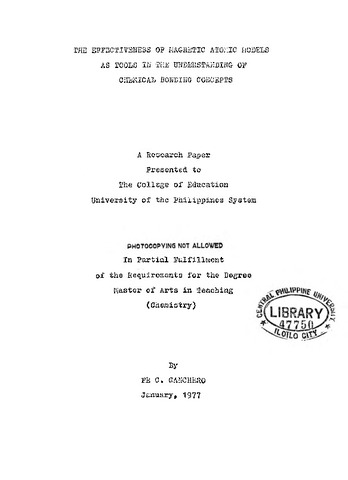
The effectiveness of magnetic atomic models as tools in the understanding of chemical bonding concepts
摘要
This study involved the construction of the magnetic atomic models and the determination of their effectiveness as tools for the understanding of chemical bonding concepts.
The atomic models represented were; sodium, lithium, chlorine, iodine, hydrogen, carbon, oxygen, and fluorine. Styrofoam spheres were used to represent individual atoms of the chemical elements. The scale employed for the atomic radius was 4 centimeters per Angstrom unit. The relative electronegativity value of each atom was represented by two compact magnets placed opposite each other at 3 millimeters from the surface of the sphere. The magnets were adjusted to their respective magnetic strengths by coating these with scotch tape,
A try-out involving the use of the constructed magnetic atomic models of the atoms was done in two high school chemistry classes. The control group received pure lecture method whereas the experimental group was allowed to perform activities involving the use of the models in addition to the same lecture given to the former group. Pretest and posttest were administered to both groups to gauge their accomplishment. The test paper of thirty matched-pairs of students were analyzed.
From the results of the 16-item test given to the two groups of students the findings were summarized:
1. The pretest scores of the two groups were generally lower than their posttest scores.
2. The mean of the posttest scores of the control group was lower than the mean of the posttest scores of the experimental group.
3. The mean difference of the posttest scores between the two groups was significant at the .05 probability level.
Based on the findings the following conclusions were arrived at:
1. By allowing the students do an activity, where constructed magnetic atomic models are used, their understanding of chemical bonding concepts was improved.
2. The use of the three-dimensional model of the atoms is indispensable when presenting a lesson on chemical bonding.
3. On the part of the students involved in the study, the constructed magnetic atomic models were effective as tools in the study of chemical bonding.
Should similar studies be done it is recommended that the following be undertaken:
1. In the construction of the models more magnets should be placed in each sphere so that there will be uniform magnetic forces all throughout. For the atomic radius a scale other than 4 centimeters per Angstrom unit may he used.
2. Other methods may be employed in adjusting the magnetic strengths such as the use of other materials instead of the scotch tape or by varying the dimensions of the magnets used for each atom.
3. Aside from paper clips other forms of iron objects may be used, to represent the bonding electrons of the atoms.
4. The number of models should not be limited only to eight atoms. Each group of elements in the Periodic Table should be represented by two or more atomic models.
5. Several try-outs may be made for the purpose of comparison of results.
建议引文
Ganchero, F. C. (1977). The effectiveness of magnetic atomic models as tools in the understanding of chemical bonding concepts (Unpublished Master’s thesis). University of the Philippines, Diliman, Quezon City.
文件类型
Thesis
部
College of Education学位
Master of Arts in Teaching (Chemistry)货架位置
GSL Theses 540.72 G152e
物理描述
46 leaves
集合
- Theses [18]