

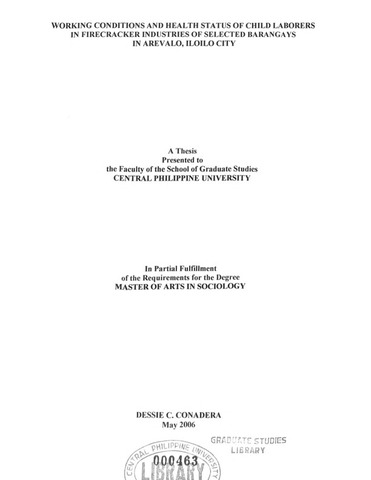
Working conditions and health status of child laborers in firecracker industries of selected barangays in Arevalo, Iloilo City
Abstract
The study was conducted to determine the working conditions and health status of child laborers in firecracker industries of selected barangays in Arevalo, Iloilo City. It also aimed to determine the relationship between working conditions and health status of child laborers. This descriptive-relational study used a one-shot survey. The sample population consisted of 210 child laborers from four barangays who were selected using the simple random sampling based on a list of previously identified child laborers. An interview schedule and focus group discussion were used for data collection.
Major Findings of the Study More than half of the respondents were female and the rest were male. Majority of them were 10- 14 years old. A high proportion of the respondents were attending school and only a few were not attending school. In terms of schooling level, most of the respondents were in the primary level. More than half of the child laborers come from small-sized families consist of 1-4 children. Majority of the respondents were middle children.
Majority of the respondents’ parents were both working. A high proportion of the respondents’ fathers were drivers while most of the respondents’ mothers were laundrywomen. Pasting of firecracker containers is the most common type of work performed by a high proportion of the respondents. Many respondents were working in workplaces with an area of 10 square meters and below. Most workplaces were made of light materials especially bamboo and located inside the house. Majority of the workplaces have 2-3 workers. Eight in ten respondents were without protective device while less than one fourth were with protective device. Most of the respondents with protective device used mask.
A high proportion of the respondents worked during the months of February to December. Many of them worked from morning to afternoon. The majority of the respondents worked from 1-2 days per week and 1-10 hours per week. Two in ten respondents handled chemicals while most respondents did not handle chemicals. Potassium nitrate was the common type of chemical handled by the respondents.
Less than one-fifth of the respondents had injury compared with those who did not have injury comprising the majority. The most common type of injury among child laborers in the firecracker industry was wound. One in ten respondents had their lingers injured.
A high proportion of respondents did not experience any accident while very few had experienced accidents, the most common type of accident of which was explosion and a few cases office. Majority of the respondents were paid while a little more than one-third were not paid. As to mode of payment, most respondents were paid on a piece-rate basis ranging from P 5-25/1,000 pieces in amount. A high proportion of respondents had health problems while less than one-fifth did not have health problems. Most respondents had health problems once to three times and the most common type of health problem was respiratory illness. Most respondents had any type of health problems whether they were using or not using protective device. The personal characteristics of child laborers in terms offset, age, number of children in the family, and parents’ work status were not significantly related with the health status of child laborers. There was no significant relationship between working conditions in terms of workplace, work schedule, work duration, chemical exposure, and safety risks. It is significant to note that use of protective device was significantly related the health status of child laborers.
Description
Abstract only
Suggested Citation
Conadera, D. C. (2006). Working conditions and health status of child laborers in firecracker industries of selected barangays in Arevalo, Iloilo City (Unpublished master thesis). Central Philippine University, Jaro, Iloilo City.
Type
ThesisSubject(s)
Keywords

Department
School of Graduate StudiesDegree
Master of Arts in SociologyShelf Location
GSL Theses 300.72 C741
Physical Description
xvii, 114 leaves