

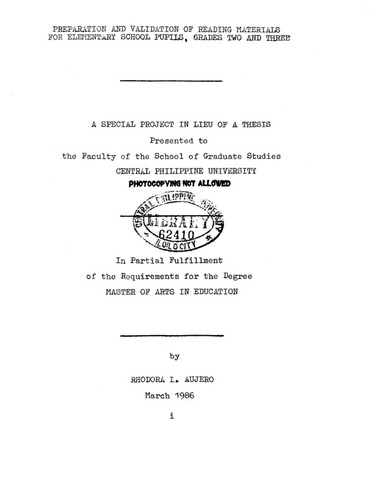
Preparation and validation of reading materials for elementary school pupils, grades two and three
Abstract
Reading is very much a part of everyday living. People read signs, directions, advertisements, announcements, letters, newspapers, magazines or books. They read to meet the practical demands of life, understand current events, satisfy spiritual and emotional needs, and for many other reasons. As Bond stated:
The ability to read well is one of the person’s most valuable achievements. Our world is a reading world. It would be difficult to find any activity, whether in school, in the home, on the farm, in business, in the professions, or even in recreational pursuits, that does not require at least some reading ability. Often reading is an indispensable channel of communication with an ever widening world.
In the elementary grades, learning to read and reading to learn should develop hand in hand throughout the school years. School life becomes meaningful and interesting as the child discovers new experiences through books that tell about people, things, places and events. The child’s interest in reading is stimulated when he is provided with a variety of reading materials that should appeal to his needs, abilities, and interests.
Conceptual Framework
Reading materials are written to be read. Unfortunately, sometimes they do not stimulate interest in reading. The teacher therefore should prepare reading materials that must be meaningful and suited to the needs and interests of the learners.
Six reading materials which are value-oriented have been prepared to meet the twofold task assigned to this project. These include 1) the development of instructional materials that are responsive and relevant to the needs and interests of the learners and 2) the development of children’s basic reading skills, namely, comprehension, vocabulary and word analysis. Since reading materials should be in forms children prefer to read, these reading materials are in narrative form, most easily comprehensible to the learner and. keyed to his level of understanding.
During the production, preparation and writing of these reading materials, the researcher kept in mind the need to further develop the skills and abilities introduced in grade one and to provide the classroom teacher with guidelines and procedures that will result in more effective and efficient use of the materials.
In order to be a tool for learning, children have to be taught to read in content areas. Thus, the reading selections are integrated with Social Studies and Science, Again, since education should emphasize values, and there is no better place to introduce them than in reading lesson, values such as helpfulness, cooperation, kindness, politeness, patience, obedience, courage and bravery are promoted by the selections There are other considerations. Communication activities should revolve around true-to-life context which typify aspects of Philippine culture. Different forms of play activities which stimulate children's desire for action and constant involvement should be utilized as learning practice devices. These are paid attention to in the reading materials. To assess effectiveness of instruction, different evaluative techniques are employed. These evaluation devices range from assessment tools which require plain observation to teacher-prepared paper-and-pencil tests.
These reading materials hope to be effective if used properly. They envision to the development of Filipino grade schoolers who are critical thinkers and, at the same time, happy and well-informed citizens of the world.
Paglalarawan
Introduction
Mungkahing Sipi
Aujero, R. I. (1986). Preparation and validation of reading materials for elementary school pupils, grades two and three (Unpublished Master’s special paper). Central Philippine University, Jaro, Iloilo City.
Uri
Special paperMga Paksa

Kagawaran
School of Graduate StudiesDegree
Master of Arts in Education with specialization in Reading (English)Lokasyon ng Istante
GSL Theses 378.242 Au48
Pisikal na paglalarawan
164 leaves